
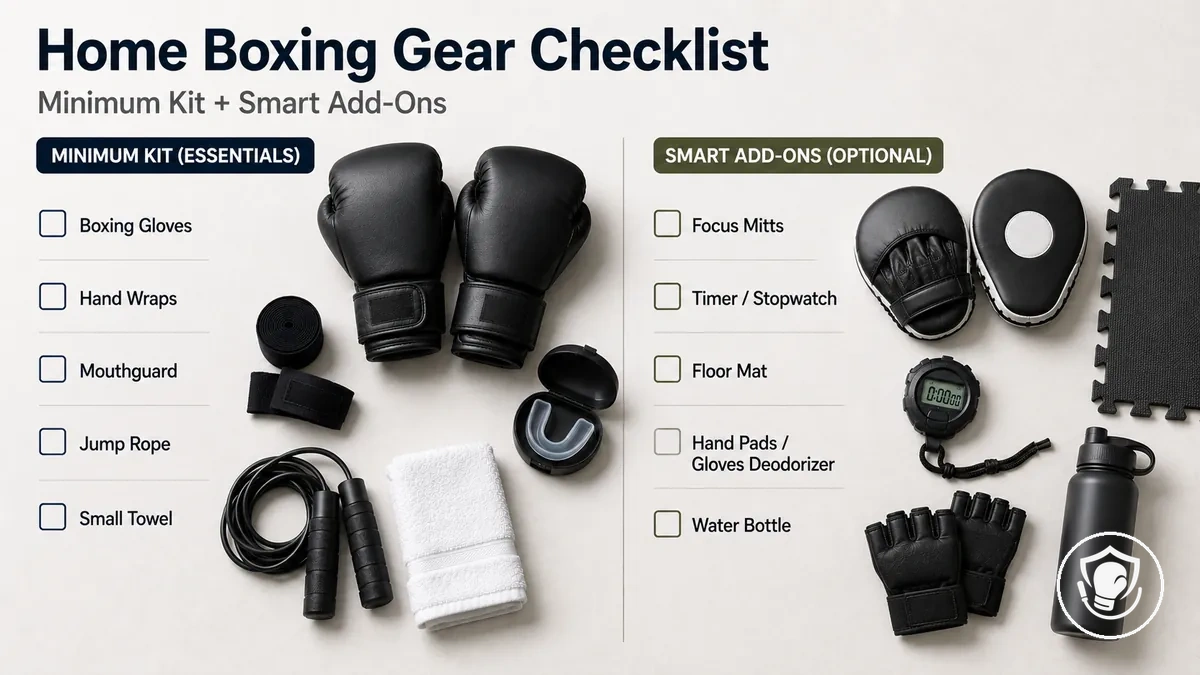
Home Boxing Equipment for Beginners: Minimum Starter Kit Checklist and Smart Add-Ons
A minimum starter kit for home boxing includes hand protection, a training surface, and a timer.
Hand protection is the first priority, typically gloves and hand wraps, to reduce injury risk and support consistency.
The rest of the checklist depends on available space and training goals, which separates the minimum kit from smart add-ons.
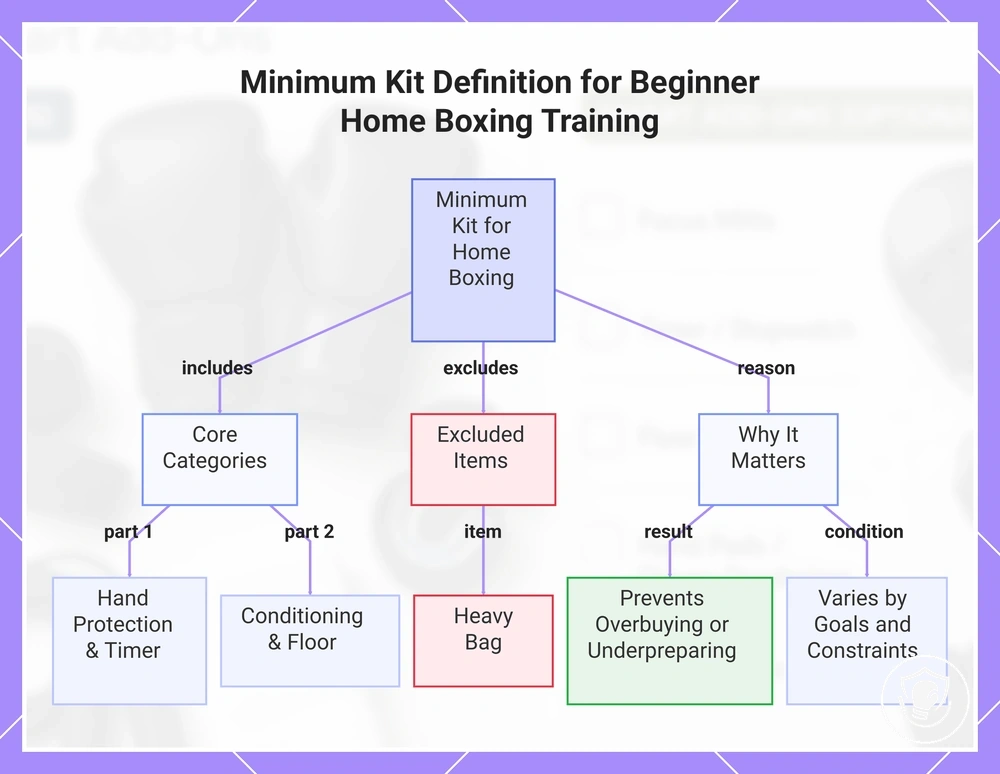
Minimum Kit Definition for Beginner Home Boxing Training
The minimum kit for beginner home boxing training is the smallest set of equipment that enables safe, repeatable practice at home.
This minimum kit typically includes hand protection (boxing gloves and wraps), a way to structure rounds (timer or app), basic conditioning tools (jump rope or bodyweight exercises), and a stable floor surface (non-slip mat or suitable area).
However, the exact minimum varies by your goals and home constraints. For a broader overview of setup paths and safe choices, the home boxing equipment for beginners hub covers these decisions in more detail.
Without a clear definition, beginners may overbuy or underprepare, so the practical starting point is to focus on categories first, not specific brands or models. Search results for starter kits or checklists usually refer to category bundles, not pre-packaged brand sets. A heavy bag, while common in many home gyms, is not part of the minimum kit definition for beginners at home. Instead, the core categories are:
- Hand protection (gloves and wraps)
- Timing (round timer or interval app)
- Conditioning (jump rope or bodyweight drills)
- Floor readiness (mat or non-slip surface)
This chart defines the minimum kit for home boxing training, showing what it includes, what it excludes, and why a clear definition matters.
What counts as an essential item in a home boxing starter kit
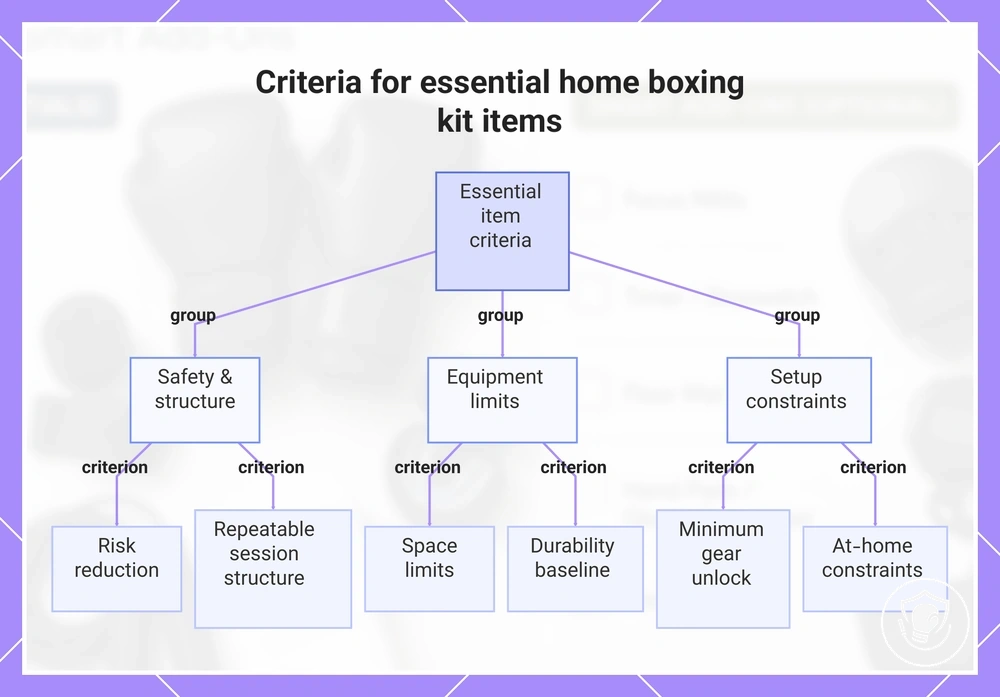
An item qualifies as essential for a home boxing starter kit when it directly supports safety or enables a repeatable training session structure, not when it adds convenience. These criteria decide which items belong in a minimum kit and which can wait.
- Risk reduction — Does the item lower the chance of injury during solo training? If yes, it is essential. Items that protect vulnerable areas from impact stress qualify as core safety items.
- Repeatable session structure — Does the item allow you to train in consistent rounds with clear start and stop points? An item that enforces work-rest cycles qualifies for structured workouts.
- Space limits — Does the item fit within your available floor area and ceiling height without requiring permanent installation? Items that exceed your space constraints may not be essential for your setup.
- Durability baseline — Does the item withstand repeated use without rapid wear that compromises safety or function? An item that tears or loses padding after a few sessions fails this criterion.
- Minimum gear unlock — Does the item let you train without requiring an essential complementary purchase? If an item needs another essential piece to be usable, it may not pass this criterion alone.
- At-home constraints — Does the item generate noise, cleanup, or storage demands that your living situation can tolerate? An item that generates noise, requires frequent cleanup, or demands storage space may fail this criterion for some living situations.
A common non-essential item is a jump rope. It supports conditioning but is goal-dependent: if your primary need is learning punch technique, a jump rope does not reduce injury risk or enable structured bag work, so it fails the essential rule for that beginner goal.
This chart shows the six criteria that determine whether an item is essential for a home boxing starter kit, grouped into three categories.
What becomes optional because it depends on your training goal and setup
Optional items become necessary only when your training goal or setup requires them, depending on space, noise, partner training, or impact focus. The following table maps these constraints to the appropriate equipment.
| Goal or Constraint | Add-on Category | When to Buy |
|---|---|---|
| Limited space | Wall-mounted or hanging bag | If floor space is tight |
| Noise restrictions | Focus mitts or double-end bag | If noise is a concern |
| Partner training | Focus mitts or double-end bag | If you have a training partner |
| Impact training | Heavy bag | If you want to build power |
| Storage constraints | Compact or inflatable bag | If you need to store equipment after use |
Core Hand Protection Checklist for Safe Striking at Home
Hand protection is the most important purchase for beginners training at home. Without proper support for your hands and wrists, even light bag work can lead to avoidable strain. A safe approach relies on a two-layer protection system: an inner layer of hand wraps or inner gloves, plus an outer layer of boxing gloves.
Each layer handles a different job. Boxing gloves provide padding distribution, wrist support through the closure system, and knuckle cushioning that absorbs impact. Hand wraps or inner gloves add wrist stabilization, knuckle alignment, and sweat control directly against the skin. Together, they improve stability and control during strikes, which helps you maintain better alignment as you train.
Relying on gloves alone or choosing overly soft gloves can mask poor alignment for some beginners. Without the inner layer, the wrist and knuckles may lack the direct support needed for safe repetition. The checklist covers two key items a home striker should have before starting a session.
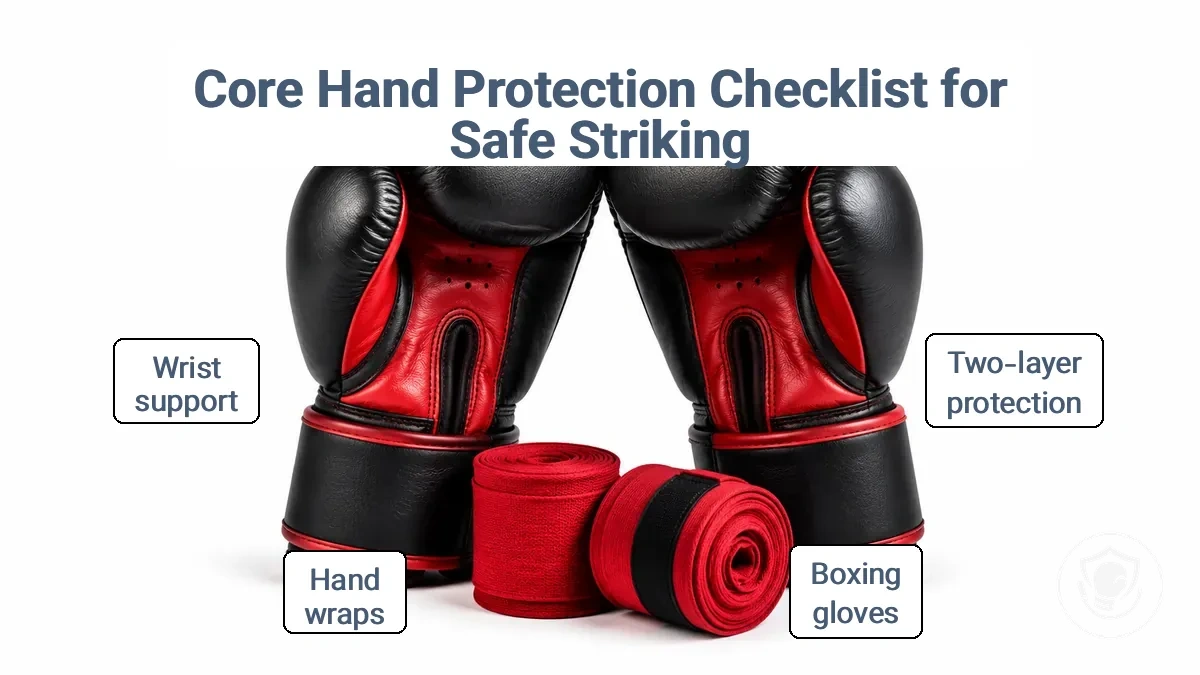
- Boxing gloves – choose a pair with even padding distribution and a secure wrist closure system.
- Hand wraps or inner gloves – add wrist stabilization and knuckle support that gloves alone may not provide.
Beginner boxing gloves that reduce hand and wrist risk
Beginner boxing gloves that reduce hand and wrist risk should focus on protection and stable closure, not advanced performance features.
- Wrist support: A supportive cuff keeps the wrist aligned on impact, helping prevent hyperextension. When wrist support is weak, the wrist may bend during punches, increasing strain on ligaments.
- Closure stability: A hook-and-loop strap secures the glove firmly around the wrist, keeping it in place. If the closure is loose, the glove can shift, reducing control and protection on each punch.
- Padding feel: Padding that distributes impact across the knuckles protects hand bones. When padding is too soft or too hard, impact absorption may decrease, often leading to discomfort or injury over time.
- Lining comfort: Breathable lining reduces moisture buildup and improves hygiene. Poor lining can cause slipping or skin irritation, distracting from training.
- Fit tolerance: A snug fit without pinching allows proper fist formation. If the fit is too loose, hand movement inside the glove can reduce punch efficiency; if too tight, it may restrict circulation and comfort.
- Common mistake: Buying gloves for appearance or extreme softness rather than structural support. A glove that looks attractive but lacks wrist stability can increase injury risk instead of reducing it.
Hand Wraps or Inner Gloves That Stabilize Your Hands Under Gloves
Hand wraps and inner gloves provide stabilization and sweat control that gloves alone may not always offer. Inner gloves can be a simpler starting point if you have limited time or prefer a consistent fit. Hand wraps take a few extra minutes to put on but let you adjust the tension on your wrist and knuckles.
| Attribute | Hand Wraps | Inner Gloves |
|---|---|---|
| Coverage | Adjustable stretch and tension; covers knuckles and wrist | Fixed coverage; often includes gel padding inside a slip-on sleeve |
| Fastening reliability | Depends on wrapping technique; can come loose if not secured well | Hook-and-loop strap typically provides consistent fastening |
| Ease of use | Requires practice to wrap evenly; more time to put on | Quick to slip on; convenient for fast sessions |
| Effect on wrist stability | Offers customizable support when wrapped correctly | Provides moderate stability; sufficient for light training |
Round Structure and Conditioning Checklist for Consistent Home Sessions
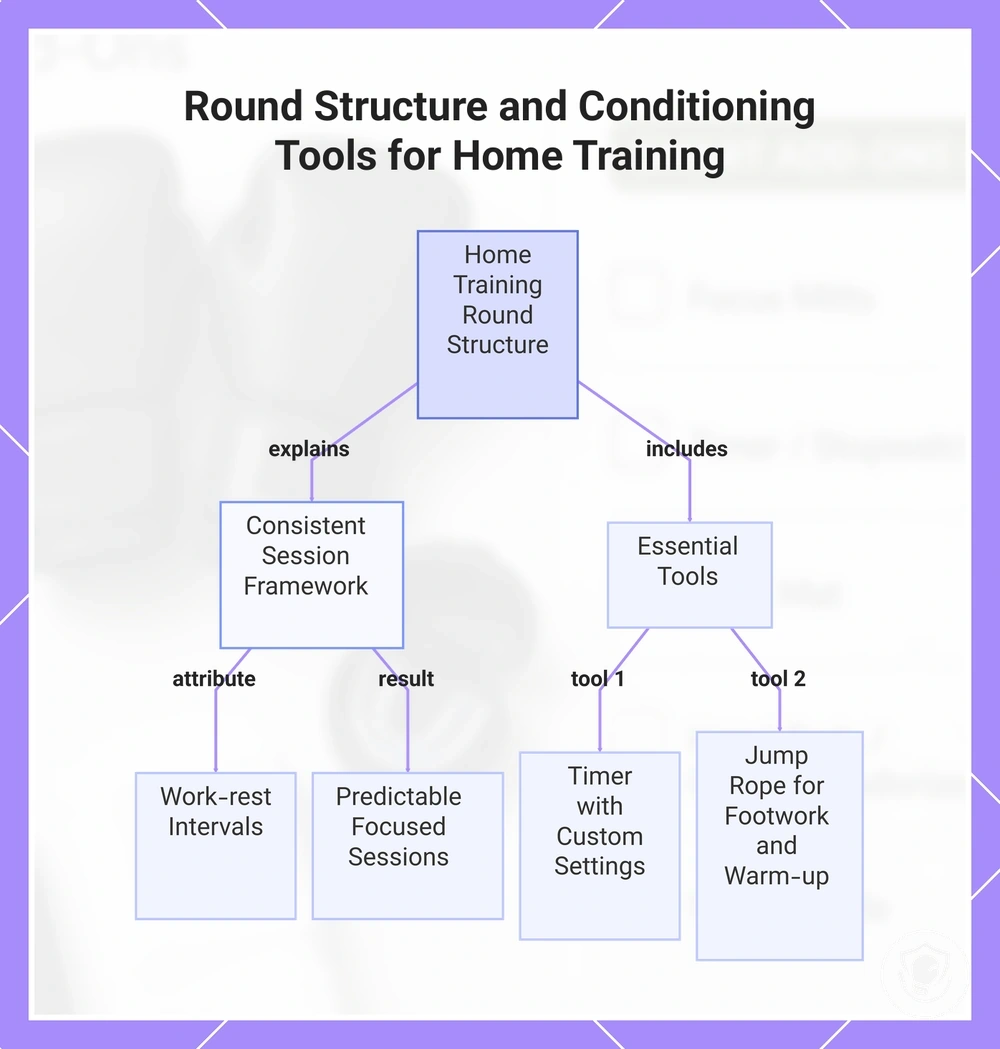
Structuring home training into repeatable rounds builds a consistent session framework. Timed work and rest intervals make each session predictable and focused.
A round timer controls work-to-rest ratios, while a jump rope builds footwork rhythm and doubles as a warm-up.
- Round timer (timing tool) – Adjustable round lengths and rest periods allow custom work-to-rest ratios. Look for a timer that supports custom settings.
- Jump rope (conditioning tool) – A jump rope develops footwork rhythm and provides an efficient warm-up. Pick a rope suited to your height and skill.
This chart explains the core concept of round-based home training and the essential tools needed to implement it.
Interval Timer for Rounds, Rest, and Repeatable Training Blocks
An interval timer standardizes rounds and rest for consistent home boxing sessions, letting you focus on technique instead of the clock.
- Preset control: Stores your preferred round and rest lengths to reduce setup time and keep sessions on track.
- Start/stop simplicity: A single button starts or pauses the timer to reduce fumbling and maintain round rhythm.
- Volume range: Audible cue loud enough to hear over punching sounds or music, so you hear the end of rest.
- Display clarity: Large digits and bright screen make the timer readable from across the room for easy time checks.
Common mistake: Using a stopwatch instead of an interval timer means no preset rounds or rest, which disrupts your rhythm and makes sessions less consistent.
Jump Rope for Warm-Up, Footwork Rhythm, and Baseline Conditioning
A jump rope supports warm-up and footwork rhythm with minimal space. Choosing the right rope comes down to a few attributes that affect how smoothly it fits into a short warm-up routine.
- Adjustable length: An adjustable rope lets you match it to your height, helping maintain a steady rhythm during warm-up.
- Handle grip: Comfortable, non-slip handles can reduce hand fatigue and can make it easier to control the rope’s rotation.
- Rope feel: A lightweight plastic or speed rope typically spins faster and can provide clearer feedback for footwork timing compared to heavier ropes.
- Floor compatibility: Using the rope on a forgiving surface such as a gym mat or wooden floor can reduce impact and can help the rope swing more consistently.
On a hard surface or in a shared space, a thinner rope may produce less noise, but height and grip preference remain the main considerations.
Floor and Space Readiness Checklist for Stability, Grip, and Protection
Floor readiness reduces slipping risk, makes movements more predictable, and helps protect home surfaces during training. Start with surface stability first—if the floor shifts or feels slippery underfoot, equipment positioning alone is often not enough to fix the problem.
This image compares three common home surfaces and shows how a simple mat or tile overlay can improve grip and help protect the original floor.
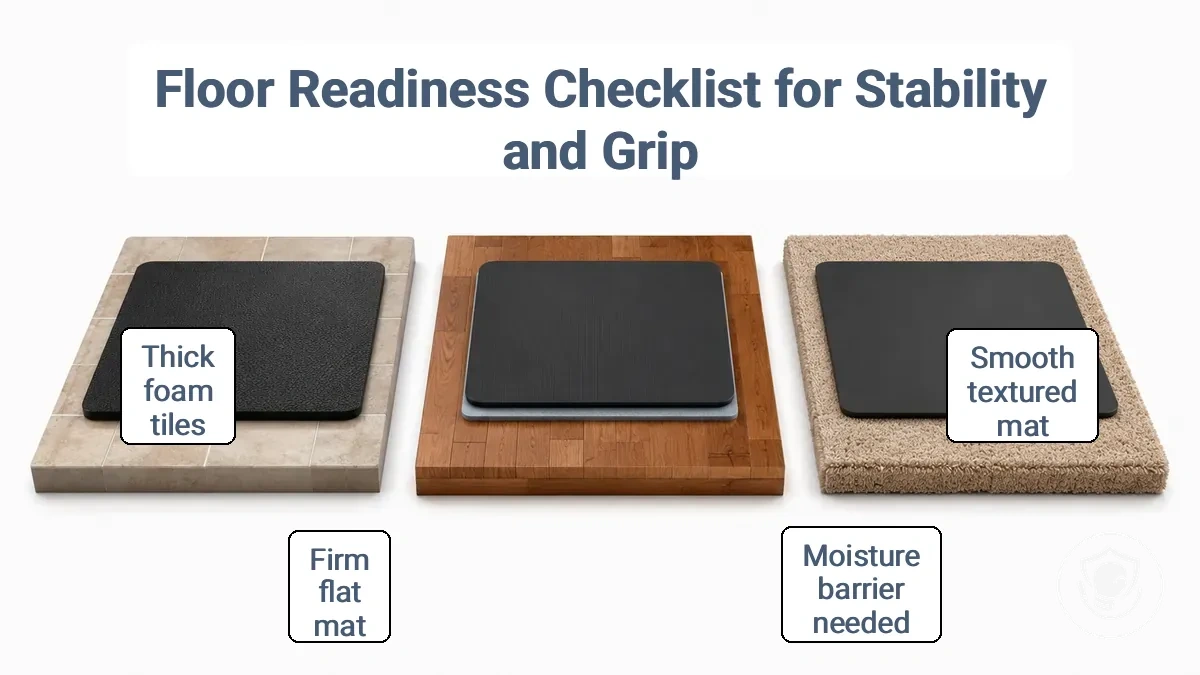
Whether you train on tile, wood, carpet, or concrete, each floor type introduces a different set of trade-offs between grip, cushioning, and sweat resistance.
A quick inspection of traction and surface hardness can help you decide which mat or tile overlay may be better suited for your routine. The following checklist groups key readiness checks by floor surface so you can evaluate your own space floor by floor.
- Tile or stone – Smooth surfaces often lack natural grip and can become very slippery with sweat. Use a mat with a textured or rubberized bottom that stays in place. Check that the mat does not slide during lateral movements and that it provides enough cushioning to reduce joint impact on hard tile.
- Hardwood or laminate – These floors can be more slippery when wet and may be damaged by moisture. Choose a mat with a moisture barrier or sweat-proof base. Regular cleaning of both the mat and the floor helps maintain traction. Verify that the mat does not trap moisture underneath, which can warp wood over time.
- Carpet – Carpet offers cushioning but often lacks stability because the mat can sink or shift. Use a firm, flat mat that does not compress too much. Check that the mat stays flat and does not create a trip hazard at the edges. Sweat absorption into carpet can cause odor, so a cleanable mat or an additional moisture barrier can help.
- Concrete or basement floor – Hard and cold, concrete floors need thick cushioning to help protect joints. Interlocking foam tiles or a thick gym mat are typical solutions. Focus on traction first—some concrete surfaces are dusty or smooth, which can reduce grip. A mat with high friction backing can reduce sliding risk and make the surface more comfortable.
For each surface, the key is to confirm that the mat or flooring choice delivers adequate grip without introducing instability, and that you can keep it clean enough to control sweat and odor. These checks keep the focus on readiness rather than full setup design.
Interlocking floor tiles and mats for home training surfaces
Interlocking floor tiles and mats are flooring components that connect via puzzle-like edges to cover a specific area without permanent installation. This makes them modular and removable, ideal for temporary or adjustable setups.
- Thickness feel: Thicker tiles provide more cushioning, but those that compress too easily under weight can lead to uneven surfaces and reduced support.
- Edge stability: Tight interlocking edges keep tiles flat and resist separation; loose edges cause seams to gap, creating tripping hazards and reducing stability.
- Seam separation risk: Mats that separate at the seams often indicate poor interlock design or insufficient edge grip, disrupting workouts and requiring frequent readjustment.
- Grip texture: Textured surfaces prevent slipping during sweaty workouts, while smooth tiles become slippery when wet, increasing fall risk.
- Sweat cleanup: Non-porous materials like EVA foam allow easy wiping of sweat and spills, whereas absorbent surfaces retain moisture, leading to odors and hygiene issues.
Test the tiles on your subfloor before committing; some mats can slide on smooth concrete or hardwood during lateral movements.
Using a non-slip underlayment or checking for anti-skid backing can improve safety.
Footwear and Traction Considerations When Your Floor is Slippery or Hard
Footwear acts as a compatibility lever when the floor cannot be changed. Its effectiveness depends on matching outsole properties to your specific floor condition. Slippery hardwood or polished tile floors reduce natural grip, while hard surfaces like concrete transmit more impact and may require different support. Since the floor remains unchanged, these traction attributes—grip, lateral stability, and ankle mobility—must come from the shoe.
In a home boxing setup, hardwood often becomes slick from sweat or moisture, and hard floors offer little cushioning. The decision map links each floor condition to its traction need and footwear constraint.
- Polished hardwood or tile (slippery): Traction need is maximum grip. Footwear constraint: choose a soft rubber outsole with a tread pattern; formal shoes with hard leather outsoles often fail to provide adequate slip resistance.
- Unfinished or matte hardwood (moderate grip): Traction need is balanced grip and stability. Footwear constraint: an outsole with moderate hardness and a multidirectional pattern can provide enough grip without sacrificing freedom of movement.
- Concrete or rubber gym floor (hard but stable): Traction need is lateral stability and ankle mobility. Footwear constraint: a flat, firm outsole with support for quick direction changes, and sufficient cushioning to reduce impact on joints.
- Floor with moisture or sweat accumulation: Traction need is consistent wet grip. Footwear constraint: a patterned or siped outsole that channels liquids away from the contact area; smooth rubber soles can become especially slippery when wet.
Smart safety add-ons that become necessary in specific situations
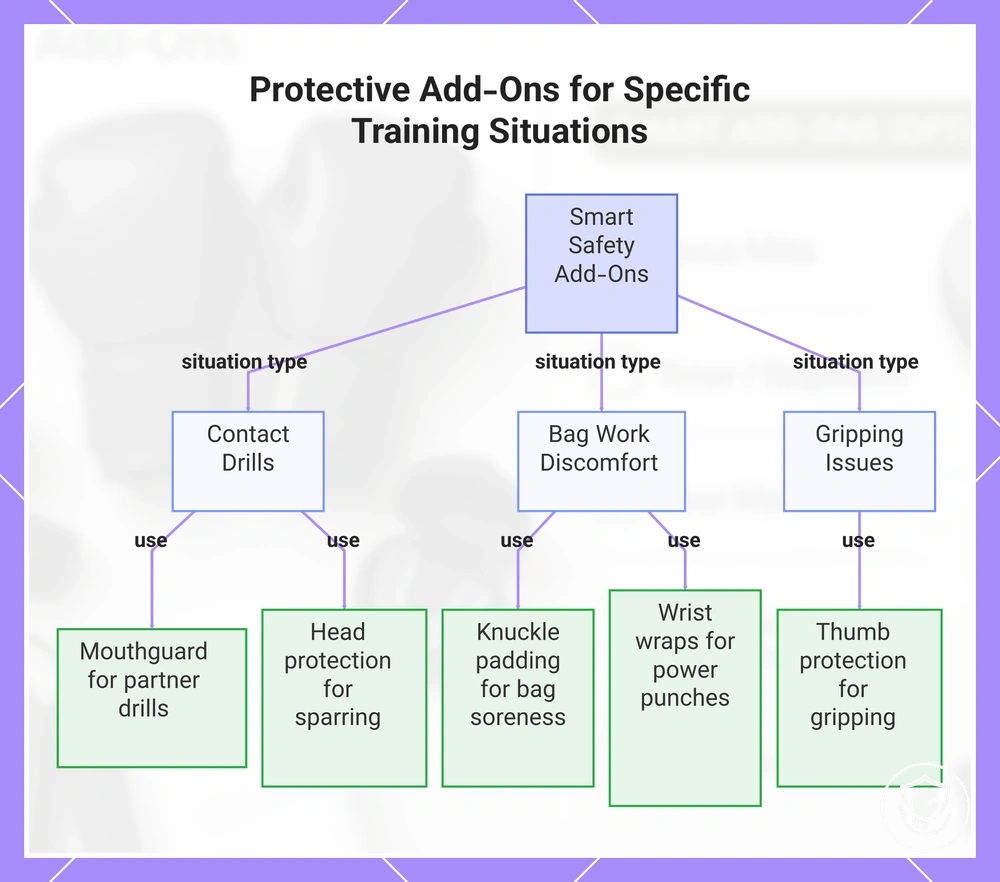
Safety add-ons are conditional purchases triggered by contact training or recurring discomfort, not default essentials.
When a new training situation introduces repeated knuckle irritation, wrist instability, or direct head contact, basic glove-and-wrap coverage may not be enough. The decision to add an extra protective layer depends on the specific risk you are encountering. For a broader view on safety-first starter choices, see our safety-first starter choices guide. The following checklist maps common training situations to the protective add-ons that may help.
- Starting partner drills → mouthguard to help reduce impact on teeth and jaw
- Frequent knuckle soreness after hitting bags → extra knuckle padding or inner gloves
- Wrist discomfort during power punches → wrist wraps or support braces
- Head contact during light sparring → head protection to help soften repeated blows
- Thumb pain when gripping → thumb-attached gloves or separate thumb protection
This chart maps common training situations to the recommended protective add-ons, showing when basic gear may be insufficient.
Mouthguard and Head Protection When Training Involves Contact or Partners
When training involves partner contact or sparring-like risk, mouth protection becomes essential. With contact, it is no longer optional. Without a properly fitted mouthguard, the risk of dental and soft tissue injuries increases during contact training.
- Fit security: The mouthguard should fit snugly without slipping. A secure fit keeps it in place during contact, lowering the risk of dental injury.
- Comfort: The mouthguard should not cause irritation or gagging. A comfortable mouthguard is more likely to be worn consistently during partner work.
- Breathing tolerance: The mouthguard should allow easy breathing. Unrestricted airflow helps you stay focused and perform well.
- Cleaning ease: The mouthguard should be easy to clean and maintain. Regular cleaning prevents odor and maintains hygiene, extending its life.
Extra hand protection add-ons when your knuckles or wrists need support
Extra hand protection add-ons are justified when gloves and wraps still leave discomfort or instability in the knuckles or wrists. Instead of replacing base layers, these add-ons target specific pressure points or motion gaps as triggered support.
When discomfort or instability persists despite gloves and wraps, the right add-on depends on the exact trigger. Common triggers and the add-on categories they may lead to:
- Bruised or painful knuckles after wrapping → extra knuckle padding or gel guards
- Wrist instability during heavy punching → rigid wrist wrap or brace with adjustable straps
- Glove or wrap slippage causing blisters or calluses → silicone-grip liners or friction-reducing sleeves
- General hand pain or swelling under compression → padded compression gloves (open-finger designs with gentle support)
One caution: persistent discomfort may indicate a need to reassess glove and wrap fit or technique rather than stack more add-ons.
Training Add-Ons That Expand What You Can Practice at Home
Training add-ons are worth buying mainly when they enable a practice mode you can use. Without a clear goal for how an upgrade fits into your routine, it can remain unused.
If your primary goal is to improve accuracy, an add-on that provides clear target feedback is worth considering. For power and impact work, a different category of upgrade tends to support that need. The matrix below organizes these options by practice mode and notes the main constraints to check.
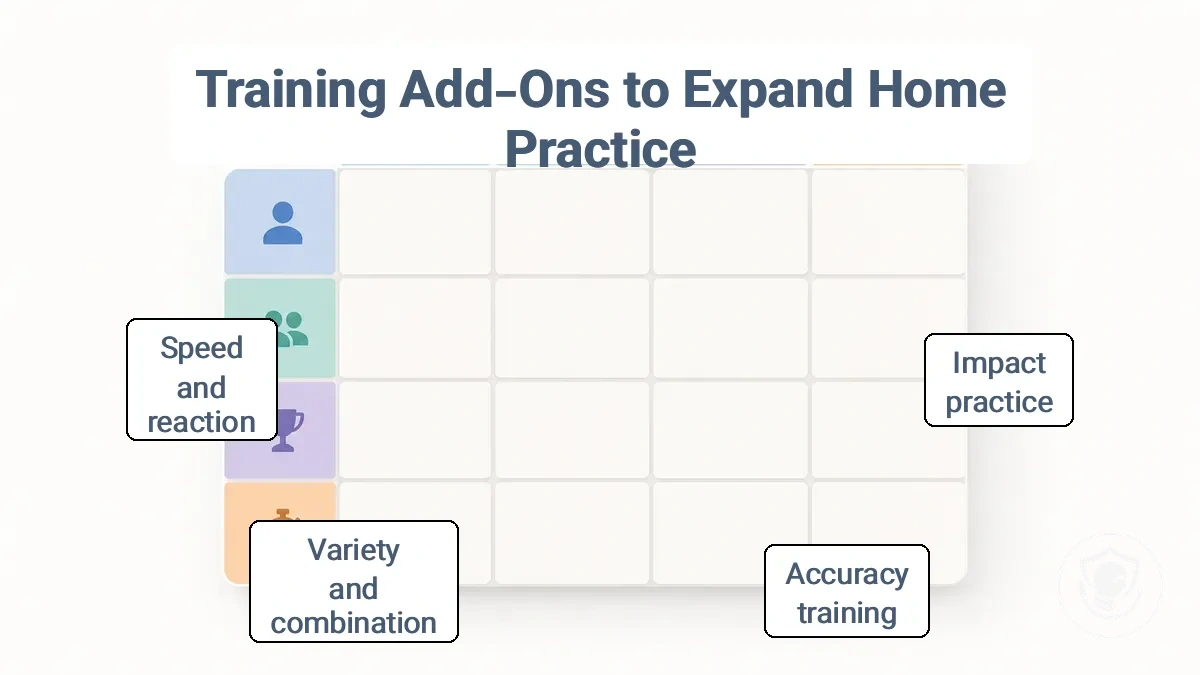
| Practice Mode | Training Attribute | Add-On Category | Constraint Gate |
|---|---|---|---|
| Impact practice | Impact feedback, power | Heavy bag or wall-mounted pad | Space (ceiling height, floor area), noise limits |
| Accuracy training | Target, precision, hand-eye coordination | Double-end or reflex bag | Space (clear area), storage (needs hanging point), low noise |
| Variety & combination work | Multi-angle drills, footwork integration | Free-standing bag or speed bag platform | Space (floor footprint), storage (when not in use) |
| Speed & reaction | Reaction time, rhythm | Speed bag or floor-to-ceiling ball | Space (ceiling mount), noise (rhythmic sound), storage |
Striking Target Add-Ons Like Bags or Pads When Impact Training Is a Real Goal
Striking targets such as a punching bag or pads are optional unless impact training is a primary goal and your home environment can tolerate the associated demands.
- Space footprint: A heavy bag needs a clear, open area for swinging and a secure mount; a free-standing bag requires dedicated floor space; pads take up almost no room.
- Noise tolerance: Impact noise from a heavy bag may disturb housemates or neighbors; the actual level often depends on the bag type, padding, and wall construction. Pads generate less noise because a partner absorbs the strike.
- Mounting feasibility: Ceiling-mounted bags require a structural anchor capable of supporting a heavy load; not all home ceilings or rentals allow drilling. Freestanding bags eliminate mounting concerns but still require floor space, while pads need no permanent attachment.
- Storage: Bags are bulky and hard to store when not in use; pads can be hung, folded, or placed in a closet.
- Partner availability: Pads need a training partner to hold them, providing interactive feedback and realistic movement. Heavy bags are solo-friendly but lack the dynamic response of a live pad holder.
If impact training is your goal and your home allows it, adding a bag or pads can unlock real feedback and power progression. Deeper comparisons are handled elsewhere.
Small accessories that improve training flow without overbuilding the setup
Small accessories matter when they reduce friction and keep training sessions consistent. A timer, training log, or fractional plate does not replace hard work but removes small interruptions that break momentum.
- Timer reduces setup time and tracking friction. Buy when you often lose track of rest periods; it may help you stay on pace without checking a phone.
- Training log reduces tracking friction. Buy when you need to record weights and progress reliably; it may keep your next session planned and remove guesswork.
- Fractional plates reduce setup time for small weight jumps. Buy when the smallest plate available is 2.5 lb and you need smaller increments; they may allow steady progression on upper body lifts.
- Sweatband or towel reduces sweat management friction. Consider when sweat drips on the bench or bar; it may keep hands and equipment dry between sets.
- Small storage bin or bag organizer reduces storage and cleanup friction. Buy when loose items clutter your gym bag or space; it may speed up transition between exercises.
- Coffee is often purchased as a pre-workout, but for most beginners it may not directly change training outcomes unless energy is low.
Selection checks that prevent beginner buying mistakes in checklist items
Most beginner buying mistakes come from ignoring fit, usability, and compatibility in favor of appearance or extremes.
Universal checks are quick validation steps that apply across equipment categories. By focusing on key attributes like comfort, space, and durability, they filter out items that may cause frustration later.
When buying gloves, wraps, a timer, a jump rope, and flooring for your home setup, use this checklist to organize key checks and spot red flags quickly.
| Item Category | Check | Red Flag | Likely Downside |
|---|---|---|---|
| Gloves | Fit (comfort, stability) | Too tight or loose | May cause hand fatigue or blisters |
| Gloves | Durability baseline (material, wear) | Thin padding or poor stitching | Can lead to quick wear and tear |
| Wraps | Usability (ease of wrapping) | Too short or slippery | May result in poor wrist support |
| Timer | Compatibility (space, noise) | Too loud or large | Can disturb others or take up too much space |
| Rope | Durability baseline (material, wear) | Thin plastic coating | Often breaks quickly |
| Flooring | Compatibility (space, storage) | Too thick or heavy | May be difficult to store or move |
| Flooring | Maintenance (cleaning, wear) | Absorbs moisture | Can lead to mold or odor |
Fit and usability checks for gloves and wraps before you commit
Fit and usability failures can create fast frustration and higher risk for beginners. Check these signals before you commit to a purchase.
- Closure security: A snug, even pull across the wrist strap with no gap between the glove and your forearm is the pass signal. If the closure slips or leaves a loose flap, wrist stability may be compromised and the glove may shift during impact.
- Hand position feel: A straight line from forearm to knuckle without twisting is the pass signal. If your hand tilts or slides sideways, the glove may not support proper punching alignment.
- Wrap tension tolerance: Even pressure across the knuckles and wrist with no pinching or excessive tightness is the pass signal. If the wrap feels too tight or leaves loose spots, the tension may be wrong for your hand shape.
- Easy to put on: A smooth entry with no bunching of the wrap material is the pass signal. If you have to tug or reposition repeatedly, the glove opening or wrap bulk may be mismatched.
- Thumb pocket alignment: A relaxed, neutral thumb position is the pass signal. If the thumb pocket pulls or restricts movement, the glove geometry may not match your hand.
- Wrist wrap coverage: A clean transition from wrap to glove cuff is the pass signal. If the wrap bunches under the cuff or leaves the wrist exposed, stability and comfort may both suffer.
- Finger mobility: A full range of finger movement inside the glove is the pass signal. If your fingers feel cramped or cannot curl, the glove size or shape may be off.
- Edge case for unusually small or large hands: If your hand size falls outside standard ranges, the combined glove-and-wrap fit becomes harder to judge. In that case, try the wrap first, then test the glove with the wrap on, looking for any pressure points or empty space that indicates a poor match.
Home-Setup Compatibility Checks for Floor Type, Noise Tolerance, and Storage
Home constraints such as floor type, noise tolerance, and storage can turn otherwise suitable boxing gear into a poor fit. Checking these first helps you prioritize equipment that works within your limits.
Floor type
- Gear with good grip often matters on hard floors because vibration can travel more easily. A mat or rubber base can stabilize the bag and reduce movement.
- On concrete slabs, impact noise may still transmit to rooms below, so check if your bag base or stand is compatible with the surface.
Noise tolerance
- If neighbors are close, impact noise from footwork or bag strikes often causes complaints. A lighter bag or a freestanding bag with a padded base may lower the disturbance.
- High noise tolerance? Heavy bags may still be fine, but if you share walls, consider gear that minimizes vibration.
Storage
- Limited floor footprint favors foldable or collapsible gear that disassembles to a compact size when not in use. A heavy bag that cannot be stored easily may clutter a small room.
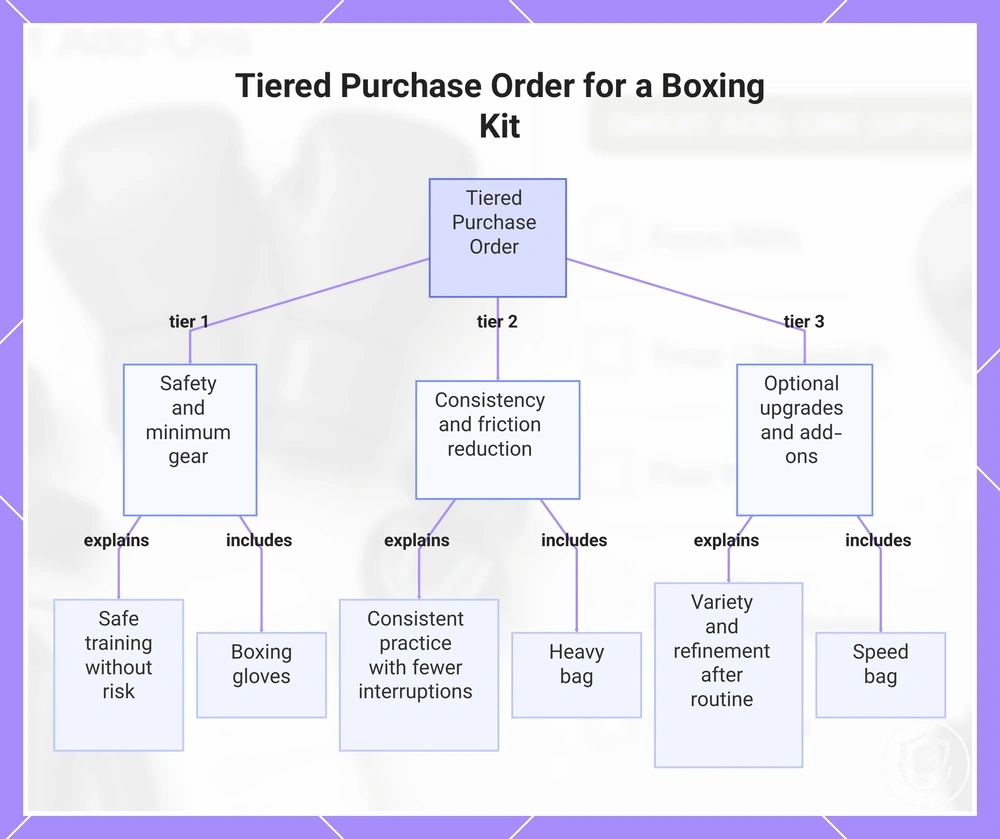
Tiered purchase order for building the kit without buying everything at once
A tiered purchase order approach reduces decision cost by sequencing purchases from safety to consistency to optional upgrades.
A tiered purchase order groups equipment into priority levels based on priority attributes. Each tier has a clear purpose: Tier 1 covers minimum gear for safe participation, Tier 2 adds items that reduce friction during consistent practice, and Tier 3 includes optional add-ons that become useful once a stable routine is established. The guide on budget priorities for beginners shows how to allocate your spending across these tiers. The default order often follows safety → consistency → optional, but which tier comes first depends on your space and contact-risk.
Tier 1: Safety and minimum gear
Rationale: Unlocks safe training without unnecessary risk.
- Hand wraps
- Boxing gloves
- Mouthguard
- Headgear (if sparring)
Tier 2: Consistency and friction reduction
Rationale: Unlocks consistent training with fewer interruptions.
- Heavy bag
- Timer or interval app
- Skipping rope
- Training shoes
Tier 3: Optional upgrades and add-ons
Rationale: These add-ons worth buying unlock variety and refinement after a stable routine.
- Speed bag
- Double-end bag
- Reflex bag
- Bag gloves or lighter gloves
This chart shows the three tiers of a tiered purchase order approach, explaining the purpose and key item for each tier to help beginners allocate spending.
Tier 1 purchases that unlock safe training immediately
Tier 1 is the minimum set for safe, repeatable beginner practice at home.
- Hand protection (gloves and wraps): Protects hands and wrists from impact during bag work.
- Timer or interval app: Helps organize rounds and rest periods to build endurance and technique.
- Jump rope: Warms up and improves footwork and cardiovascular fitness.
- Floor tiles or mat: Provides a stable, slip-resistant surface that cushions joints.
Impact-target gear, such as heavy bags and focus mitts, is not included in Tier 1 unless impact training is your immediate goal. This baseline kit supports safe practice for beginners still deciding their long-term training direction.
Tier 2 Upgrades That Remove Friction and Increase Consistency
Tier 2 upgrades are justified when they remove a specific friction that threatens consistency. Friction blocks consistency.
- Setup time
- A quicker-connect system can reduce setup time, removing a delay that often leads to skipped sessions.
- A dedicated storage solution can reduce the 'where is it?' delay, making it easier to start without hesitation.
- Buy trigger: Consistent skipping due to setup time justifies this upgrade.
- Comfort
- Better padding or ergonomic design can reduce discomfort that otherwise cuts sessions short.
- Moisture-wicking materials can keep you dry and focused, reducing the urge to stop early.
- Buy trigger: Discomfort that cuts sessions short justifies comfort upgrades.
- Hygiene
- Antimicrobial surfaces can reduce odor and cleaning time, making equipment more pleasant to use repeatedly.
- Quick-dry materials can help prevent mildew buildup, so gear is ready sooner for the next session.
- Buy trigger: Hygiene concerns causing hesitation to reuse equipment make this upgrade relevant.
- Tracking
- A built-in timer or progress log can help you stay on routine, providing feedback that reinforces consistency.
- Visual indicators can show when maintenance is due, helping to prevent unexpected downtime.
- Buy trigger: Losing track of progress and motivation justifies tracking upgrades.
Tier 3 add-ons that are only worth it after your training pattern is stable
Tier 3 add-ons are worth it only after your training pattern is stable. They can add variety, feedback, or convenience, but you don't need them for a solid foundation. Only buy them once your habit has proven itself — consistent training for several weeks without skipping.
- Variety trigger: If your routine is consistent and you want to reduce boredom, consider interchangeable targets or pad sets. Constraint: Only buy if you have dedicated storage space and can add setup time to your session.
- Impact feedback trigger: When you need objective data on power or speed, feedback devices like impact sensors can provide measurable cues. Constraint: Ensure the device matches your training space's noise limits and does not require complex calibration.
- Convenience trigger: If setup and teardown time cuts into your workout, convenience add-ons like quick-mount brackets or compact storage can be worth it. Constraint: Verify compatibility with your existing equipment and that the time saved justifies the cost.
- Progression trigger: When your training has plateaued and you need a new challenge, add-ons that extend intensity (e.g., heavier resistance bands or tiered targets) can help. Constraint: Only add if your current routine already includes proper warm-up and recovery.
- Timing trigger: If your sessions lack structure, a programmable timer or interval tracker can improve session quality. Constraint: Avoid if you already use a smartwatch or phone timer with acceptable accuracy.
Caution: Avoid buying complex add-ons as a substitute for motivation. If your routine is not yet stable, the gear may sit unused. Let the need emerge from consistent practice, not from novelty.