
Home Boxing Equipment Budget for Beginners: Spending Priorities, Value Trade-Offs, and Upgrade Timing
A home boxing equipment budget for beginners prioritizes protection-first spending before upgrades, focusing on spending priorities, value trade-offs, and upgrade timing rather than listing every item. This is for budget-conscious beginners training at home with basic gear.
Many beginners overspend on branded items or underinvest in hand protection, leading to wasted money or injury. The result is a cycle of replacing cheap gear or upgrading sooner than necessary. Matching spending to actual training needs reduces these avoidable costs.
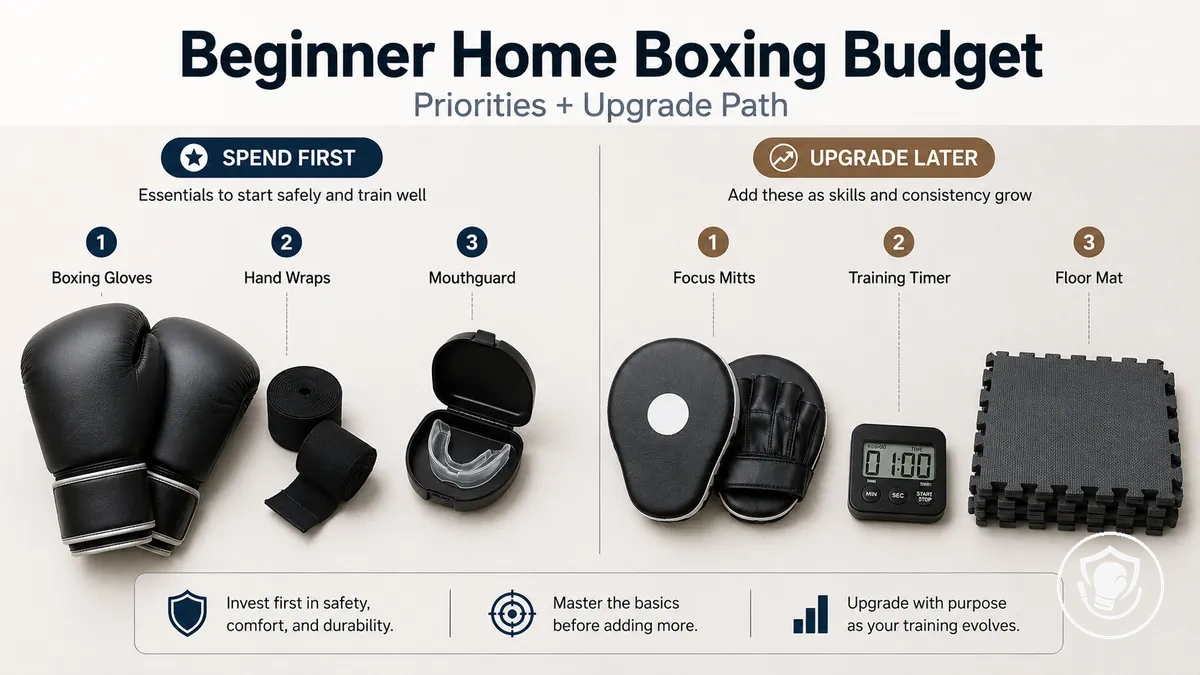
The first spending priority for home boxing equipment is typically hand protection: hand wraps and boxing gloves. The order of purchase depends on the type of training, but gear for absorbing impact and protecting joints comes before bags or accessories.
- Hand wraps provide wrist support and knuckle padding and often cost a small amount per pair.
- Boxing gloves vary in price from basic training models to more durable pairs, with protection varying by padding quality.
- A punching bag becomes relevant once the beginner has consistent hand protection and a safe training space.
How much to spend on each item depends on training frequency and whether the user hits pads, a bag, or does partner drills.
A common assumption is that cheap gear provides adequate protection for infrequent training. In reality, low-cost gloves may lack wrist support or padding density, increasing the risk of hand fatigue and poor form.
However, the most expensive professional gloves are often unnecessary for beginners who train a few times per week. A value threshold often lies in mid-range training gloves that balance durability and protection without the premium of competition-grade materials. The trade-off is between initial savings and long-term replaceability: cheaper gloves wear faster and may need replacement within a few months.
Upgrade timing for home boxing equipment depends largely on training frequency and target type. A beginner training daily with a heavy bag may notice glove wear after a few months, while someone training twice weekly with focus mitts may last longer. A reasonable plan is to budget for a durable first pair of gloves and wraps, then add a punching bag or stand once training consistency is confirmed.
The spending priority for home boxing equipment is conditional on training frequency, target type, and gear quality, with hand protection consistently first.
Budget decision frame for beginner home boxing equipment: training impact, risk, and replaceability
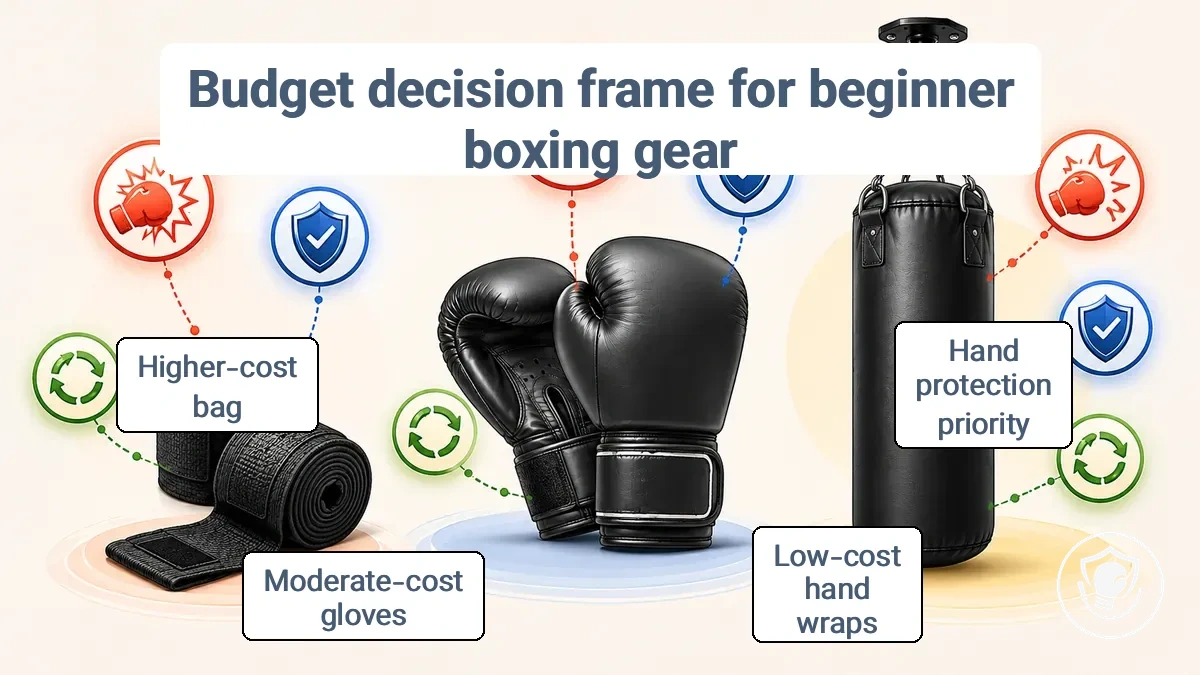
Budget prioritization for home boxing equipment means linking each spending choice to training impact, injury-risk reduction, and replaceability. A beginner who starts with the right allocation can avoid both overspending on unnecessary upgrades and underspending on safety-critical items.
These spending decisions are laid out without recommending specific brands or products.
The image maps these attributes across the three essential equipment categories.
For a complete overview of essential items, see the home boxing equipment for beginners hub. The checklist that follows details each decision point.
- Hand wraps — attribute: wrist and knuckle support; acceptable condition: secure fit without fraying or excessive stretching; cost-value: low spend (often under $20), can reduce risk of joint strain and may extend glove life.
- Boxing gloves — attribute: padding density and wrist closure; acceptable condition: foam that does not bottom out during bag work; cost-value: moderate spend ($30–$100), can improve punch quality and help lower hand injury risk; replaceability: typically 6–12 months of regular use.
- Punching bag — attribute: fill stability and surface durability; acceptable condition: bag holds shape and does not split after repeated strikes; cost-value: higher spend ($80–$300), important for power development and endurance; replaceability: 1–3 years depending on fill type and frequency.
For a beginner, hand protection is often the most effective spending priority in home boxing equipment, as it can reduce injury risk and improve training impact. After that, a durable bag and training gloves represent the next practical allocation, balancing cost with long-term utility.
Minimum spend baseline: the protection-first starter kit that makes home training viable
The minimum spend baseline for home boxing equipment is a protection-first starter kit that prioritizes hand and wrist safety, a durable striking surface, and adequate glove padding to make home training viable. 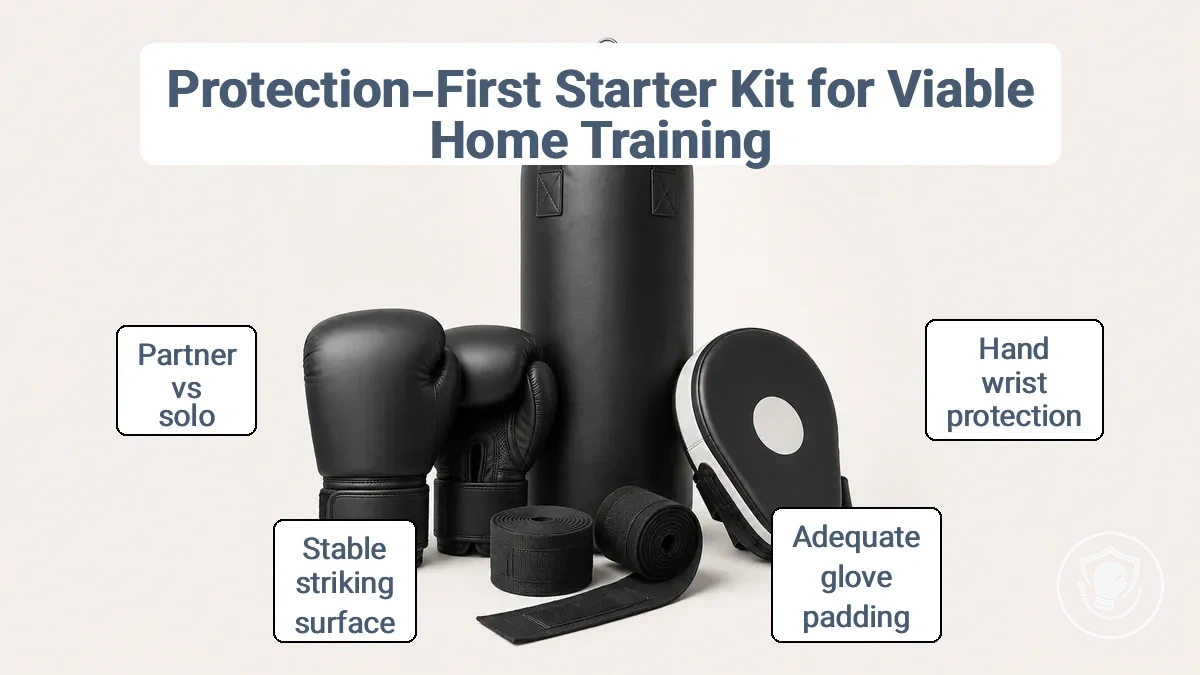 Choosing between focus pads or a heavy bag shapes spending priorities and determines which kit elements are essential first.
Hand wraps offer low-cost primary protection for the wrist and knuckles. Training gloves require enough padding for the intended activity, while lighter gloves often trade protection for speed. The striking surface must be stable to reduce the risk of jarring on contact. The value for money of each item depends on how well it meets these baseline attributes.
The minimum kit checklist helps confirm each piece meets its essential role. These checks separate baseline items from optional upgrades:
- Hand wraps — long enough to cover both wrist and knuckles; material that stays in place without bunching.
- Training gloves — sufficient padding for the chosen activity (bag work or partner drills); secure wrist closure and breathable lining.
- Striking surface — a heavy bag with adequate filling and stable mounting, or focus mitts with enough padding to absorb partner strikes.
- Footwear and floor mat (optional) — reduces slipping and protects the floor but is not part of the safety baseline.
Skipping any of the core checks increases the risk of hand or wrist strain and may require premature replacement of underperforming gear.
A pads-first setup typically needs a partner and a pair of focus mitts, keeping the initial spend lower but requiring a committed training partner. A bag-first setup relies on a heavy bag and its mounting hardware, which costs more upfront but allows solo training on your own schedule. Both approaches are viable as long as the hand protection and striking surface meet the baseline discussed above.
Spend Priorities That Prevent Injuries and Early Replacement: Gloves and Hand Protection Thresholds
Setting spending priorities for home boxing gloves and hand protection means focusing on cost-value thresholds—determined by attributes like wrist support, padding consistency, closure stability, and proper fit—that affect safety and replacement frequency. Recognizing which attributes are essential versus optional helps allocate your budget effectively.
- Wrist support: refers to how well the glove stabilizes the wrist during impact, which can reduce strain on tendons and joints.
- Padding consistency: means the density and distribution of protective material across the knuckle and back of the hand, affecting impact absorption.
- Closure stability: involves how securely the strap or lacing system holds the glove in place during movement.
- Fit: covers overall snugness without restricting circulation or dexterity.
Each attribute has a cost threshold below which the risk of injury or premature wear may increase.
| Attribute | Priority | Budget Implication |
|---|---|---|
| Wrist support | Must-have | Inadequate support can increase injury risk and may speed up glove breakdown |
| Padding consistency | Must-have | Thin or lumpy padding can lead to early replacement and reduced protection |
| Closure stability | Must-have | Loose closure can shift the glove, causing discomfort and premature wear |
| Fit (overall sizing) | Must-have | Poor fit can compromise both safety and glove lifespan |
| Impact dispersion (back-of-hand) | Nice-to-have | Adds extra protection but is not essential for most beginner training |
| Breathable lining | Nice-to-have | Improves comfort but typically does not affect core protection or longevity |
| Reinforced palm | Nice-to-have | Can extend durability for heavy use, but standard palm often suffices for beginners |
When evaluating gloves for your budget, consider wrist support and padding as non-negotiables. Allocate more to gloves with consistent padding density and a secure closure system. Consider impact dispersion only if you hit heavy bags frequently or have wrist concerns. These criteria help distinguish where to invest and where to save, avoiding overspending on features that add little to safety or lifespan.
For example, a beginner on a tight budget might choose a glove with good wrist support and padding over one with advanced impact dispersion. This trade-off often means the glove lasts longer and provides safer training, even without comfort features. As training demands increase, upgrading to gloves with nicer features can be done later.
Cheap vs expensive boxing gloves for beginners: what changes and what does not
For beginners choosing home boxing equipment, budget often affects support consistency, comfort, and longevity more than performance outcomes; the trade-off lies in how well the glove maintains its structure over repeated use, not in punching ability. Understanding these differences helps beginners allocate spending priorities based on training volume and personal comfort needs.
The attributes that vary most between price tiers are wrist support, padding resilience, closure integrity, and lining comfort. Wrist support refers to how securely the glove stabilizes the joint during impact; higher-cost gloves often use reinforced straps or tighter closure systems. Padding resilience describes how well the foam retains its shape after repeated bag work; budget gloves may compress unevenly over time. Closure integrity affects fit consistency, and lining comfort contributes to long-session wearability. These attributes serve as practical checkpoints when comparing value for money in home boxing equipment.
Common differences between budget and higher-priced boxing gloves include:
- Wrist support: Budget gloves may have basic strap closures; higher-priced gloves often provide multi-strap or hook-and-loop systems that can offer more consistent hold.
- Padding: Foam in cheaper gloves tends to flatten faster, while premium gloves often use layered or injection-molded foam that retains resilience longer.
- Closure: Velcro closures on lower-cost gloves may wear out sooner; higher-end gloves sometimes use reinforced stitching and stronger materials.
- Lining: Synthetic linings in lower-cost gloves can retain moisture; better linings often wick sweat and reduce hand irritation.
Replacing gloves more frequently can offset the initial savings, making the overall cost higher for frequent users. Examining durability trade-offs that matter can help identify when replacement is needed.
- For light use, budget gloves may suffice initially, provided the fit and wrist support are acceptable.
- For frequent bag work or sparring preparation, higher-cost gloves often deliver better value because they maintain protection longer.
Wraps and inner options in a budget kit: support value vs convenience value
In a budget home boxing kit, hand wraps and inner gloves represent a trade-off between support and convenience. For a beginner, the key difference is how each option fits under standard gloves — reusable wraps cost less per use over time, while inner gloves with built-in padding offer quicker setup but can add bulk that alters fit.
For hand wraps and inner gloves, the main attributes fall into support drivers and convenience drivers:
Support drivers:
- Wraps – Longer wraps (often around 180 inches) can provide better wrist stability and knuckle coverage, but they require practice to wrap consistently and may take longer to adjust before each session.
- Inner gloves – Inner gloves with integrated padding can deliver compression and protect the knuckles, but the added volume can alter the fit under boxing gloves, especially in budget models with smaller hand compartments.
Convenience drivers:
- Quick-wrap gloves – Quick-wrap or pull-on inner gloves can save time and are simpler for a beginner to use, yet their support is less adjustable than traditional wraps, which can reduce wrist stability during impact.
- Shorter wraps – Shorter wraps (120 inches) can be faster to wrap but typically offer less coverage and compression, making them a trade-off that may not suit heavy bag work or sparring.
If support is your priority, a longer hand wrap or a fitted inner glove that does not create excessive bulk is likely worth the extra spend. For convenience, a quick-wrap system can meet basic needs, but stability depends on positioning. For a beginner on a budget, starting with reusable wraps and upgrading to inner gloves later can balance support and convenience without overspending.
Where you can save money without losing training value: low-impact accessories and add-ons
As a beginner, you can save money without losing training value by choosing low-impact accessories and add-ons that provide feedback, safety, or convenience. A skipping rope, hand wraps, and a basic groin guard each serve a clear role and cost very little, while branded gloves or high-tech trackers add convenience or aesthetics but little additional training value until the fundamentals are in place.
Low-impact accessories in home boxing equipment for beginners can be grouped by role: feedback, safety, or convenience. For each group, a minimal acceptable condition typically covers the training need.
The decision to upgrade should be based on whether the core equipment already meets training goals, not on whether the accessory could be improved.
These criteria help decide when an add-on offers good cost-value and when it can be deferred:
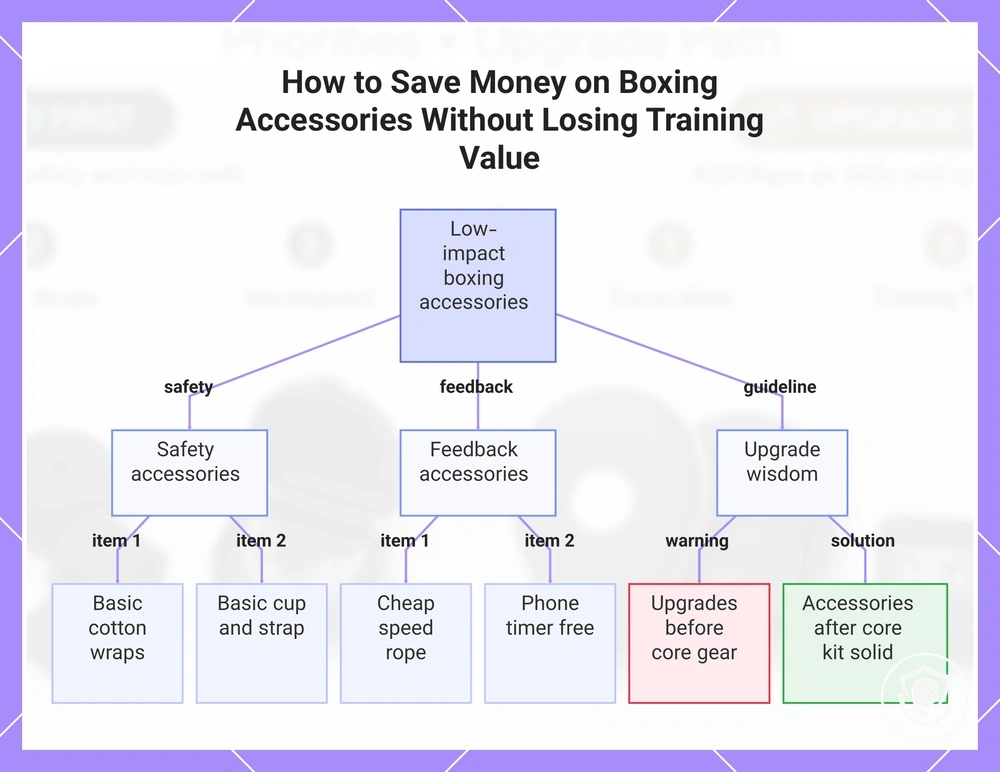
- Hand wraps: safety and wrist support; basic cotton wraps suffice; upgrading to quick-fit or gel wraps adds convenience but is optional for training progression.
- Skipping rope: conditioning feedback; a cheap speed rope works; weighted or tangle-free rope changes feel but does not improve workout effectiveness.
- Timer or app: round tracking; a phone timer is free; dedicated gym timer or smart band adds convenience but does not improve training stimulus.
- Groin guard: protection; basic cup and strap are adequate; ventilated or padded model adds comfort but safety remains unchanged if fit is correct.
These items are supplementary and can be replaced later without losing training value, especially when budget is tight and spending priorities are clear. A common trap is buying multiple upgrades before the heavy bag or gloves are adequate, creating opportunity cost rather than training benefits. A safe approach is to treat accessories as replaceable convenience items once the core kit is solid, not as early investments.
This chart shows which boxing accessories provide good cost-value for beginners and when to avoid unnecessary upgrades.
Starter Sets and Bundles: When a Beginner Boxing Gear Bundle Is Worth It
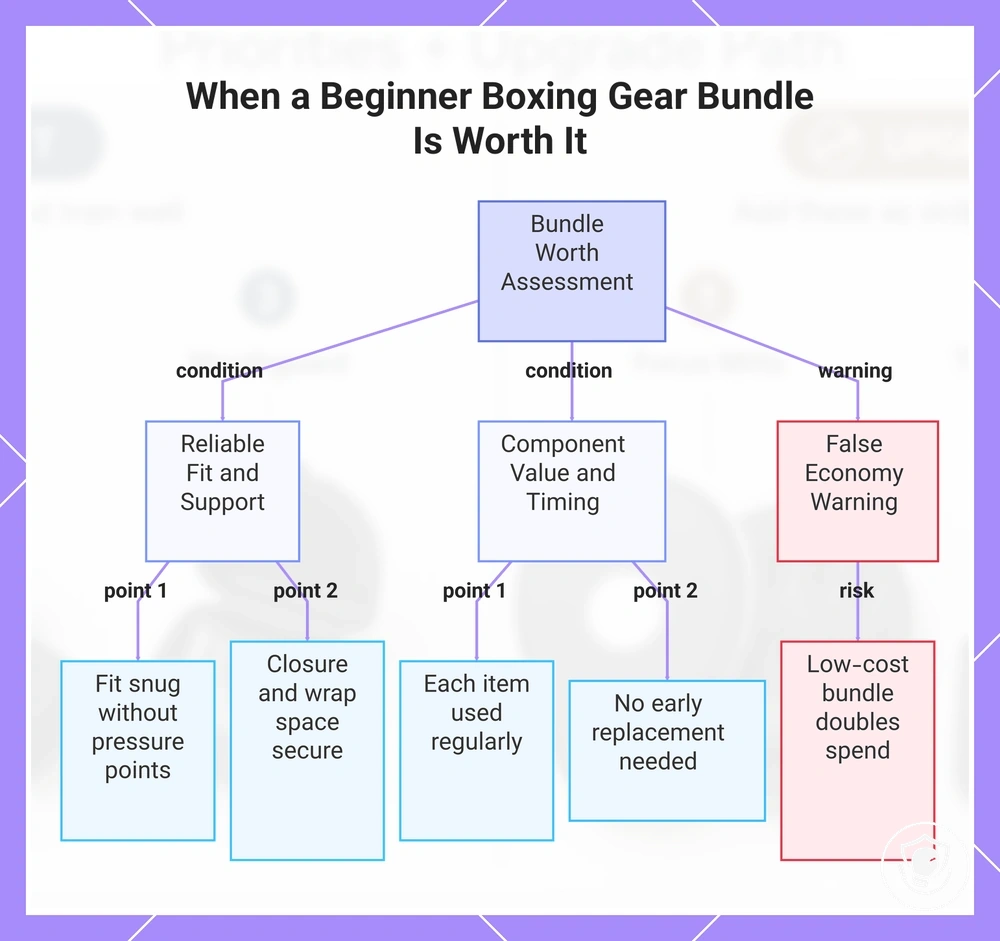
A beginner boxing gear bundle is worth it when the set provides reliable fit and sufficient support across its components at a total cost below the combined price of individually chosen pieces that would need early replacement. The real test is whether each item can handle regular training without needing an upgrade in the first few months. For home boxing equipment, the decision is whether the bundle simplifies spending priorities or risks adding redundant items that inflate cost without improving training.
The attributes that determine bundle value include fit reliability—how well gloves and headgear match hand and head shape—closure quality, wrap suitability inside the glove, and the absence of redundant items that pad the set without adding function. A starter kit that compromises on these factors may lower the cost-value ratio for a beginner on a budget.
The following cost-value checks help decide if a bundle is worth its cost:
- Fit: Do the gloves and headgear feel snug without pressure points or excessive movement during shadowboxing or bag work?
- Closure: Do straps, laces, or Velcro secure firmly and evenly, or do they loosen after a few rounds?
- Wrap space: Is there enough room inside the glove for hand wraps without bunching or restricting finger movement?
- Component usefulness: Is every item likely to be used regularly, or are some likely to sit unused after the first session?
- Replacement timing: Would replacing any single item cost nearly as much as the entire bundle, making the initial bundle a poor allocation of spending priorities?
A common false economy involves a low-cost bundle where the gloves lose padding after weeks, the headgear shifts during sparring, and the hand wraps are too short to provide adequate wrist support. Separately replacing those items often doubles the original spend, making the initial purchase not worth it for a beginner. A bundle is worth it only when its components are unlikely to need replacement within the same season.
This chart shows the main condition checks and the false economy warning for deciding whether a beginner boxing gear bundle provides real value.
How to Evaluate a Boxing Gloves and Wraps Combo: Fit, Closure Quality, and Easy Replacement Parts
Evaluating a boxing gloves and hand wraps combo begins with fit and support, not price. Two simple checks — how the gloves feel with wraps on and how well the closure secures your wrist — can tell you more about long-term value than product labels. If both pass, the combo can be a reliable choice for your home boxing equipment.
Fit under gloves means the hand wraps add wrist and knuckle support without creating tight spots or discomfort inside the glove. Closure stability refers to how securely the glove’s strap locks around your wrist; a hook-and-loop strap that does not shift during training can reduce the risk of strain. Wrap suitability involves choosing a wrap length that matches the glove’s interior volume, so your hand does not slide around inside. These criteria help you decide whether a specific gloves-and-wraps combo fits your spending priorities.
To assess any new combo on a budget, run through this short checklist:
- Put on your usual hand wraps, then slip into the gloves. Your fingers should curl easily without the glove feeling loose. If the glove feels too tight with wraps, look for a different model or consider thinner wraps.
- Fasten the closure. A double strap can provide more precise wrist support, but a single strap that stays locked is often sufficient. The glove should not slip or come loose during shadow boxing.
- Make a fist and throw a few air punches. Your wrist should stay aligned with your forearm; any bending at impact signals weak support. This often indicates that the closure or padding is inadequate.
- Feel the interior seams and the wrap texture. Rough stitching or abrasive wrap edges can cause discomfort over time, leading to early replacement. Seam quality matters for durability.
- Check that the wraps do not bunch up inside the glove. Excessive bulk restricts finger movement and can reduce punch accuracy. If you need to adjust wraps constantly, the combo likely needs a different wrap length or glove shape.
A combo that fails on fit or closure often requires upgrading sooner, which raises its total cost-value. If the combo feels slightly loose around the wrist but snug elsewhere, consider upgrading to a glove with a wider hook-and-loop strap or pairing it with longer hand wraps for extra support. This scenario often arises with budget beginner gloves that use shorter straps. A small upgrade in closure or wrap length can extend the combo’s useful life without replacing everything.
Common bundle traps that raise total cost: unusable sizing, weak wrist support, and redundant items
Unusable sizing, weak wrist support, and redundant items are common bundle traps that raise total cost. These traps often lead to replacing gear or leaving it unused, shifting spending priorities away from value for money. Recognizing these traps early helps you allocate your budget toward what actually matters in a starter kit.
Unusable sizing refers to wrist wraps or gloves that claim to fit all but fit few. Weak wrist support describes wraps lacking stiffness or adjustability to stabilize the wrist during punching. Redundant items are pieces in a bundle that duplicate what a beginner likely already owns or does not need, such as extra hand wraps or a second pair of gloves. Distinguishing these traps from genuine value requires a simple check before purchase.
Common bundle traps show these signs, outcomes, and budget-safe alternatives:
- Sign: The wrist wrap feels loose or too tight after fastening. Outcome: Poor support or discomfort, leading to replacement. Better choice: Check your wrist circumference against the product's sizing guide before buying, and look for adjustable straps that extend beyond a narrow range.
- Sign: The wrap stretches or slips during punching. Outcome: Reduced wrist stability, which can compromise technique and increase the need for a firmer support. Better choice: Look for wraps with reinforced stitching or a denser fabric that holds shape under load.
- Sign: The bundle includes extra items you already own, such as a second set of hand wraps or a glove size you do not use. Outcome: Unnecessary spend on gear that sits unused. Better choice: Compare bundle contents with your existing gear; buy a smaller kit or individual pieces if the extras add no value.
For example, a beginner who buys a bundle with a one-size-fits-all wrist wrap may find it either too loose for heavy bag work or too tight for shadowboxing. The wrap ends up unused, and a properly sized replacement adds to the overall spend on home boxing equipment. Checking fit and support before purchase can help you avoid these traps and keep your budget focused on the gear that improves your training.
Upgrade path for a home boxing setup: staged spending based on training frequency and progression
A staged upgrade path for home boxing equipment ties budget and spending priorities to consistent use and proven needs rather than early optimism. Start with gear matching your current training frequency and upgrade only when a clear limit appears in comfort, feedback, durability, or variety—the point at which equipment no longer supports safe, effective practice.
Key attributes that signal the need for an upgrade include:
- Comfort – how the equipment feels during repeated use: glove padding, wrap support, bag surface.
- Feedback – how well the gear communicates impact location and timing for technique work.
- Durability – becomes relevant as training frequency rises and wear signs appear faster.
- Variety – limits growth when movement patterns no longer challenge coordination or conditioning.
The upgrade path stages describe typical triggers based on training pattern:
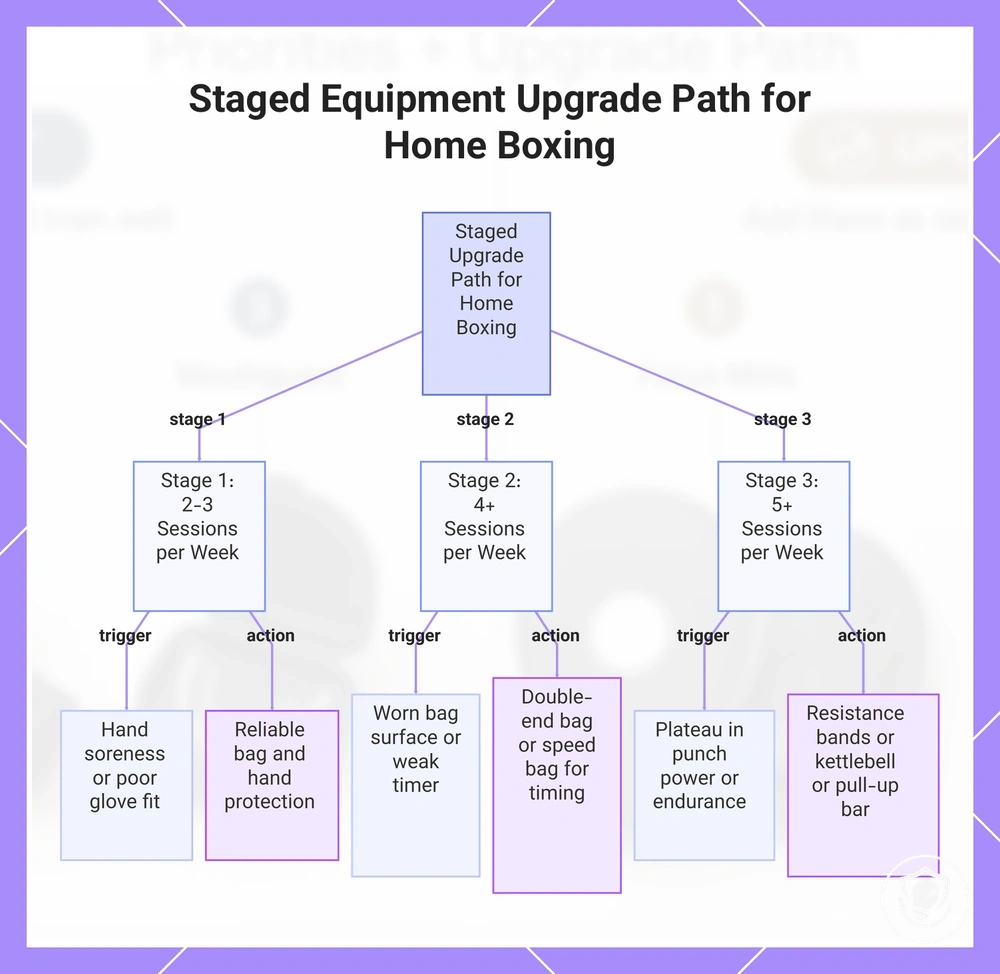
- Stage 1: Essential striking kit – When training frequency is 2–3 sessions per week, comfort is often the first limit. Trigger conditions include hand soreness, poorly fitted gloves, or a bag that feels inconsistent. The cost-value gain is a reliable, safe striking surface and hand protection.
- Stage 2: Accuracy and timing tools – When frequency reaches 4 or more sessions per week, feedback and durability become limiting. Triggers include worn bag surface, a timer that is not loud enough for rounds, or a desire to work on head movement and accuracy. Adding a double-end bag, speed bag, or floor-to-ceiling ball sharpens timing without requiring more space.
- Stage 3: Conditioning and strength support – At high training frequency (5+ sessions), variety becomes the ceiling. Triggers include plateau in punch power or endurance. Adding resistance bands, a kettlebell, or a pull-up bar fills the strength gap without replacing the boxing core.
The replaceability of worn items in the upgrade path matters: a glove with flattened padding may not be improved by upgrading the bag. For a pads-first beginner, glove comfort is likely the first trigger; a bag-first user may notice feedback limitations sooner. Let your training pattern and the first limitation guide purchase timing, not a fixed calendar.
This chart shows the three upgrade stages for home boxing equipment, each triggered by specific limits in comfort, feedback, durability, or variety based on training frequency.
Stage 1 Upgrades: Improving Protection and Comfort Before Expanding Equipment Types
The stage-1 trigger for a beginner with home boxing equipment occurs when training frequency is limited by discomfort or safety concerns. This makes upgrades that reduce these issues a cost-value priority. This prioritization can help keep spending aligned with cost-value and support risk control without overcommitting the budget.
Stage 1 upgrades directly improve protection or comfort during punching. Their value depends on how well they address the specific trigger condition. A short prioritized list clarifies which upgrades often have the most impact on training consistency.
- Hand wraps: wrist and knuckle support; use when you feel strain in the wrist after a session; they can improve joint alignment and allow longer rounds with less injury risk, supporting consistent training frequency.
- Bag gloves: padding and grip; upgrade when knuckle soreness appears after moderate-intensity work; proper gloves can reduce impact stress and allow you to train more often with fewer recovery breaks.
- Mouthguard: dental and jaw protection; add when you start heavy bag drills or consider light sparring; it can lower injury risk and build confidence, encouraging regular sessions.
- Low-cost adjustment: hand wrap technique: correct wrapping can improve fit and support even with lower-priced wraps or gloves; when combined with proper tension, it can postpone the need for a premium glove purchase if the current pair offers adequate protection.
The timing of each stage 1 upgrade depends on when the trigger condition appears, and replaceability (for example, swapping wraps as they lose elasticity) can help keep spending predictable.
Stage 2 Upgrades: Adding Training Variety Once the Starter Kit Is Used Consistently
Stage 2 upgrades for home boxing equipment add training variety by introducing new stimuli rather than replacing current gear. Whether to upgrade comes down to whether your current gear still meets your training frequency and whether you can allocate part of your budget toward variety instead of foundational protection.
A stage 2 upgrade focuses on variety attributes such as feedback (e.g., different bag densities or rebound), movement (e.g., mobile targets or floor mats for footwork), and target type (e.g., double-end bags or focus mitts). These attributes change how you train by adding new stimuli that can improve timing and coordination. The trigger condition for upgrading is often when your current setup no longer challenges your reactions or when you hit a plateau in a specific skill. A practical criteria cue is whether the new piece fills a gap that your starter kit cannot address without increasing overall cost-value.
How each upgrade fits your training frequency and timing involves these trade-offs and benefits:
- Feedback upgrades (softer vs. harder targets): trade-off of durability vs. responsiveness; benefit of better timing work.
- Movement upgrades (floor markers or agility ladder): low cost, offer value for footwork but require adequate floor space.
- Target type upgrades (double-end bag): can improve accuracy and reaction but need setup time and may not suit low ceilings.
- Timing-based upgrades (timer or interval app): minimal cost, support structured rounds but do not replace physical gear.
These upgrades tend to be replaceable within a reasonable budget when they wear out, but protection items like gloves and headgear should remain your first priority.
For example, a beginner who trains three times per week may notice that their heavy bag workout feels repetitive. Adding a double-end bag can re-engage focus without a large budget shift. Stage 2 upgrades offer variety when your training frequency justifies them.
Stage 3 Upgrades: Paying for Durability and Long-Term Value
Stage 3 upgrades focus on paying for durability and long-term value. They become worth considering when usage patterns are stable and visible wear signals appear, guiding your spending priorities.
Durability in home boxing equipment describes how well a component resists degradation from repeated use. Cost-over-time spending implies that a higher initial outlay may reduce the total replacements needed over time, shifting the value threshold from initial price to long-term cost.
Common upgrade components have wear indicators and usage conditions where a durability-focused upgrade provides value:
- Heavy bag cover – surface fraying or seam separation – often after months of regular training – upgrading to thicker synthetic leather can reduce replacement risk.
- Training gloves – loss of padding density – once palm cushioning flattens – a model with denser foam tends to extend usable life.
- Skipping rope – coating nicks and bearing wear – after daily use over several weeks – a rope with replaceable bearings can avoid full-tool replacement.
- Headgear – strap stretching and foam compression – when used in three or more sessions per week – reinforced stitching and higher-density foam can improve durability.
A beginner training two to three times per week can wait until wear signals are clear, then allocate budget to the upgrade that most reduces future replacement frequency. The decision to invest in durability is sensible when the current component’s failure point is predictable and the upgraded part may outlast multiple cycles of the standard option.
Budget mistakes and false economies: buying too early, buying the wrong spec, and skipping fit checks
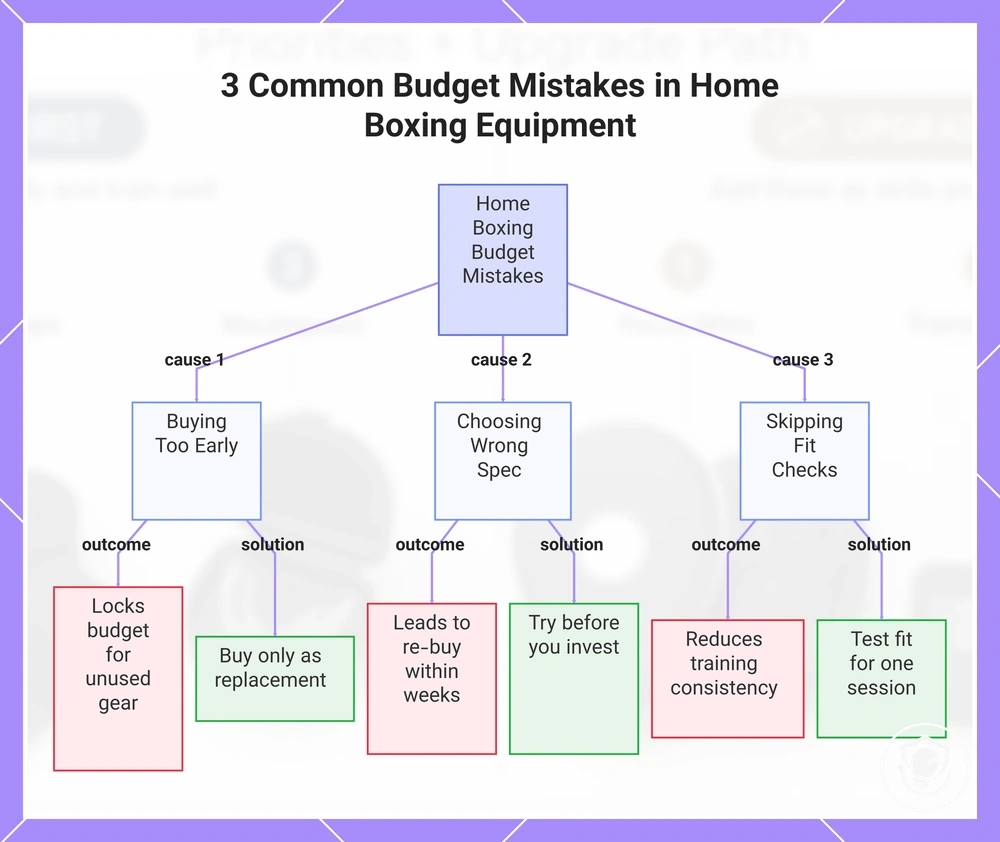
Beginners buying home boxing equipment on a budget often make three costly mistakes: buying too early, choosing the wrong spec, or skipping fit checks. A practical approach is to treat each purchase as a value-for-money check against your actual needs.
For home boxing equipment, a false economy means spending less now but paying more later through replacement or avoided use. A fit check is the process of verifying that equipment matches your dimensions and support requirements. If an item cannot be used consistently due to discomfort or poor durability, the initial saving is not real.
Common errors with home boxing equipment, their typical signs, outcomes, and corrective actions:
- Buying too early because of a sale: You store unused gear that may not fit later → You lock up budget that could go toward essentials → Check your training routine first and buy only when the item replaces something you use.
- Choosing the wrong spec because of price: The gear feels uncomfortable or wears quickly → You often re-buy a better version within weeks → Read product descriptions and try before you invest.
- Skipping fit checks as a time saver: The item does not align with your body or grip → It reduces training consistency and may cause strain → Spend one session testing fit before purchase.
Even with good initial choices, gear eventually wears out — when to replace worn gear depends on visible wear and reduced performance.
Suppose you bought cheap home boxing gloves that were too tight. Instead of replacing everything, adjust your spending priorities by returning the item or using it for light drills until you can upgrade a single piece. This shows that recovery is possible without starting over.
This chart shows three costly mistakes beginners make when buying home boxing equipment on a budget, along with their outcomes and corrective actions.
Budget FAQs for Beginner Home Boxing Equipment: Cost, Bundles, Wraps, and Glove Value
Question: What is the typical cost range for a beginner home boxing setup?
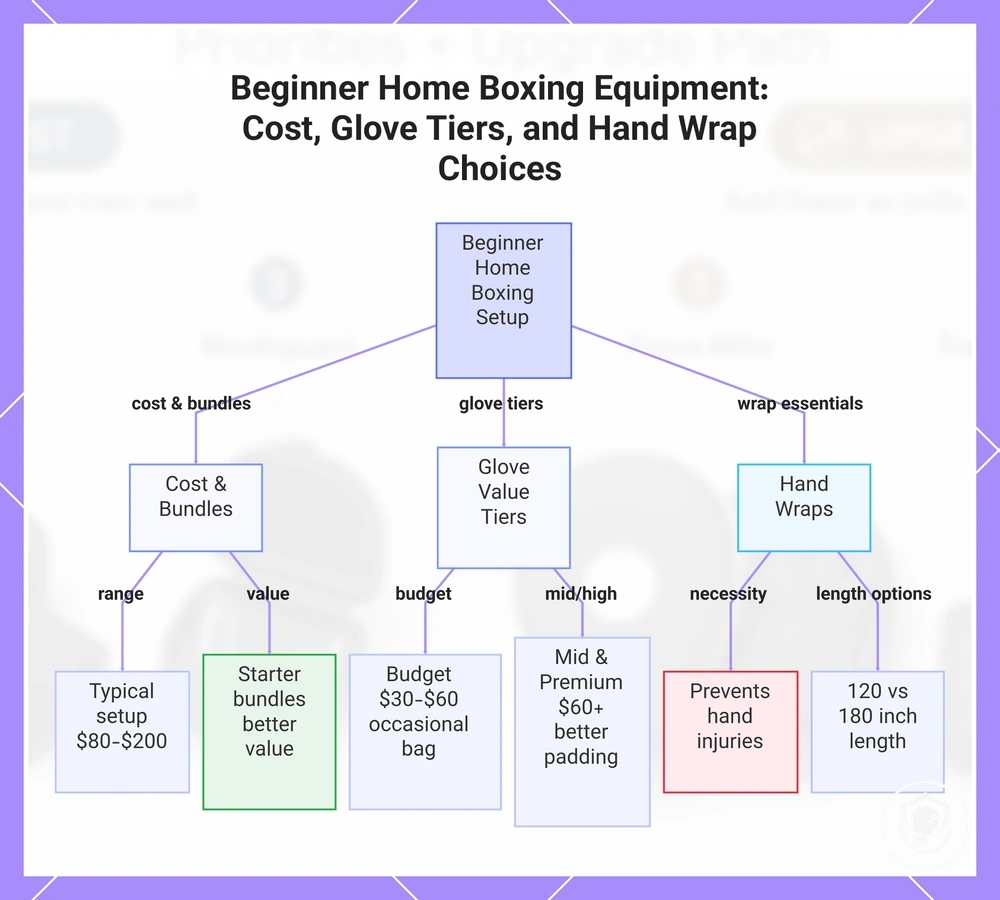
Answer: A beginner home boxing equipment setup typically costs between $80 and $200, depending on quality and brand choices. This usually includes gloves, hand wraps, and a bag, but additional items or premium materials can raise the price.
Question: Are starter bundles a good value for money?
Answer: Starter bundles usually offer better value for money than buying items separately because they combine core pieces at a discounted price. They often include gloves and wraps, which covers the basic spending priorities. However, check that the bundle matches your body size and training goals to avoid unnecessary upgrades later.
Question: What are the main value tiers for home boxing gloves?
Answer: Home boxing gloves tend to fall into three value thresholds: budget ($30–$60), mid-range ($60–$150), and premium (over $150). Budget gloves can work for occasional bag work, while mid-range and premium options typically offer better padding and wrist support. Your choice depends on the trade-off between cost and the durability you need for consistent training.
Question: Are hand wraps really necessary when using gloves on a bag?
Answer: Yes, hand wraps are a low-cost priority that protect your gloves and help prevent hand injuries. They absorb sweat, help prevent sprains, and add a layer of padding underneath your gloves. Skipping wraps can increase the risk of hand injuries even with quality gloves.
Question: What length of hand wraps should a beginner choose?
Answer: Beginners can choose between 120-inch and 180-inch hand wraps. The longer length tends to provide more wrist coverage and can offer better support for heavier bag sessions, while 120-inch wraps tend to be easier to wrap and suit smaller hands. The more suitable choice often depends on your hand size and how much wrist support feels comfortable.
This chart shows the main cost range, glove value tiers, and hand wrap considerations for a beginner home boxing setup, helping you understand the key decisions and priorities.
How expensive is it to start boxing at home with a safe minimum kit?
Starting boxing at home on a budget with a safe minimum kit can vary in cost, depending mainly on your choices for hand protection and training surface.
- Must-pay items: Boxing gloves, hand wraps, and a non-slip mat provide the protection and stability needed for safe training. Skimping on these can lead to hand injuries or slips, so they are essential for a safe start.
- Can-wait items: A punching bag adds resistance and feedback but can be postponed. Shadow boxing and reflex drills build technique without a target, so you can add a bag later when your budget allows.
Once you have the protective essentials, put your remaining budget toward a target that fits your space and how often you train.
Are cheap boxing gloves okay for beginners, and when do they become a bad buy?
Cheap boxing gloves can work for beginners using home boxing equipment as long as training stays light and the gloves provide adequate wrist support, padding, and a secure closure. Fit and protection matter more than price alone. The threshold shifts when training includes frequent heavy bag work, and durability then becomes more important.
Signs that cheap boxing gloves are a bad buy include:
- thin padding that flattens quickly
- a loose closure that increases wrist strain
- early material breakdown
Budget priorities for cheap boxing gloves shift when frequent bag work is part of training — cost-value comes from durable padding and strong construction to reduce replacement risk. A practical check: if the gloves feel unstable or cause discomfort during movement, it may be time to upgrade.
Do you need wraps and gloves to start, or can you skip one in a budget setup?
For a beginner setting up home boxing equipment on a budget, gloves are essential for striking. Hand wraps are a high-value support layer you can skip only under specific conditions.
Your training frequency and target type determine whether skipping wraps is a practical trade-off for your spending priorities.
- Skip wraps initially — You save a small amount of money and avoid learning to wrap, but you lose wrist support and knuckle protection. This can be acceptable for short, low-intensity pad work only. It tends to cause discomfort or increased injury risk when hitting a heavy bag or as session frequency grows.
- Do not skip wraps — Even basic hand wraps add significant support and fit under most gloves without adding bulk. They offer good value because they are inexpensive, improve comfort, and absorb sweat to keep gloves fresher longer. For most beginners, allocating a few rupees for wraps is a smart spending priority.
A practical check: if you plan to hit a heavy bag more than once a week, include hand wraps in your initial spend.
Should a beginner buy 120-inch or 180-inch hand wraps for a budget kit?
For a beginner’s home boxing equipment budget, 120-inch hand wraps suit smaller hands and lighter training, while 180-inch wraps offer more wrist support and coverage for heavier sessions. Your hand size and training intensity determine the better fit. Spending priorities should depend on your training goals: light pad work may not need extra length, but if you plan bag work or sparring, investing in 180-inch wraps can be a worthwhile trade-off when you consider cost and value.
- 120-inch wraps provide less coverage and are less bulky, so they can fit more easily inside snug gloves—a good fit for smaller hands or lighter training intensity.
- 180-inch wraps offer extra knuckle padding for heavier punching but can feel bulky in tight gloves.
Is a boxing starter kit worth it, or is building a kit piece-by-piece better value?
A starter kit is often worth it for a beginner setting up home boxing equipment when the included gloves, wraps, and headgear fit well and provide enough support for your current training level. It is also a good option when you are unlikely to need separate items for different purposes.
The choice between a bundle and separate purchases depends on fit certainty, replacement flexibility, and upfront cost versus long-term value.
The main trade-offs are:
- Fit certainty: A bundle saves when fit matches; piece-by-piece wins when sizing is uncertain or a single item needs replacement.
- Replacement flexibility: Bundles limit upgrading a single component; separate purchases let you swap gloves or wraps without wasting spend on working gear.
- Upfront cost vs. long-term value: Bundles lower initial outlay for a quick start; separates cost more first but can give better value by avoiding redundant items and investing in high-use gear.
A beginner who needs everything on a limited budget benefits from a starter kit; one who already owns wraps and wants a specific glove size or brand prefers buying only missing pieces.