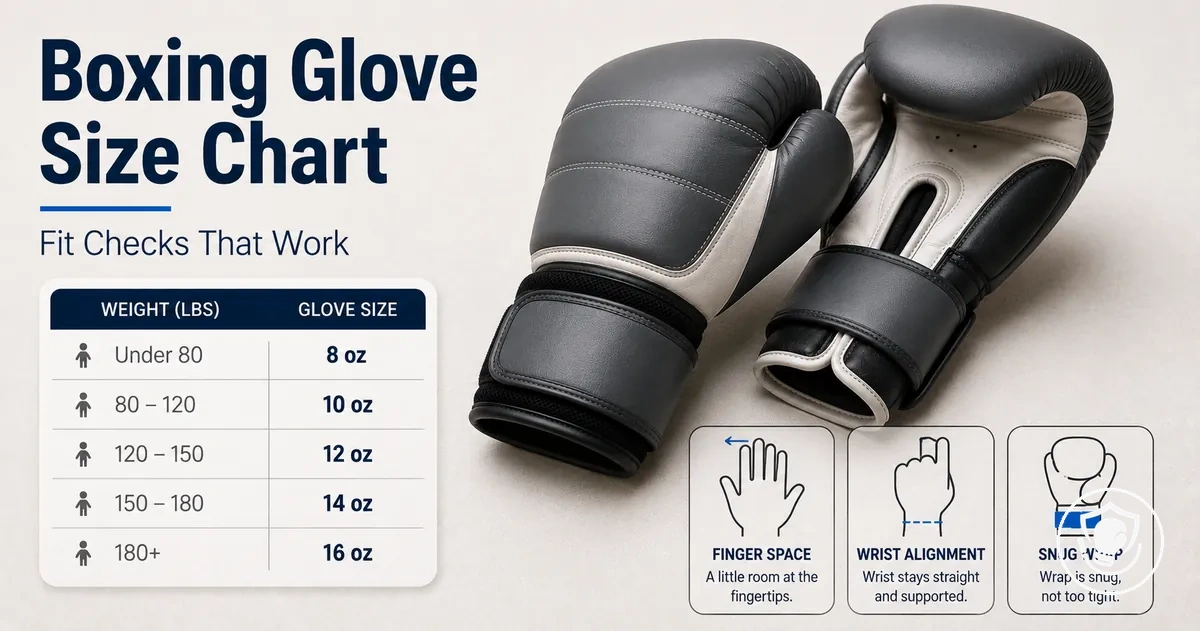
Boxing Glove Size Chart and Fit Checks for Beginners
Boxing glove size refers to the weight in ounces (oz), not to a standard hand measurement. Choosing a workable size depends on your training goal, hand volume, and how the glove fits with hand wraps. These factors help you pick a starting size and confirm fit before your first session.
This page does not compare brands, explain competition rules, or coach punching technique. It focuses on sizing and fit checks only. Oz is a helpful starting point, but it is not a full fit predictor because padding layout, glove shape, and closure design vary between models.
A good starting size for general training is often between 12 and 14 oz, but hand wraps and glove shape can affect the fit. The first subheading clarifies what glove size means for different training needs.
- Training goal: affects whether lighter gloves for speed work or heavier gloves for sparring are needed.
- Oz (ounces): signals the amount of padding and weight, which affects hand protection and partner safety.
- Hand volume factors: hand circumference, hand wraps, and hand shape can change how a glove fits.
- Fit-check signals: wrist support, thumb placement, and knuckle position help indicate correct fit.
What glove size represents: ounce weight, padding distribution, and hand volume assumptions
Boxing glove size is measured in ounces (oz), and the number indicates the total weight of the glove. It does not guarantee the internal fit or padding thickness; oz is a starting signal.
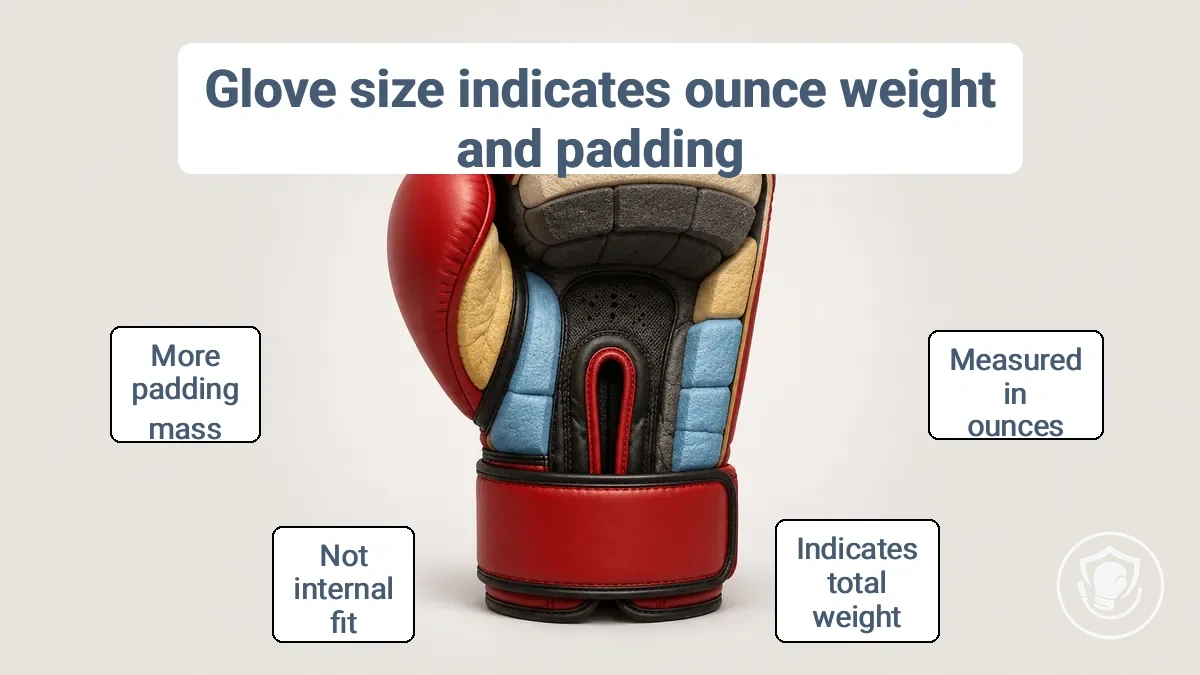
A higher oz rating typically means more total padding mass, which can affect impact absorption and fatigue, though the effect can vary by model design. The internal space and hand volume can differ between gloves of the same oz rating due to shape and construction.
Influences
- Glove weight and how heavy it feels on the hand
- Padding mass
- Fatigue during long training sessions
- Handling speed and wrist mobility
Does not determine
- Exact internal hand volume – two 14 oz gloves can have different finger pocket sizes
- Exact wrist support – wrist stiffness depends on closure and cuff design, not ounce rating alone
- Protection level – protection also depends on padding density, material, and fit
- Whether the glove suits a specific hand shape – narrow or wide palms may fit differently
For training, a heavier glove can offer more padding for partner drills, while a lighter glove may allow faster hand speed for bag work. The right choice depends on your training goal and how your hand fits inside the glove. Hand wraps and hand shape are the next factors to consider.
Hand sizing inputs that change the outcome: wraps, wrist support needs, and hand shape
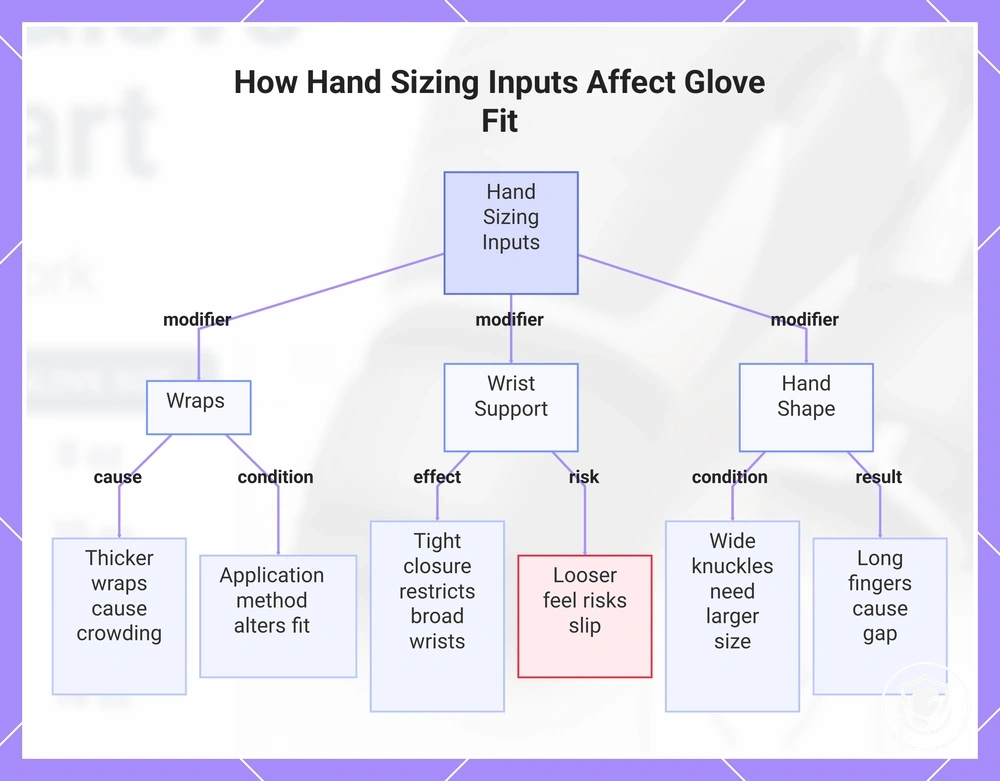
Personal variables such as hand wraps, wrist support needs, and hand shape change the best glove size even when the ounce weight matches by modifying the internal space available, shifting the ideal size outcome. Together these inputs set a starting range that needs to be refined by trying the gloves on.
When you add hand wraps before putting on the gloves, the extra thickness can reduce the space around your fingers and knuckles. A preference for more or less wrist support also changes how tightly the glove closes around the joint, affecting the feel of the wrist lock. Hand measurement alone does not account for these modifiers, so it is not enough.
Hand volume refers to the mass your hand occupies inside the glove, while hand shape describes whether your hand is broad with short fingers or narrow with long fingers. Both influence where crowding or slipping may occur. Because fit varies even among people with the same circumference, fit checks validate the correct size by accounting for shape and volume.
- Wraps
- Thicker wraps (cotton or gel) take up more internal space, which can create crowding at the knuckles and fingers.
- The way wraps are applied—tight over the palm or loose around the wrist—changes how the glove sits on the hand.
- Some glove models with narrow inner pockets may require sizing up when wraps are used.
- Wrist support
- A glove with a tighter closure system provides more wrist lock, which can feel restrictive if the hand shape is broad across the wrist area.
- Users who prefer a looser wrist feel may choose a smaller size to avoid excess movement, but risk slip at the back of the hand.
- The position and tension of the wrist strap affect stability feel and can alter the perceived fit even when the hand measurement is correct.
- Hand shape
- A hand with a wide knuckle area and short fingers may need a larger size to avoid crowding, even if the circumference matches a smaller size.
- Long fingers with a narrow palm can create a gap at the knuckle line, causing the glove to slip during impact.
- Hand volume that is high relative to circumference (thick palm, fleshy base) can fill the glove cavity too quickly, making a medium size feel tight.
This chart shows how hand wraps, wrist support preferences, and hand shape modify the internal space and shift the ideal glove size, requiring fit checks beyond hand measurement.
Measuring hand circumference with a tape for a starting size range
Measuring your hand circumference with a tape measure gives you a starting range for glove size, not a final rule. Use this as a starting range.
- Wrap a flexible measuring tape around the widest part of your palm, just below your knuckles, with your hand relaxed and fingers together.
- Ensure the tape is snug but not tight, and lies flat against your skin.
- Measure your dominant hand, as it is often larger.
- Note where the tape overlaps the zero mark and read the measurement.
- Record the number and keep your wrap method consistent for repeatable results.
If you fall between sizes, re-measure once and confirm fit by trying on gloves.
How Wraps and Closure Style Change the Effective Internal Space
Hand wraps and closure style change a boxing glove's internal space without altering its size marking. Wrap thickness and strap tension can affect how tightly the glove fits around the hand, which influences finger crowding, knuckle pressure, and the perception of wrist lock.
With wraps applied snugly, the internal volume is reduced, often leading to a more compact fit and increased pressure across the knuckles. Without wraps, the same glove may feel looser, with more room inside and less wrist stability. That difference makes fit checks necessary after wraps and closure adjustments are made.
- Wraps
- Thicker wraps can reduce internal space, which may increase finger crowding and knuckle pressure.
- Wrap thickness can affect wrist lock perception by altering how snugly the glove sits around the wrist.
- Closure tension
- Tighter strap tension can improve wrist lock and stability, but may pull the glove tighter around the hand.
- Looser closure can leave more internal space, which may reduce wrist support and allow slight hand movement inside the glove.
Beginner glove size chart: choosing a starting ounce range by body weight and training goal
Your starting ounce range depends on body weight and training goal; a size chart gives a practical starting range, and fit checks confirm the choice.
The beginner glove size chart organizes starting ounce ranges by body weight band and training goal. Use your weight band and training goal to find a starting range.
| Body weight band | Training goal | Starting ounce range |
|---|---|---|
| Under 100 lbs | Bag work / Pads | 6–10 oz |
| Under 100 lbs | Sparring | 12–14 oz |
| 100–150 lbs | Bag work / Pads | 10–12 oz |
| 100–150 lbs | Sparring | 14–16 oz |
| 150–175 lbs | Bag work / Pads | 12–14 oz |
| 150–175 lbs | Sparring | 16 oz |
| Over 175 lbs | Bag work / Pads | 14–16 oz |
| Over 175 lbs | Sparring | 16–18 oz |
For quick scanning, the graphic below summarizes the same beginner glove size chart by weight band and training goal.
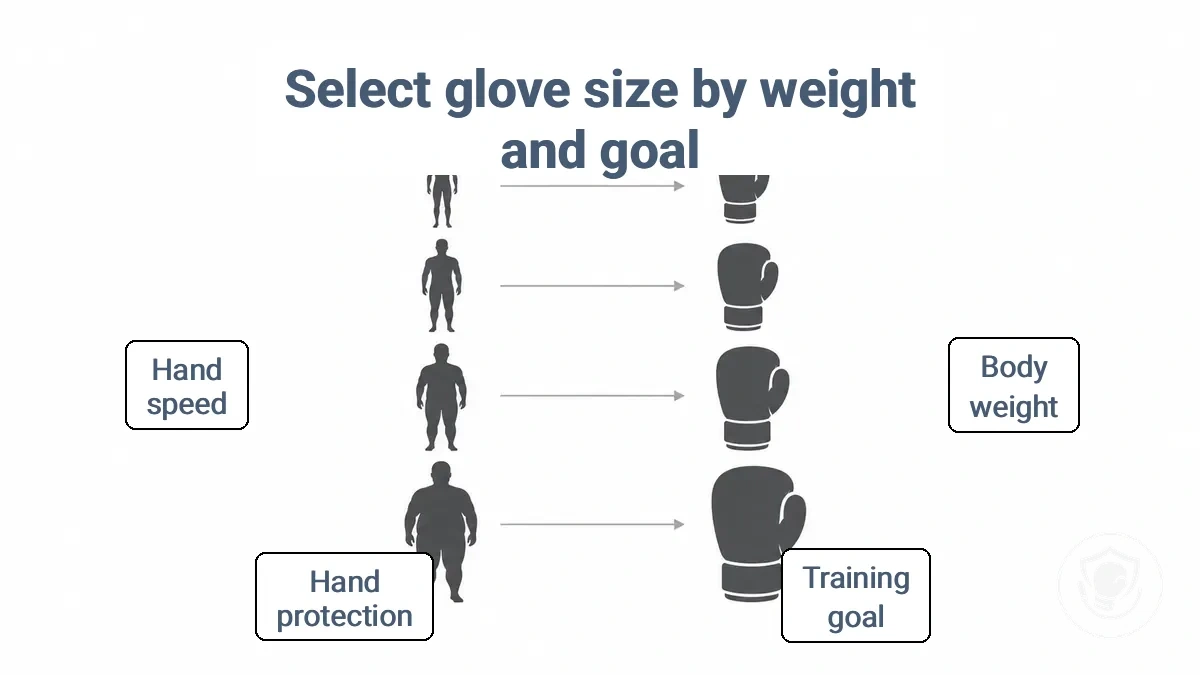
Fit varies, so your starting range involves a trade-off between hand protection and speed.
- Choose higher within the range when you prioritize hand protection or have larger hands.
- Choose lower within the range when you want faster hand speed or have smaller hands.
If you land between two weight bands, try the larger ounce first for safety, then adjust based on feel.
Choosing between adjacent sizes when you land between chart ranges
When you land between adjacent sizes, the tie-breaker is your training goal and how the glove feels during movement, not the chart alone. Use the checklist to decide.
For a 14 vs 16 decision, if the smaller size fits but the wrist lock feels loose, size up; if wraps feel tight, size down.
- Wrap volume: After wrapping, the glove should fit snugly without pressure. If wraps bunch or restrict movement, size down for better internal movement.
- Wrist stability: The wrist lock should hold securely without a gap. If the lock feels loose, size up for stability.
- Fist-closure comfort: You should be able to close your fist fully without resistance. If fingers feel cramped or the glove bunches, size down.
- Internal movement: Your hand should not shift inside the glove when you punch. If it does, internal movement is excessive and size down helps; a locked-in feel signals a good fit.
Fit checks that work: finger length, knuckle pocket, thumb position, and wrist lock
A good fit gives you a stable wrist lock and hand position, with minimal numbness or sharp pressure points, and lets you form a natural fist with aligned padding. Check the zones in order.
Fit checks that work start with consistent hand wraps and closure tension for repeatable comparisons. The image labels the zones — fingers, knuckles, thumb position, and wrist lock.
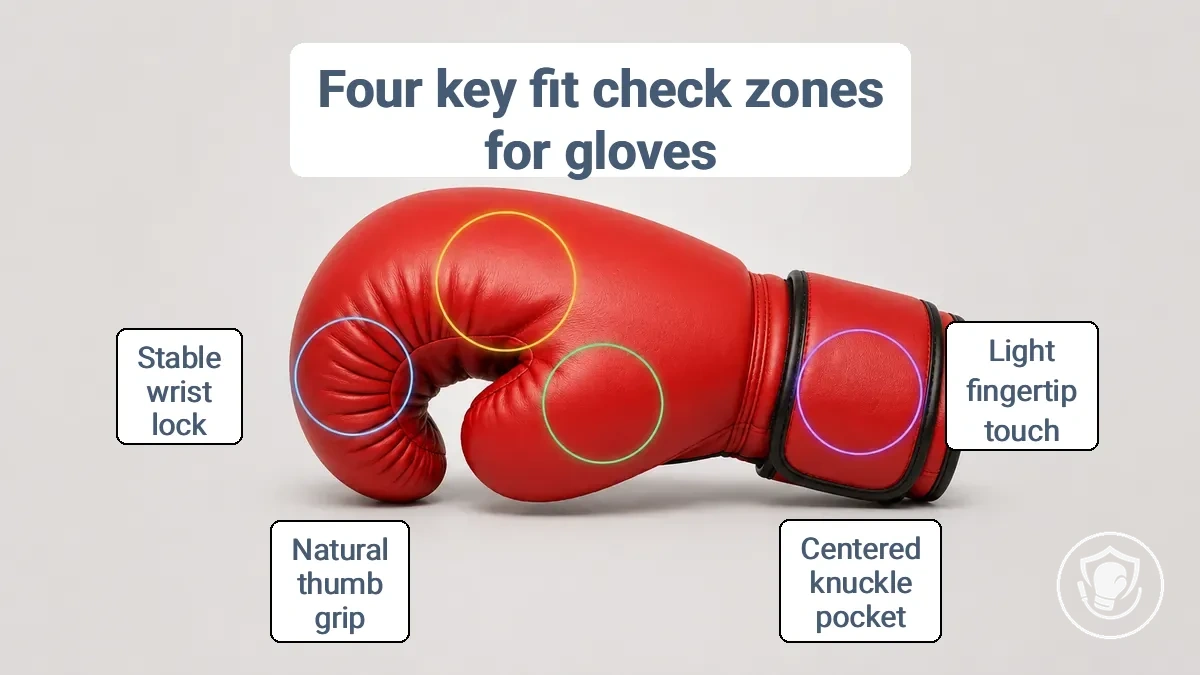
Snugness is normal; unsafe tightness can cause numbness or sharp pressure. Don't mistake initial snugness for a bad fit — use the zone checks next.
- Fingers
- Fingertips should lightly touch the glove's end without bending back — light press is normal, excessive pressure may mean the glove is too short. (good sign if light touch)
- Cramped or numb fingers often point to incorrect pocket depth. (adjust needed)
- Check finger length with a loose fist; forced bending often means the glove is too short. (good sign if natural curl)
- Knuckles
- When you clench a fist, your knuckles should sit centered in the padding pocket. Off-center placement may reduce protection. (good sign if centered)
- Sharp pressure points on the knuckles often mean the pocket is too narrow or shallow. (adjust needed)
- The knuckle pocket should feel padded but not compressed; bunching padding may indicate a loose glove. (good sign if even)
- Thumb
- The thumb position should allow a natural grip without rubbing against the inside seam. (good sign if smooth)
- A thumb slot that presses into the side of your thumb or causes friction may signal poor alignment. (adjust needed)
- Thumb numbness after a few minutes of wear can indicate a too-tight thumb compartment. (adjust needed)
- Wrist
- A stable wrist lock comes from straps that tighten evenly without restricting circulation. (good sign if no gaps)
- A glove that shifts when you punch or a loose wrist means increasing closure tension or trying a different cuff style. (adjust needed)
- The glove should stay in place during movement; any rotation signals poor fit. (good sign if firm)
Quick fit checklist before your first session
This quick fit checklist confirms your gloves are ready before your first session. Run the checklist once.
- Fist closure: Fingers curl fully into the palm with knuckles comfortably aligned — pass if snug and no pinching.
- Thumb comfort: Thumb rests naturally without strain and does not force your hand out of position — pass if relaxed.
- Wrist lock stability: When the wrist strap is locked, the glove stays secure and does not shift when you rotate your hand — pass if firm.
- Shift under light simulation: Make light simulated punch motions; the glove should not shift or rotate — pass if it stays in place.
- Glove alignment: Padding sits centred over your knuckles and cuff wraps evenly around your wrist — pass if centred.
If any check fails, adjust the fit or try a different size instead of forcing break-in.
Small hands: preventing slide and loss of control without cutting circulation
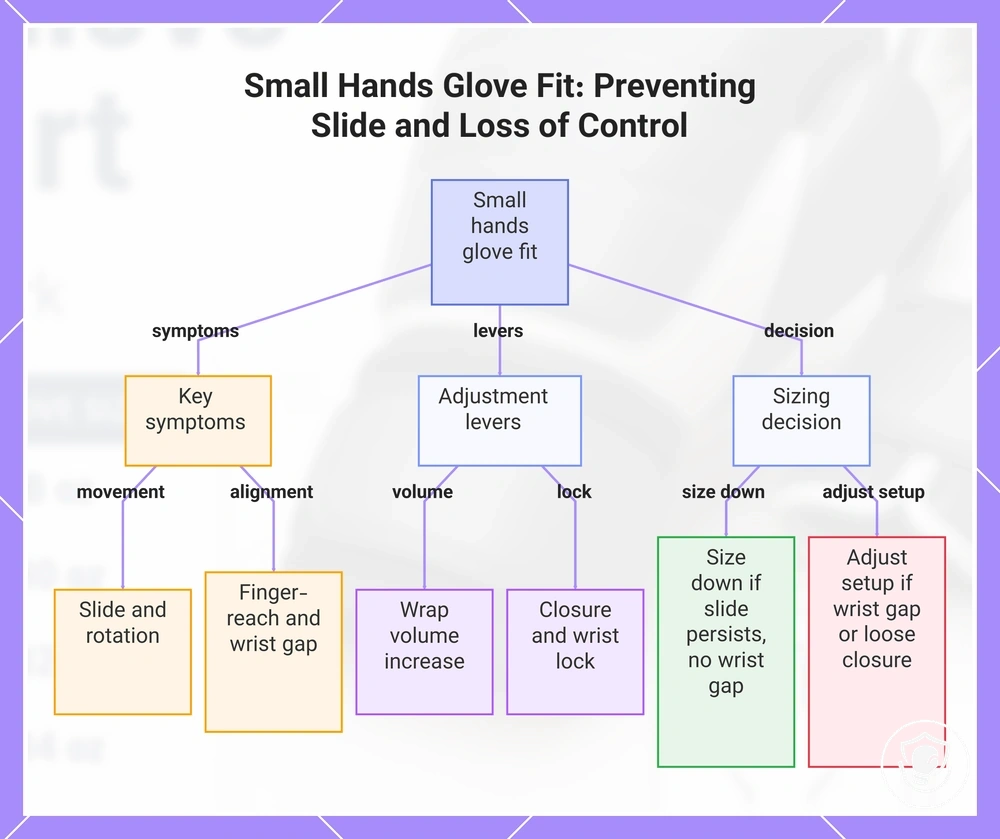
For small hands, the core fit issue is internal movement and an unstable wrist feel, which causes slide and loss of control, not the glove's weight alone. When the hand rattles or rotates during impact, treat it as a volume + lock problem, not a weight problem.
A fit mismatch can sometimes feel like a circulation problem. Numbness or tingling may signal pressure from a wrist gap or over-tightened closure rather than cold. Separating symptoms from causes helps you choose the right adjustment.
- Symptoms of a poor small‑hand fit:
- Slide – the hand shifts inside the glove on impact.
- Rotation – the glove twists around your hand mid‑punch.
- Finger‑reach mismatch – fingertips do not press into the pocket.
- Wrist gap – space between your wrist and the glove’s cuff.
- Adjustment levers that can improve lock without cutting circulation:
- Wraps – thicker or more targeted wrapping fills internal volume.
- Closure tension – tightening the wrist strap can stop rotation.
- Wrist lock – securing the cuff against the forearm can stabilise the glove.
- Sizing step – going down a half size may help if wrap volume alone does not remove the hand rattle.
Size down when the hand still slides after increasing wrap volume and there is no wrist gap – a smaller glove reduces internal space and can stop rotation. Adjust the setup when the slide comes from a wrist gap or the closure feels loose regardless of wrap; improving wrist lock and closure tension may be safer than forcing a smaller size. Use the symptom pattern: if fingertip reach is correct but the palm moves, sizing down is often effective; if fingertips curl or the wrist gap persists, refine wraps and closure first.
This chart shows the key symptoms of poor small-hand glove fit and the adjustment levers to improve lock without cutting circulation, including when to size down versus adjust wraps and closure.
Large hands: avoiding pressure points, thumb crowding, and restricted fist closure
For boxers with large hands, the primary fit challenge is not simply selecting a higher oz glove but ensuring internal volume channels do not concentrate pressure or restrict fist closure. When the knuckle pocket is too shallow or the finger compartment too narrow, the hand becomes cramped even if the overall size range matches. These constraints can create hotspots along the thumb channel, and volume channels can be limiting.
Many assume that matching the recommended size range alone ensures comfort. However, internal pocket and channel dimensions may still produce thumb crowding or numbness cues, especially when the hand fills the glove differently than expected.
- Knuckle pocket: Shallow or narrow knuckle pockets can concentrate pressure on the knuckles during impact.
- Pressure points: A tight pocket often creates focal pressure points across the back of the hand, especially near the index and middle fingers.
- Fist closure: If the glove’s internal length is too short, the fingers may not curl fully, which can lead to a restricted fist and reduced punch alignment.
- Thumb channel: A narrow or shallow thumb channel can cause thumb crowding.
- Rubbing and comfort: Persistent rubbing along the thumb webbing area often signals that the thumb channel needs more width or a different curvature.
- Finger compartment: When four fingers are cramped side by side, the compartment may force the hand into a splayed position, reducing control and increasing pressure between fingers.
- Wrist entry: A tight wrist opening can compress the hand’s base, causing discomfort that may radiate into the palm and can limit wrist mobility during punches.
- Volume mismatch: Even if the hand fits the length and width ranges, an overly tight internal volume (especially in the palm area) can still produce numbness cues and hinder hand closure.
This chart shows the main fit issues for boxers with large hands, including pressure points, closure restrictions, and internal volume problems.
When gloves feel wrong after sizing: tightness, looseness, and wrist instability patterns
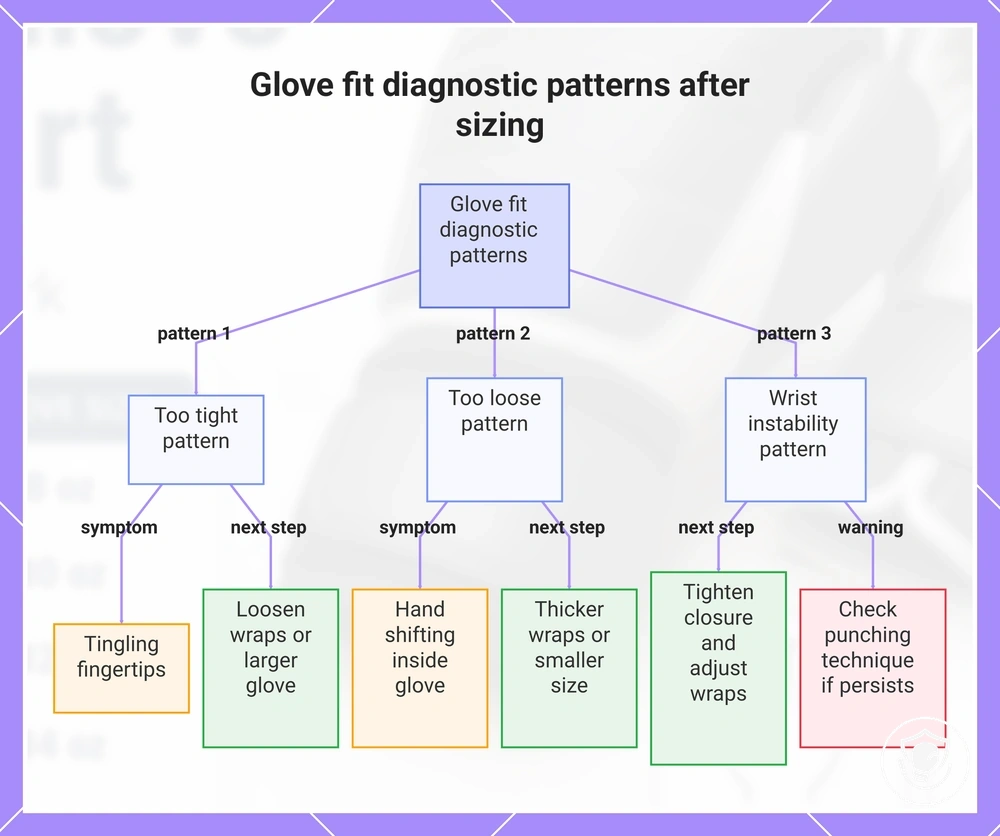
When gloves feel wrong after sizing, classify the issue as too tight, too loose, or wrist instability before making any adjustment. Each pattern points to a different cause and a different safe adjustment order. Pick the closest pattern from the diagnostic list.
Glove fit problems usually start with wraps, internal volume, or closure tension; check wraps first, then internal volume, then closure tension. The diagnostic list organizes these symptoms into likely causes and the safest next adjustment for each pattern.
If unstable wrist feel persists after adjusting fit, it may come from punching technique rather than glove fit — see our guide to reduce wrist pain from punching.
A common myth is that break-in resolves any initial tightness. In truth, persistent numbness or sharp pain often means the fit is unsafe and break-in may not correct it, so change your size or setup rather than forcing through discomfort.
- Tingling fingertips — likely too tight from wraps or insufficient internal volume — safest next change: loosen wraps or try a larger glove.
- Hand shifting inside the glove — likely too loose from excessive internal volume — safest next change: use thicker wraps or a smaller size.
- Unstable wrist feel during impact — likely weak closure tension or poor wrist lock — safest next change: tighten closure and adjust wraps to lock the wrist.
- Pinching across the knuckles — likely too tight from low internal volume — safest next change: change wraps for thinner material or size up.
- Thumb joint pain — likely too tight in the thumb compartment — safest next change: check thumb placement and closure tension; try a different glove shape.
- Wrist gives way when punching — likely insufficient closure tension causing wrist instability — safest next change: add wraps for wrist support and tighten closure.
- Numbness that persists after loosening — likely chronic compression from too-tight fit — safest next change: remeasure hand size and select correct glove based on full hand circumference.
- Pain on the back of the hand — likely too tight from closure tension or low internal volume — safest next change: loosen closure and assess wrap thickness.
This chart shows how to classify glove fit problems into three patterns and find the safest next adjustment.
What to do when gloves are too tight without relying on unsafe break-in
When gloves cause numbness, sharp pressure, or restrict circulation, the fit is too tight and requires setup changes, not break-in. The goal is to restore circulation and allow full fist closure without strain.
- Adjust wrap thickness – too much wrap crowds the glove and can cut off blood flow.
- Ease closure tension – loosening the strap or lace creates more room inside without altering the glove itself.
- Move up one size step – if fit checks still fail after wrap and closure changes, a larger size is the recommended fix.
- Re-run fit checks – after each adjustment, test for numbness, pressure points, and full fist closure to confirm the change works.
Mild snugness that softens with wear is normal; persistent compression that leaves deep marks or causes tingling is not.
What to Do When Gloves Feel Loose or Shift During Punches
When gloves feel loose or shift during punches, the cause is usually excess internal volume or an insufficient wrist lock rather than an oz weight mismatch alone. Test stability with light shadow movements before deciding the size is wrong. If adjusting your wraps and closure tension stops the shift, the size is likely correct; if rotation or shift continues, a smaller size may be needed.
- Properly wrapped hands fill internal volume and improve wrist lock — if shifting stops after rewrapping, wraps may have been the issue (more stable).
- Make sure closure tension is snug; a loose strap or lace can allow the glove to rotate on impact — if rotation decreases, closure may have been the problem (more stable).
- Check wrist alignment: if the glove permits wrist bending during extension, shift may occur — correcting alignment should reduce movement (still shifting).
- Check whether the glove rotates around your hand when you flex and extend your fingers — rotation indicates excess internal volume or poor wrist lock (still shifting).
- Make a fist and check if your hand slides inside the glove — if it does, add wraps or tighten closure to occupy space (more stable).
Sizing mistakes that cause poor fit: wrong baseline, missing wraps, and misreading wrist support
A common mistake is choosing a glove by oz or chart alone without validating fit signals. Use this to avoid repeat fit failures.
If fit issues persist, revisit baseline and chart inputs; if the glove still feels off, re-check fit with wraps before assuming size is wrong.
- Baseline measurement errors – Measure hand circumference and length with a flexible tape before consulting a chart.
- Oz-only choice – Picking gloves by weight alone may ignore hand shape; pair weight with fit validation.
- Chart-only choice – Relying on a chart without personal measurements can lead to mismatch.
- Skipping wraps when you plan to use them – Wraps add volume; measure with wraps on to avoid compression.
- Overtightening to compensate for internal volume mismatch – Overtightening can restrict blood flow; correct internal fit first.
- Confusing stiffness with true wrist lock – A stiff glove does not guarantee wrist lock; rely on closure alignment and wrap support.
- Misreading wrist support – Positioning the wrist closure too high or too low can reduce its effectiveness; align with the wrist joint.
This chart shows common sizing mistakes that lead to poor boxing glove fit, grouped into measurement errors, wrap-related issues, and wrist support misinterpretations.