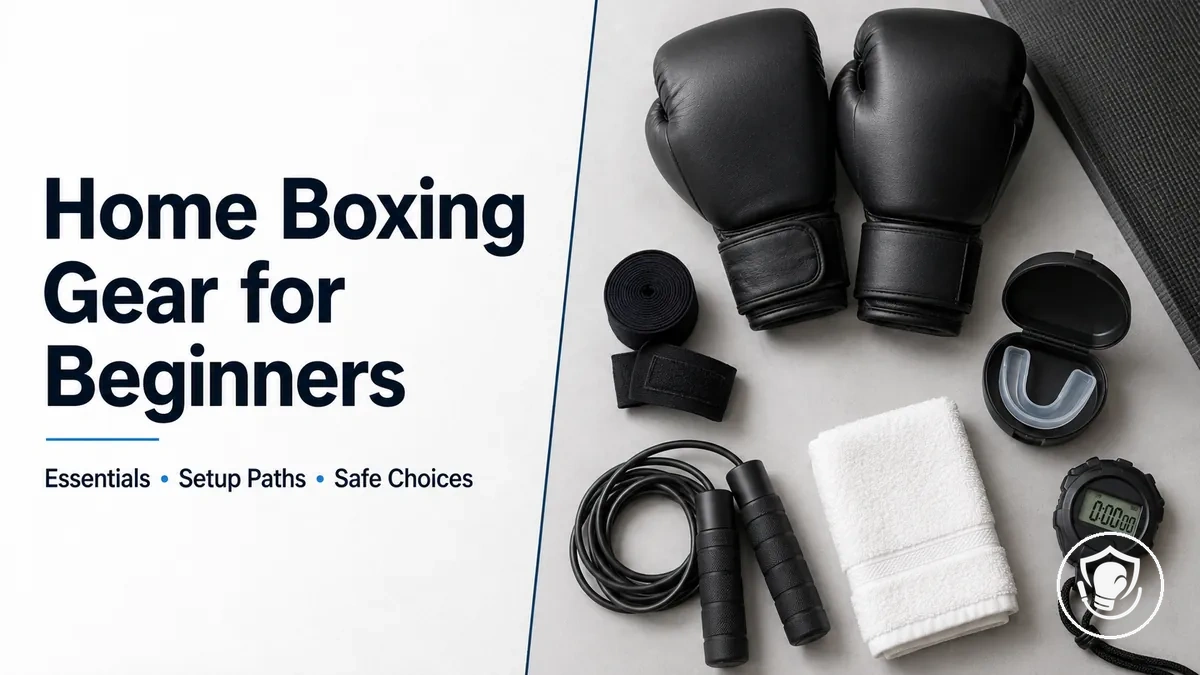
Home Boxing Equipment for Beginners: Essentials, Setup Options, and Safe Choices
Home boxing equipment for beginners refers to the gear needed to start safe, effective striking practice at home without relying on a commercial gym. The goal of this page is to help you decide what to get first, why certain items matter more than others, and how to avoid common setup mistakes. Safe choices in this context mean prioritizing hand and wrist protection, choosing a striking option that fits your space, and buying only what supports consistent training without overextending your budget.
Many newcomers assume they need a full home gym setup with a heavy bag, speed bag, and multiple pairs of gloves before they can start. In practice, a starter kit is much simpler: boxing gloves, hand wraps, a punching bag or training pads, and a mat if you train on hard floors. The rest can be added later as your goals and routine develop. Keeping the scope tight prevents overbuying and reduces the risk of buying gear that does not suit your actual space or training style.
Imagine you are a solo beginner with limited floor space and no prior boxing experience. Your main decisions revolve around which striking option works for your home—a hanging bag, a freestanding bag, or pad work if you have a partner—and how to ensure your hands and wrists stay safe from the first session. Later sections on this page will define what home boxing equipment for beginners includes, how to choose based on your training goal, and what safety checks matter before you start striking.
Your space, noise limits, and training goal will change which equipment makes sense for you, and the following sections will guide those choices with clear criteria. By the end, you should have a clear decision path without feeling pressured to buy everything at once.
What home boxing equipment includes for beginners and what it does not
Home boxing equipment for beginners is the set of protective and practice gear needed to start training safely at home. It covers three training functions: hand and wrist protection, a striking surface (bag, pads, or no-bag drills), and minimal support for consistency. The items fall into two categories: minimum essentials you need from the start and optional add-ons that depend on your space, goals, and training style.
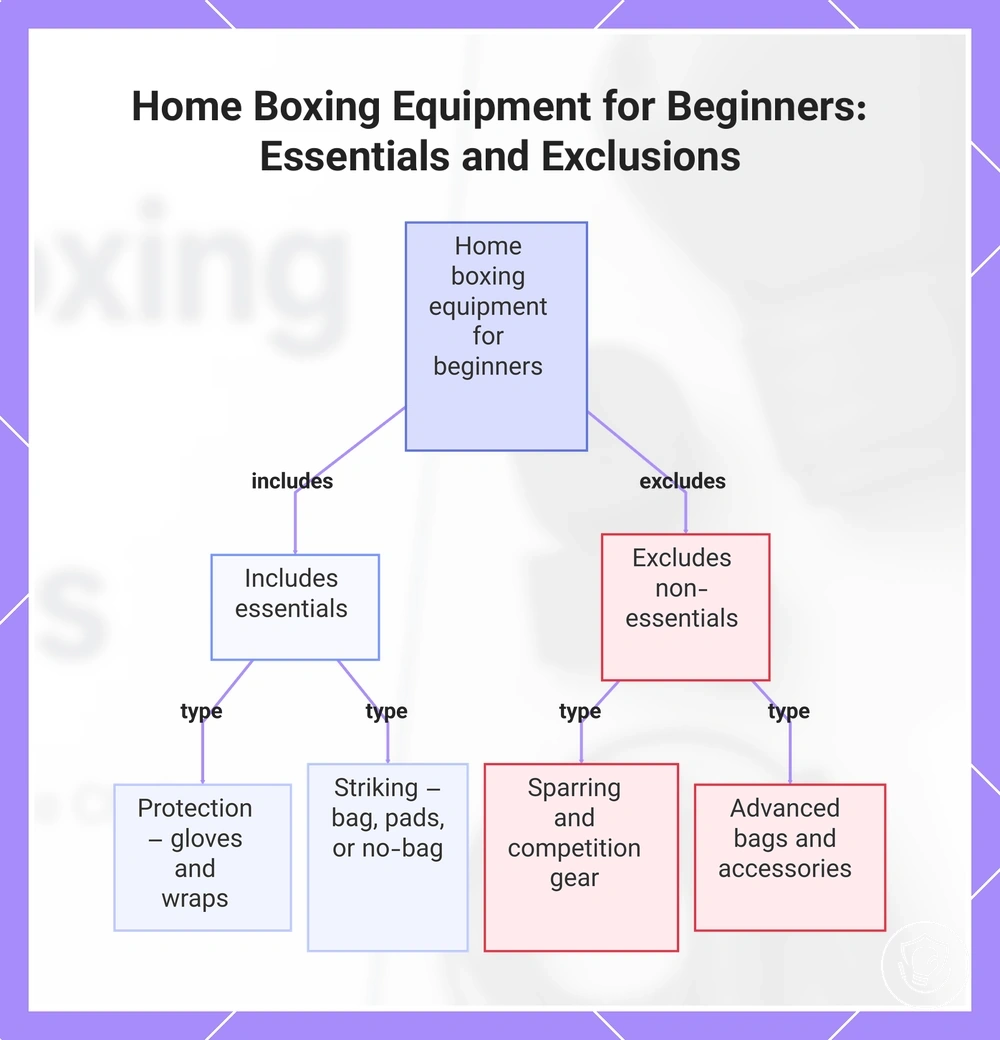
Let us clarify what belongs in each category. Home boxing equipment for beginners includes:
- Protection essentials: boxing gloves and hand wraps for hand and wrist safety.
- A striking practice option: a punching bag, training pads, or a no-bag routine for learning technique.
- Basic floor protection: a mat or non-slip surface for stable footwork.
- A simple timer or round tracker for structured sessions (optional but helpful).
It does not include:
- Competition gloves or headgear designed for sparring and bouts.
- Speed bags, double-end bags, or maize bags used for advanced timing drills.
- Full-body protective gear such as chest guards or groin protectors for non-contact practice.
- Boxing shoes, specialized clothing, or branded gym accessories not tied to the core striking function.
This split matters because it prevents overbuying and reduces the risk of using gear that does not fit a beginner's actual needs. A common mistake is to treat a starter kit like a complete gym shopping list. Most beginners can start with the protection and one striking option, then add support items as their training goals become clearer. That principle guides the essentials checklist in the next section.
This chart shows the essential items home boxing beginners need and the gear they should avoid, answering what is included and excluded from a starter kit.
Beginner home boxing starter kit essentials for at-home practice
For safe at-home practice, the minimum home boxing starter kit for beginners includes protection essentials, a striking practice option, and a few support add-ons. The logic is simple: protect your hands and wrists first, then choose how you will practice striking, and finally add extras for consistency when needed.
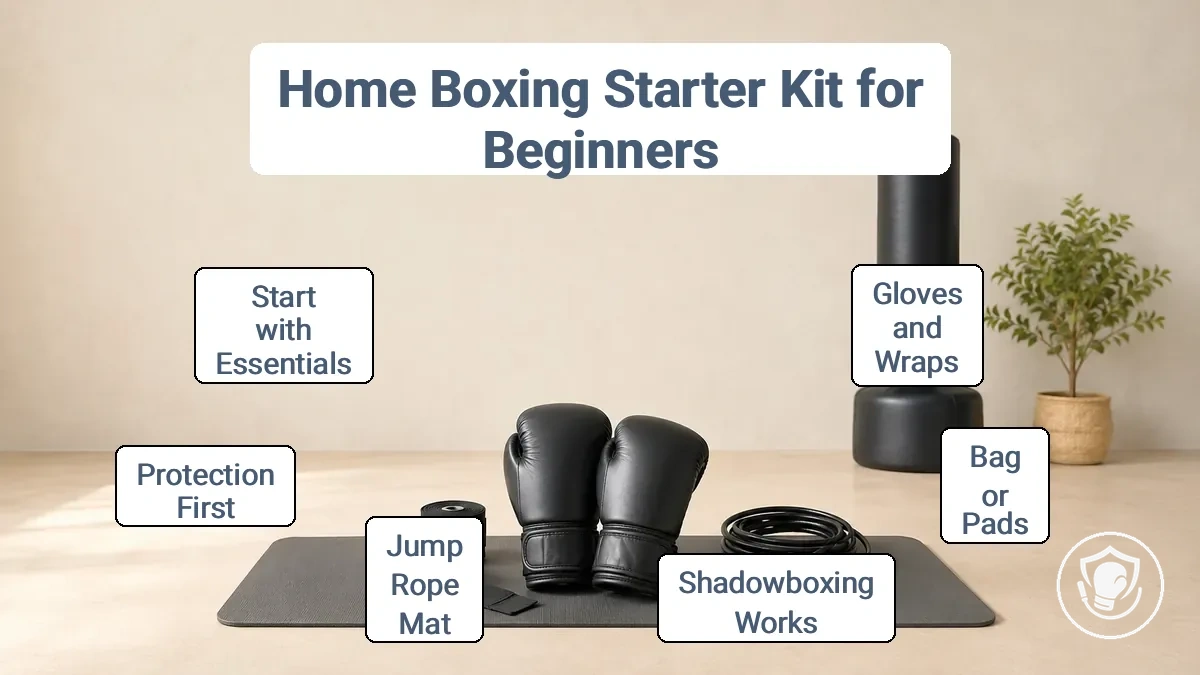
Below is a checklist that groups starter kit essentials by training function:
- Protection: Boxing gloves – padded, with wrist support; 12–14 oz is a common starting weight.
- Protection: Hand wraps – stabilize wrist and knuckles; 180-inch cotton wraps are a standard choice.
- Protection: Wrist support – built into wraps or separate brace for added stability.
- Practice option: Heavy bag – builds power and stamina; needs ceiling mounting or a stand.
- Practice option: Focus mitts or pads – require a training partner but allow controlled movement.
- Practice option: No-bag training (shadowboxing) – works on form and footwork without any equipment.
- Support: Jump rope – for warm-up and coordination.
- Support: Training mat – improves floor grip and protects surfaces.
Hands and wrists are a common concern for beginners, which is why boxing gloves and hand wraps form the foundation of any starter kit. Boxing gloves provide padding to absorb impact, while hand wraps stabilize the wrist and knuckles. Together, they can help reduce the risk of strains and soreness that can discourage new practitioners. For a complete breakdown of what to look for in protection gear, see our beginner home boxing essentials checklist.
You need at least one way to practice striking at home. The most common options are a heavy bag, training pads, or no-bag training. Heavy bag training builds power and stamina but requires ceiling mounting or a stand. Pads need a training partner but allow more control over movement. No-bag training, such as shadowboxing, works on form and footwork without any equipment. Choose the path that fits your space, budget, and whether you train alone.
If you want to build consistency, a jump rope and training mat are useful support add-ons. Wait until your protection gear and striking practice path are in place.
- Minimum to start: Boxing gloves and hand wraps. Smart add-on later: Bag gloves if you start heavy bag training.
- Minimum to start: One striking method (bag, pads, or no-bag). Smart add-on later: A second striking method for variety.
- Minimum to start: Basic jump rope. Smart add-on later: Training timer and conditioning accessories.
Hand and wrist protection essentials: gloves, wraps, and support options
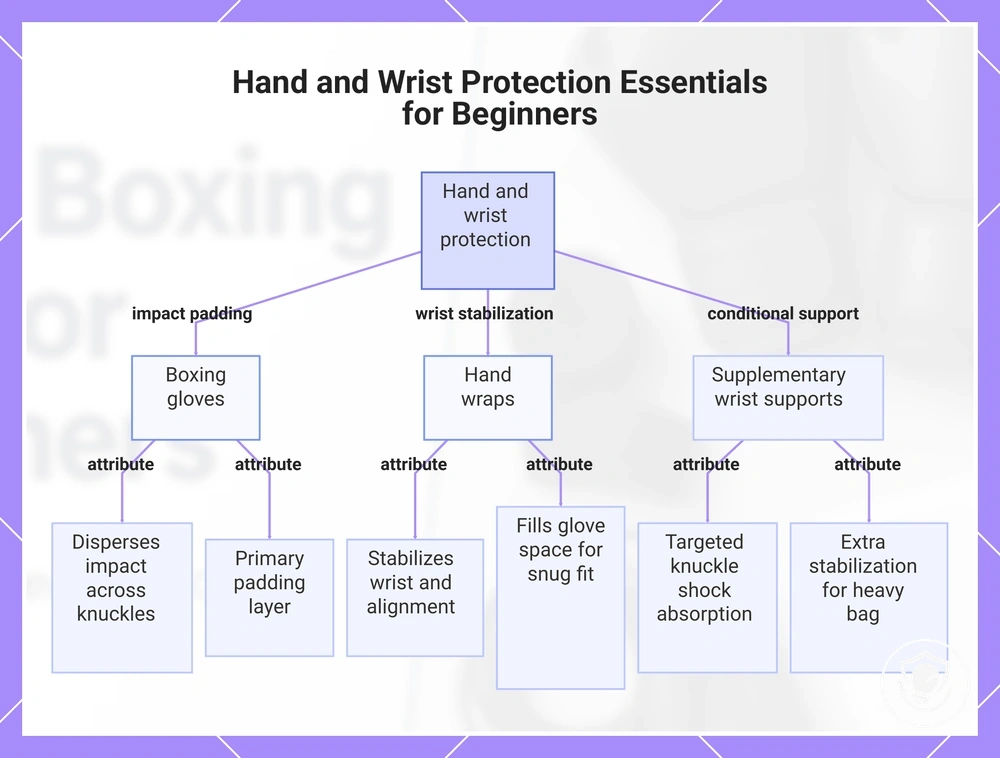
For beginners training at home, the main protection goal is reducing avoidable hand and wrist injuries through proper impact absorption, alignment, and joint stability. Beginners who are still developing punching form can benefit from a protective setup that manages forces transmitted through the knuckles and wrist during bag or pad work. Boxing gloves, hand wraps, and supplementary wrist supports each play distinct roles in creating that protection.
Boxing gloves provide the primary layer of padding, dispersing impact across a larger surface to shield the knuckles and hand bones. However, gloves alone do not stabilize the wrist against hyperextension. Hand wraps secure the wrist joint, support hand alignment, and fill empty space inside the glove for a snug fit. Together, gloves and wraps form a paired system that addresses both impact absorption and wrist stability. For a closer look at when wraps specifically matter, see do beginners need hand wraps.
Some training situations may benefit from additional wrist support beyond standard wraps, such as gel-padded wrap-style supports or neoprene wrist braces. These can be relevant when a beginner experiences wrist fatigue during longer sessions or needs extra stabilization for heavy bag work. A gel wrap adds targeted shock absorption for the knuckles while an adjustable strap reinforces the wrist, but these add-ons are conditional—they can be helpful but are not a replacement for proper glove fit. For details on how glove padding and closure types influence protection, see glove protection and use-cases. Here is a summary of the roles these hand and wrist protection essentials serve:
- Boxing glove padding → Distributes impact force → Can reduce shock to knuckles and hand bones during repeated strikes.
- Hand wraps (cotton or elastic) → Stabilize the wrist and support hand alignment → Can lower the risk of hyperextension and small-bone misalignment.
- Adjustable wrist strap (on wraps or gloves) → Can provide customizable compression → Helps maintain wrist stability when properly adjusted.
- Gel or neoprene padded inserts → Adds targeted shock absorption for knuckles → Can be useful for beginners increasing bag work volume.
- Quick-slip wrap design → Simplifies pre-training setup → Can encourage consistent use of hand protection before each session.
This chart shows the main types of hand and wrist protection gear for beginner boxers, their roles in impact absorption and wrist stability, and optional supplementary supports.
Striking practice options at home: heavy bag, pads, and no-bag training
Heavy bag, pads, and no-bag training serve different purposes and come with distinct home constraints. The choice depends on space, noise tolerance, mounting availability, partner access, and feedback needs.
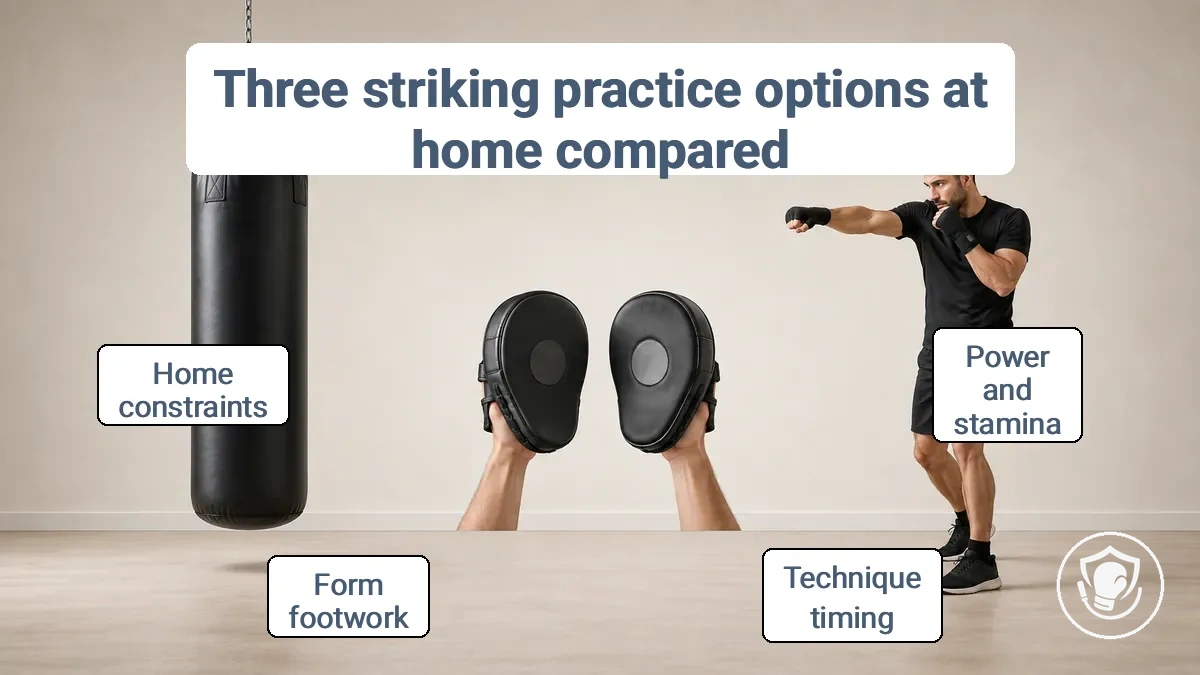
The table compares these striking practice options by training focus, home constraints, and main trade-offs.
| Option | What it trains best | Home constraints | Main trade-off |
|---|---|---|---|
| Heavy bag | Power, stamina | Space, noise, mounting | No live feedback |
| Pads | Technique, timing | Partner needed | Limited solo use |
| No-bag | Form, footwork, low impact | No equipment needed | Less resistance, conditioning |
If you have limited space and no partner, a heavy bag (with proper mounting) or no-bag shadowboxing may be more realistic. If you train with a partner, pads offer direct feedback and controlled intensity. Heavy bag training can reinforce poor habits without mindful practice, while no-bag training can complement bag work but may not build the same conditioning. For a more detailed breakdown of these trade-offs, see the heavy bag vs pads decision guide.
Training support add-ons that improve consistency: timing, conditioning, and floor grip
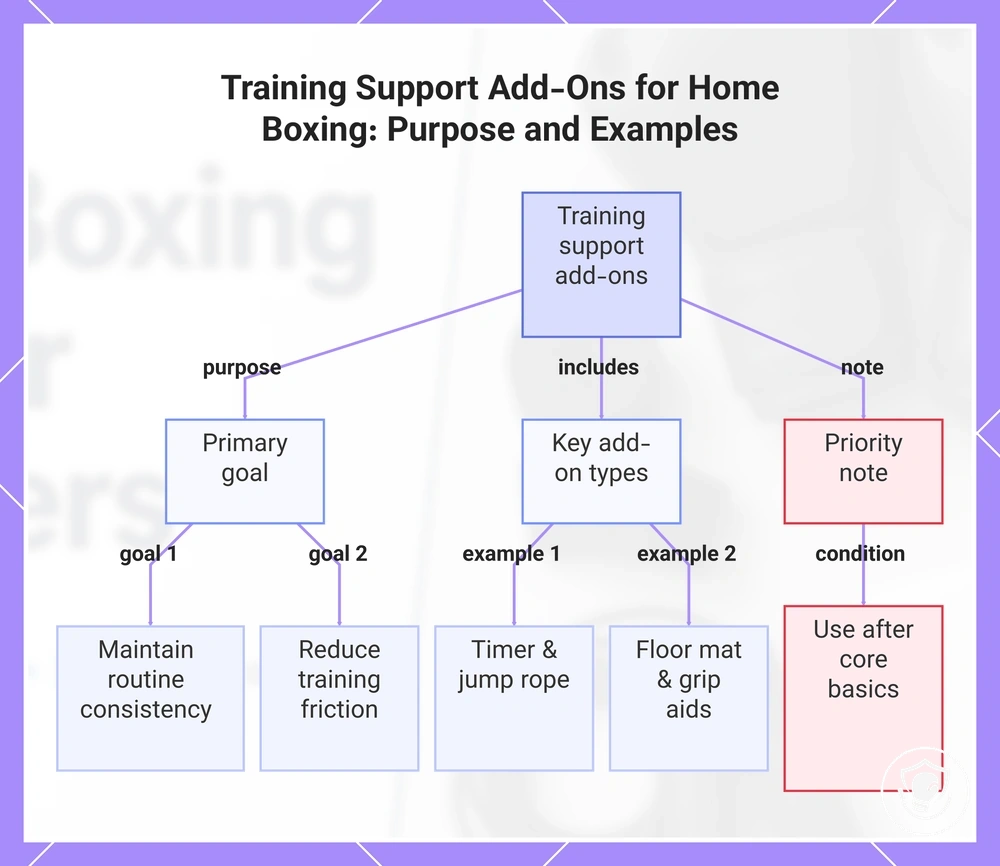
Support add-ons for home boxing equipment are supplementary items that help maintain routine consistency and reduce friction during training, but they are not required for safe practice. These items address common factors that interrupt flow, such as losing track of round timing, slipping on a smooth floor, or skipping a warm-up. Consider them only after the core protection basics—gloves, wraps, and a striking target—are in place.
Training support add-ons help with recurring distractions that can interrupt focus:
- Round timer: Helps maintain structured workout intervals and prevents guesswork on rest periods.
- Floor exercise mat: Provides a stable, non-slip surface that reduces shifting and protects flooring.
- Jump rope: Supports conditioning and coordination as a warm-up or finisher without requiring extra space.
- Grip-enhancing socks or hand chalk: Reduces unwanted slipping during dynamic moves, especially on smooth floors.
Keep the add-on set minimal; adding too many extras before mastering protection and technique can delay progress.
This chart shows the main purpose of training support add-ons for home boxing, their key examples grouped by function, and the recommended priority—using them only after core protection basics.
Choosing a home boxing setup path that matches your goal and constraints
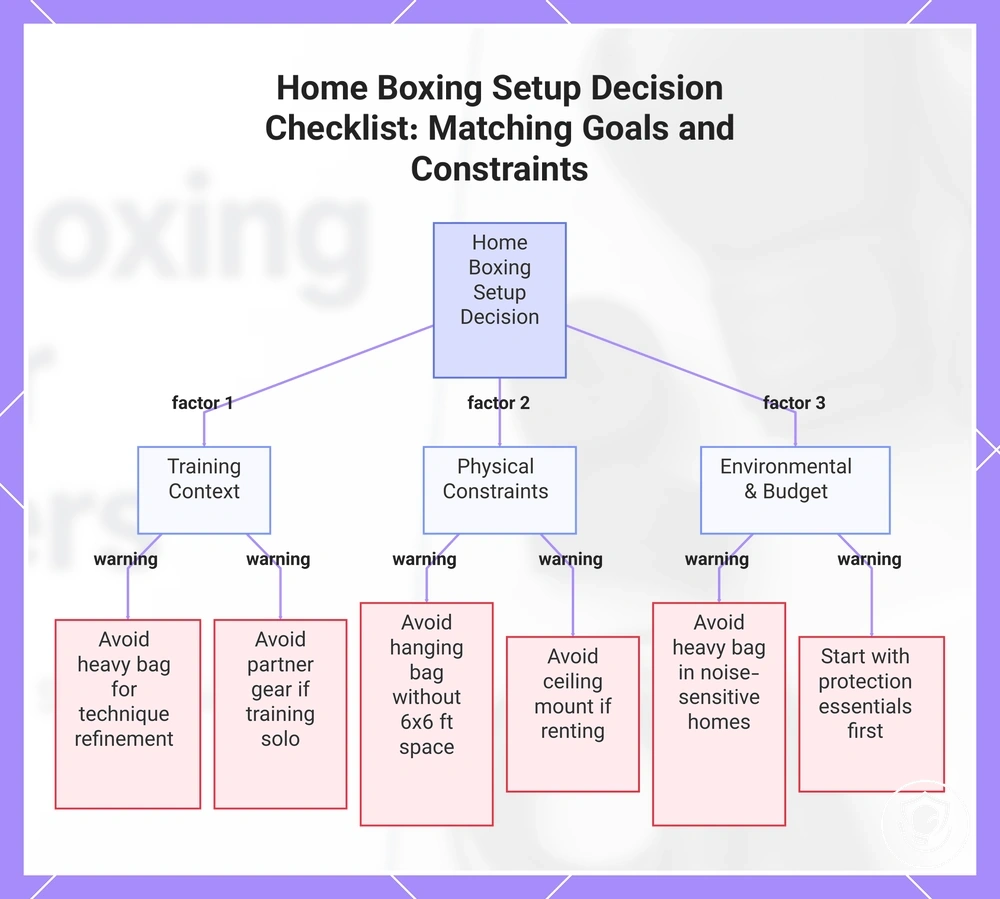
Choosing a home boxing setup path starts with matching your training goal to your home constraints. The two deciding factors are what you want from training and what your space, noise limits, and mounting options allow.
A decision checklist maps each training goal and constraint to a compatible setup path, separating what you need from what you can add later. Use this to avoid overbuying.
Without first defining their goal and space limits, beginners often buy gear that does not fit their training context. The checklist turns those unknowns into clear, practical choices before you commit to a setup.
- What is your primary training goal? — Determines whether a heavy bag, pads, or no-bag approach suits your focus — Avoid buying a heavy bag if your goal is technique refinement rather than power work.
- How much open floor space can you dedicate to training? — Decides whether a hanging bag, freestanding bag, or bag-free layout is workable — Avoid a hanging bag if you cannot clear at least a 6x6 ft area for safe movement.
- Is mounting equipment into walls or ceiling an option? — Affects whether you install a hanging bag or choose a freestanding alternative — Avoid ceiling mounts if you rent or cannot locate a suitable beam.
- Does noise from bag work affect neighbors or housemates? — Points toward quieter options such as freestanding bags, pads, or shadowboxing — Avoid heavy bag setups in noise-sensitive homes without vibration dampening.
- Do you train alone or with a partner? — Changes whether pads and focus mitts are practical additions — Avoid investing in partner gear if you train solo most sessions.
- What is your budget for the initial gear? — Sets whether you start with a full kit or a minimal set with upgrade room — Avoid overspending on accessories before covering protection essentials like gloves and wraps.
A setup path is not a training routine—it guides what to buy and where to place equipment, not how to schedule workouts. Start with gear that fits your space and goal, then adjust as your training evolves.
This chart shows the three main decision factors for choosing a home boxing setup and key warnings for each factor to avoid common mistakes.
Equipment choices that change by training goal and practice style
Your training goal shapes which equipment priorities are most relevant for a beginner home boxing setup. Common beginner goals include general fitness boxing, technique and consistency work, and high-intensity conditioning.
The table maps each goal to the corresponding equipment emphasis and trade-offs. Use the priorities, not labels, when planning your setup. For a closer look at how priorities shift by activity, choose gear by your training goal.
| Goal/style | Priority attributes | Equipment emphasis | Common trade-off |
|---|---|---|---|
| General fitness / conditioning | Calorie burn, consistency, full-body engagement | Heavy bag, jump rope, floor mat | Space and noise can be higher; requires more room |
| Technique & skill development | Hand positioning, footwork, accuracy | Focus mitts (with partner), reflex bag, shadow boxing | Often requires a training partner for pads; lower impact |
| Stress relief & basic cardio | Ease of setup, low learning curve, minimal equipment | Free-standing bag, gloves, wraps | Limited intensity progression; bag may not be as responsive as pads |
For example, a beginner whose primary goal is calorie burn and fitness may prioritize a heavy bag and jump rope for interval-style training, accepting the need for more space and noise management.
Equipment choices that change by space, mounting limits, noise, and floor stability
The equipment that suits a home boxing setup depends on the space available, the mounting possibilities, the noise your surroundings tolerate, and the stability of your floor. These four constraints—space, mounting, noise, and floor stability—determine which bag types, support gear, and accessories are practical in your home.
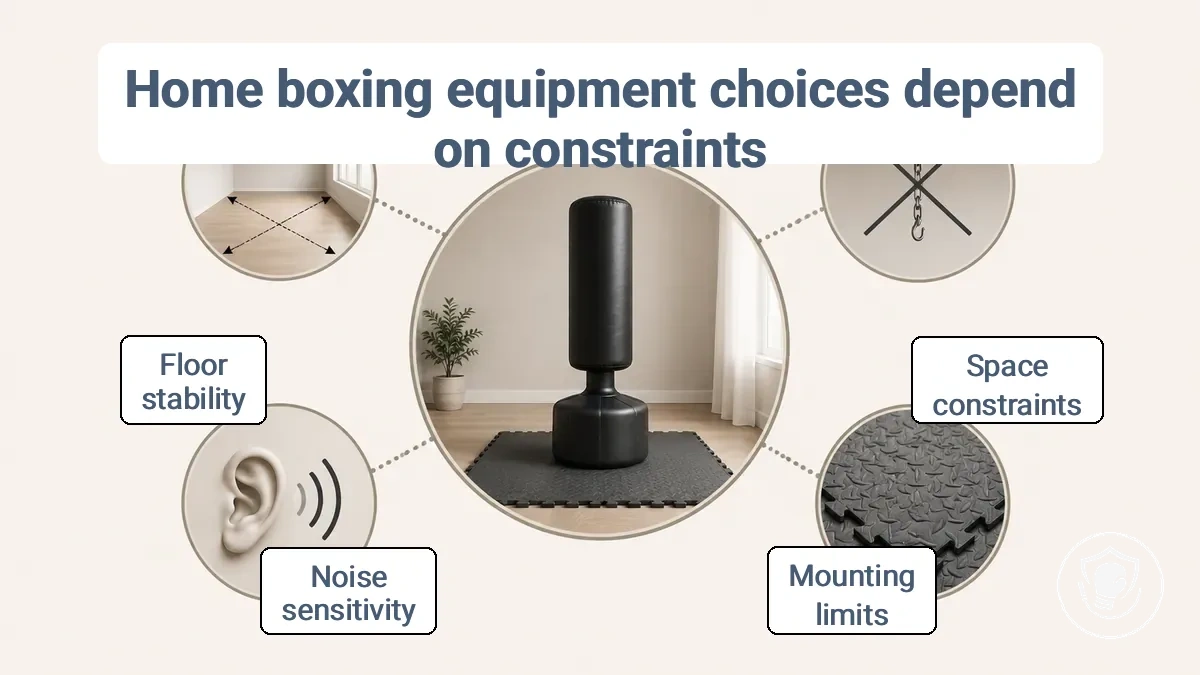
Mapping each constraint to compatible options helps avoid mismatch purchases.
| Constraint | What it limits | Better-fitting option types | Trade-off to accept |
|---|---|---|---|
| Space | Available footprint and clearance for bag swing and movement | Compact freestanding bag, wall-mounted pad, no-bag training | Reduced striking range or partner dependency |
| Mounting limits | Ability to install a hanging bag or wall-mounted units | Freestanding punching bag, floor-mounted stand | Larger floor footprint, potential instability if base is not weighted |
| Noise sensitivity | Impact noise from the bag and vibration transferred to floor or walls | Padded focus mitts, no-bag training, vibration-isolation pads under bag stand | Less realistic striking feedback and often requires a training partner |
| Floor stability | Protection of the floor surface and absorption of impact shock | Interlocking foam mats, rubber gym flooring tiles | Additional cost, and heavy bag impact may still transfer vibration |
Some people assume that buying quieter gear or adding floor protection solves all noise and vibration issues, but actual results vary by building construction and setup details. Using vibration isolation pads under a bag stand and placing thick rubber mats under the training area can reduce transmitted noise, but they may still produce noticeable impact sound from a heavy bag. For example, a compact freestanding bag on multiple foam layers may be tolerable in a ground-floor apartment, but the same setup might still disturb neighbours above. A small-space planning guide—such as our small space home boxing setup—provides more detail on fitting gear to your layout. Keep in mind that space fit addresses physical constraints, while goal fit, covered in a separate section, addresses training purpose; they are two different decisions.
Safety basics for beginner home boxing equipment: reducing hand and wrist injury risk
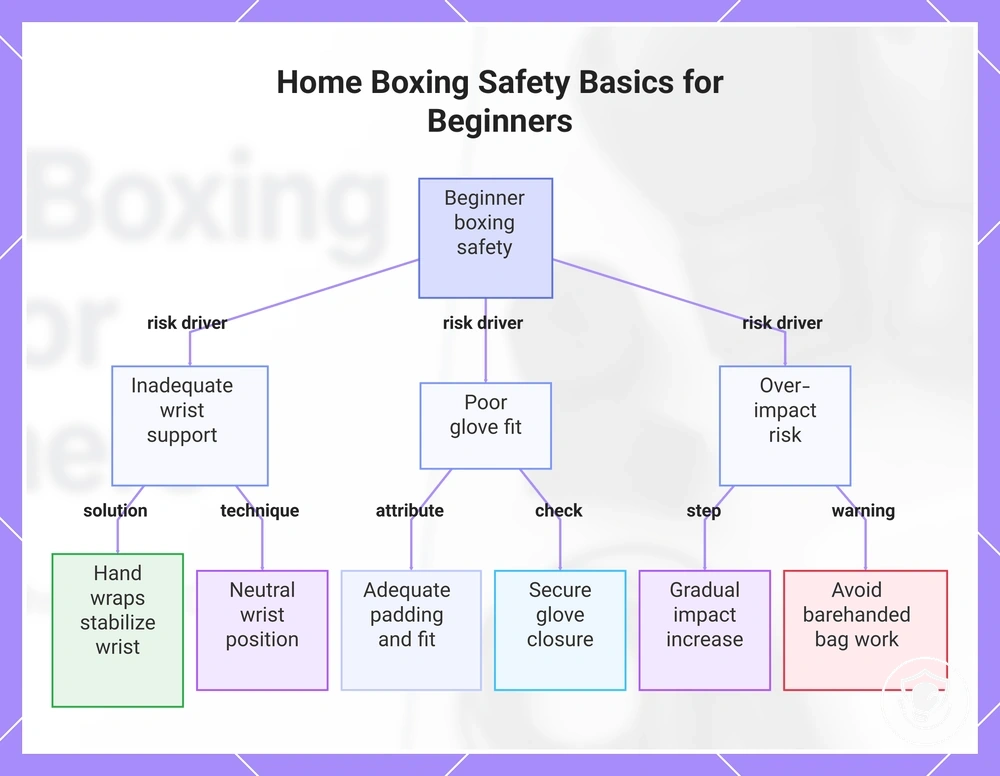
The safety objective for beginner home boxing equipment is to reduce avoidable hand and wrist injuries through proper fit, adequate support, and appropriate impact exposure. Protecting the hands and wrists starts with choosing gear that matches your hand shape and training intensity, then using it correctly. Avoiding common mistakes such as poor fit, insufficient support, too much impact too soon, or an unstable setup can reduce the likelihood of injury.
Beginners often overlook how quickly hand and wrist issues develop when equipment does not fit or support properly. Wrist strain, knuckle soreness, and even small fractures can result from gloves that are too loose or too tight, hand wraps that do not stabilize the wrist, or hitting a bag with excessive force before the hands are conditioned. The most common risk drivers are inadequate wrist support, poor glove fit, and over-impact relative to the beginner's current tissue tolerance. Improving fit and support is an effective way to reduce these risks.
Below is a safety checklist that addresses common causes of hand and wrist injuries in home boxing training. Each point maps a common training situation to an injury mechanism and the protective measure that reduces risk:
- Hand wraps: Wrapping the wrists and knuckles adds stability and disperses impact force, reducing the risk of sprains and fractures. Fit should be snug but not restrictive.
- Glove padding and fit: Gloves with adequate padding and a secure closure protect the knuckles and keep the wrist aligned during impact. A glove that fits well limits internal movement that can lead to injury.
- Neutral wrist position: Keeping the wrist straight (neutral) when striking transfers force through the forearm rather than the joint, lowering stress on the wrist. This depends on glove design and punch technique.
- Appropriate impact volume: Beginners should start with moderate bag sessions and increase intensity gradually. Too many hard strikes in one session can overload hand structures before they adapt.
- Avoid barehanded bag work: Hitting a heavy bag without gloves and wraps removes essential protection and increases the risk of hand and wrist injuries, even during light practice.
- Secure glove closure: Velcro or laces must be tight enough to prevent the glove from shifting during punches. Slippage reduces wrist support and can cause misalignment.
- Check wrap technique: Wraps that are too loose fail to support; wraps that are too tight can impair circulation. A proper wrap method stabilizes the wrist without discomfort.
How much these measures help depends on your hand anatomy, the fit of your specific gear, and the volume of training. No single checklist guarantees injury prevention, but following these basics reduces avoidable risk. For a more detailed breakdown of common risks and prevention steps, refer to the dedicated home boxing safety basics guide.
A common misconception is that equipment alone prevents injuries. In reality, equipment reduces risk, but technique—such as keeping the wrist neutral and not overextending punches—plays a separate and equally important role. A safer approach combines well-fitted, appropriately used gear with gradual, technique-focused practice.
Question: Should beginners hit a heavy bag barehanded?
Answer: No. Without gloves and wraps, the hands lack essential impact absorption and wrist support, increasing the chance of sprains, fractures, or bruising.
Question: Do more padding and tighter wraps always mean safer?
Answer: Not always. Excessively thick padding can reduce feedback and encourage poor punch form, while overly tight wraps can restrict blood flow. A safer setup is a glove that fits well with moderate, even padding and wraps applied snugly but not painfully tight.
This chart shows the main risk drivers for hand and wrist injuries in home boxing and the protective measures that reduce those risks.
Beginner fit and support checks that matter before you hit a bag or pads
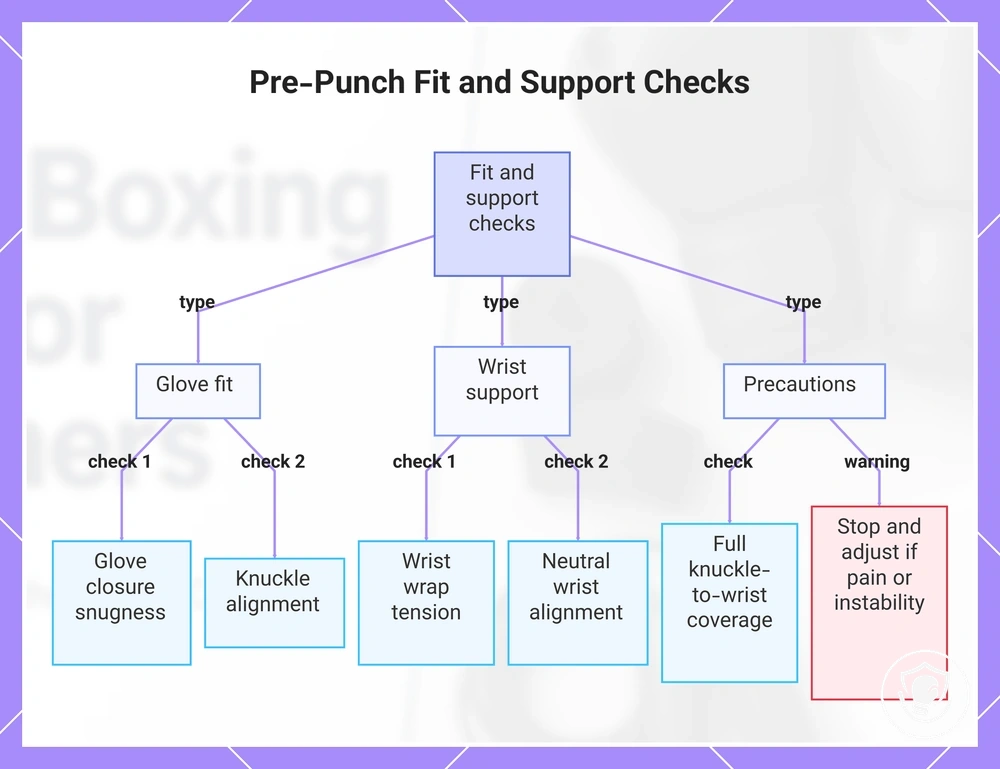
Fit and support checks catch common problems before they lead to hand or wrist strain during bag or pad work. They detect glove slippage, weak wrist alignment, or inadequate wrap tension — conditions that can increase injury risk. Verify these points before your first punch to reduce avoidable discomfort.
Check these points before your first impact:
- Glove closure snugness: The strap should hold the glove firmly around your wrist without excessive looseness. If the glove shifts or rotates during movement, the closure may be too loose — adjust the strap or consider a different size.
- Wrist wrap tension: After wrapping, your wrist should feel supported but not compressed. If the wrap feels too tight or restricts circulation, re-wrap with slightly less tension. If it feels loose and allows wrist movement inside the glove, tighten the wrap.
- Hand wrap coverage: The wrap should cover the knuckles, the palm, and the wrist area evenly. Exposed skin or uneven padding may indicate a wrapping method that needs adjustment.
- Knuckle alignment: When you make a fist inside the glove, your knuckles should align roughly with the center of the padded striking surface. If your knuckles feel off-center, the glove may not be the right shape or size.
- Thumb position: Your thumb should sit comfortably in the designated thumb compartment without bending awkwardly. If your thumb pushes against the side or feels pinched, the glove fit may need adjustment.
- Glove fit relative to finger length: Your fingers should reach the top of the glove lining without being cramped. If your fingers are too short or too long inside the glove, consider a different model or size.
- Wrist alignment when making a fist: With your fist closed, your wrist should remain in a neutral, straight line with your forearm. If your wrist bends or deviates, the wrap or glove support may not be providing adequate alignment.
- Support feel on the back of the hand: The glove should feel secure around the back of your hand without pressing into the tendons. A sensation of pinching or pressure may indicate the glove is too narrow.
If you feel pain, instability, or persistent slippage during these checks, stop and adjust your wraps or gloves before continuing.
This chart shows the three main categories of fit and support checks to verify before hitting a bag or pads: glove fit, wrist support, and precautions, including a safety warning.
When additional protective gear is relevant in home practice
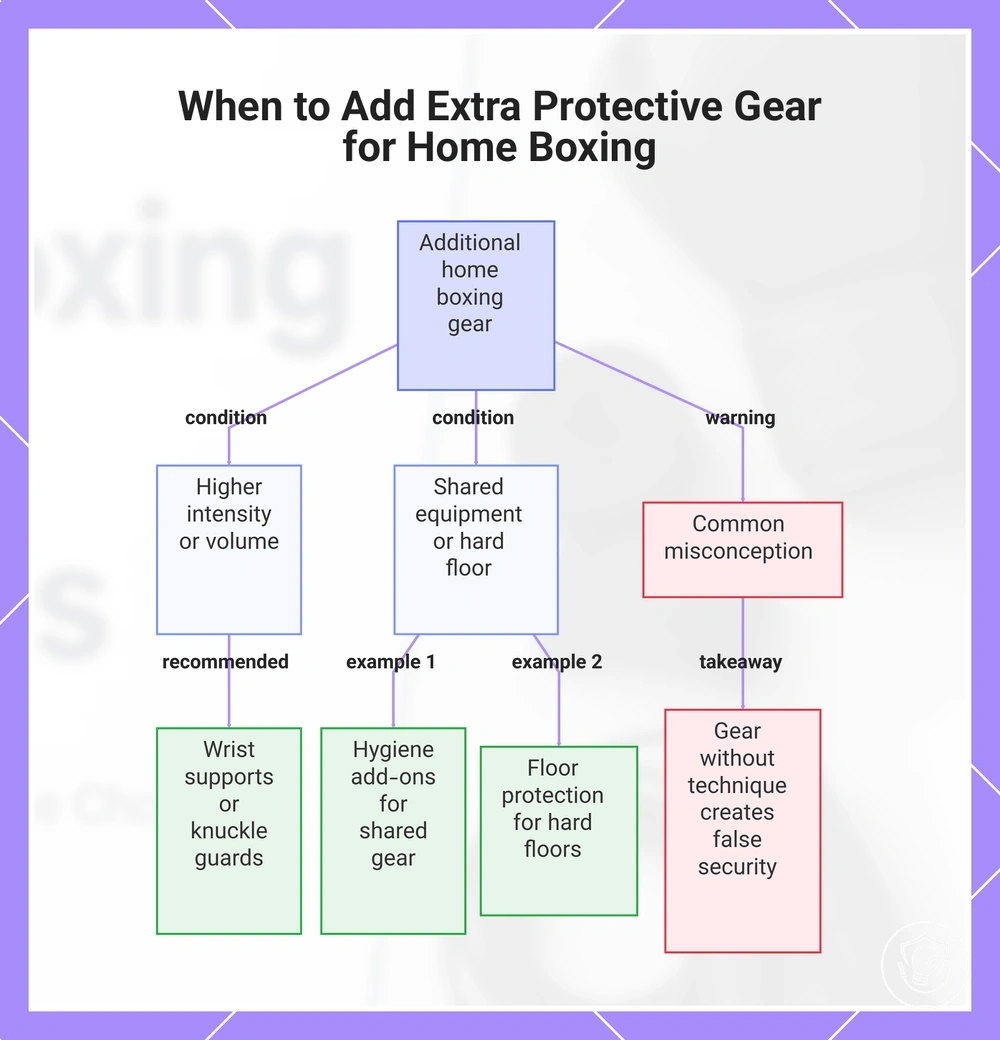
Additional protective gear for home boxing is conditional and depends on practice intensity and context. It is not required for every beginner session but may become relevant as training volume or impact increases.
When training volume rises or when using shared equipment, certain add-on protection can reduce common risks. For example, higher punch volume or heavier bag work may increase wrist strain, making wrist supports or extra hand wrap padding worth considering. Similarly, if gloves or wraps are shared between household members, hygiene-focused add-ons such as glove deodorizers or washable inner liners can help maintain cleanliness.
- Higher training intensity or longer sessions may justify wrist supports or gel knuckle guards to reduce impact stress.
- Shared equipment increases the need for hygiene add-ons like antibacterial glove wipes or removable liners.
- Training on hard floors without a mat may justify additional floor protection to reduce joint fatigue and equipment wear.
A common misread is that more protective gear often means safer training. In practice, adding gear without addressing fit or technique can create a false sense of security. The decision to add protection should follow a clear need rather than a precautionary blanket.
This chart shows the conditions that justify extra protective gear in home boxing and a common misconception about safety.
Spending priorities for beginners: minimum kit first, then smart upgrades
The spending order for beginners starts with protection essentials, then the practice modality choice, and finally convenience upgrades. Following this sequence helps avoid early waste from buying extras before the safety and fit basics are confirmed.
A typical beginner mistake is buying add-ons like a heavy bag or training accessories before the protection items fit correctly. This often leads to gear that does not match the actual training setup or needs early replacement. The table below maps the spending priorities for beginners to what to buy, why it matters, and what can wait until the setup is stable.
| Priority tier | What to buy | Why it matters | What can wait |
|---|---|---|---|
| 1 | Boxing gloves and hand wraps | Fit and wrist support reduce injury risk during early training | Punching bag or training pads |
| 2 | Striking option (bag or pads) | Practice modality that matches the available space and training goal | Training timer or floor mat |
| 3 | Support add-ons (mat, timer) | Convenience and consistency for regular practice | Gear deodorizer or storage accessories |
A smart upgrade in this context is adding a floor mat after the gloves and bag are already working well for the available space. An early waste, by contrast, is buying a premium bag mount before checking that the basic bag setup fits the room and does not disturb others. The difference often depends on whether the upgrade solves a real friction in the current routine or just seems useful before the routine exists.
Can I start with just gloves and skip wraps?
Gloves alone may not provide enough wrist and knuckle support for consistent training. Hand wraps add a layer of stability that reduces the risk of strain, especially during bag work, but wraps are not always needed for very light pad drills at low volume.
Is a punching bag the first thing I should buy?
No. Protection essentials — gloves and wraps — come first. The bag choice depends on the available space and whether the beginner trains alone or with a partner, so it is better to decide on the striking option after the protective gear fits well.
Care, hygiene, and storage for home boxing equipment to extend lifespan
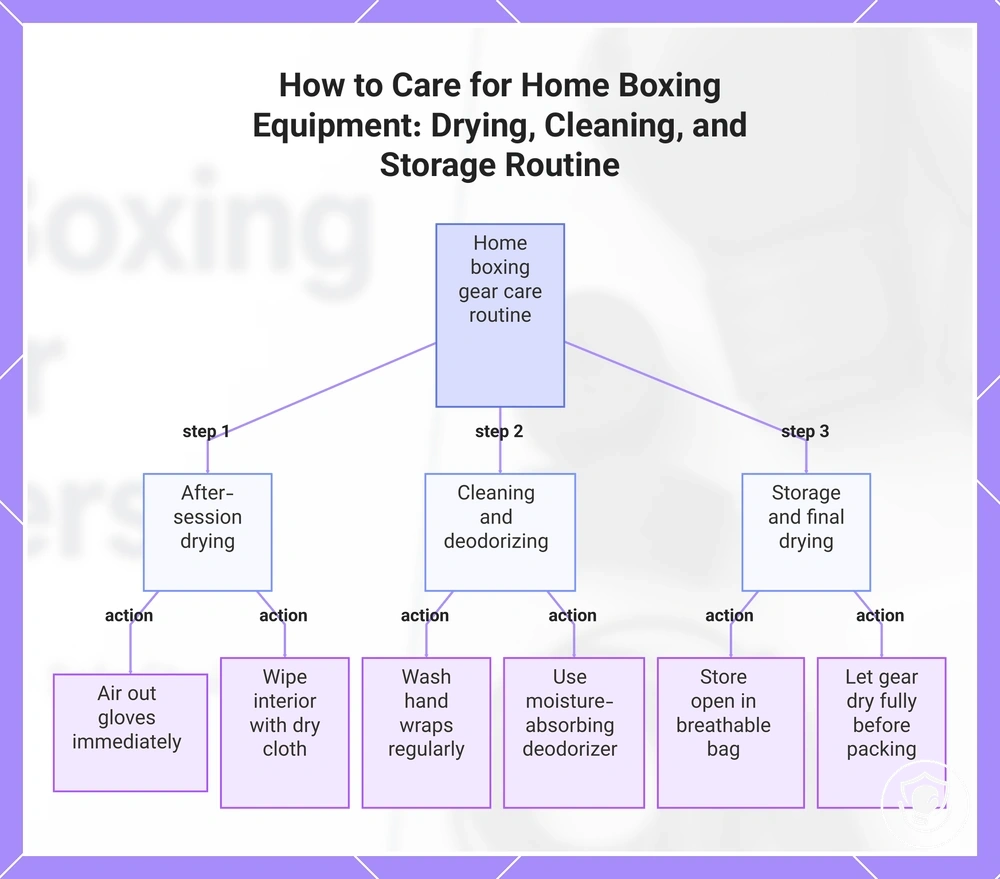
Basic care for home boxing equipment can reduce odor, slow material breakdown, and delay premature replacement. Sweat and moisture trapped inside gloves and wraps create conditions that degrade materials over time. An after-session routine helps keep your gear functional.
A consistent routine of drying, cleaning, and proper storage addresses these issues.
- Air out gloves immediately after each session in a well-ventilated area – allows moisture to evaporate and can slow bacteria growth.
- Wipe the interior of gloves with a dry cloth after use – removes surface sweat before it soaks into padding.
- Wash hand wraps regularly after every use or every few sessions – helps prevent accumulated sweat and odor from transferring to the glove lining.
- Store gloves with straps open and in a breathable bag or on a hook – maintains airflow and helps prevent trapped moisture.
- Use a moisture-absorbing deodorizer such as cedar sachets or glove dogs – draws dampness out of padding and can help neutralize odors between sessions.
- Keep gear away from direct sunlight and heat sources – reduces risk of material cracking or fading.
- Let your gear dry fully before packing it away – minimizes the chance of mold and persistent odor.
Training in a space with limited airflow, such as an apartment or a small room, means the same drying routine applies but may need extra effort. Without good air circulation, moisture stays inside gloves and wraps longer. Using a small fan to circulate air over the open gloves for an hour can help speed drying. Even in tight storage, leaving the gear bag unzipped or hanging gloves rather than stuffing them in a closed bin reduces moisture buildup.
This chart outlines the essential after-session care steps for home boxing equipment, including drying, cleaning, and proper storage to extend lifespan.
Beginner FAQs and quick checks for home boxing equipment decisions
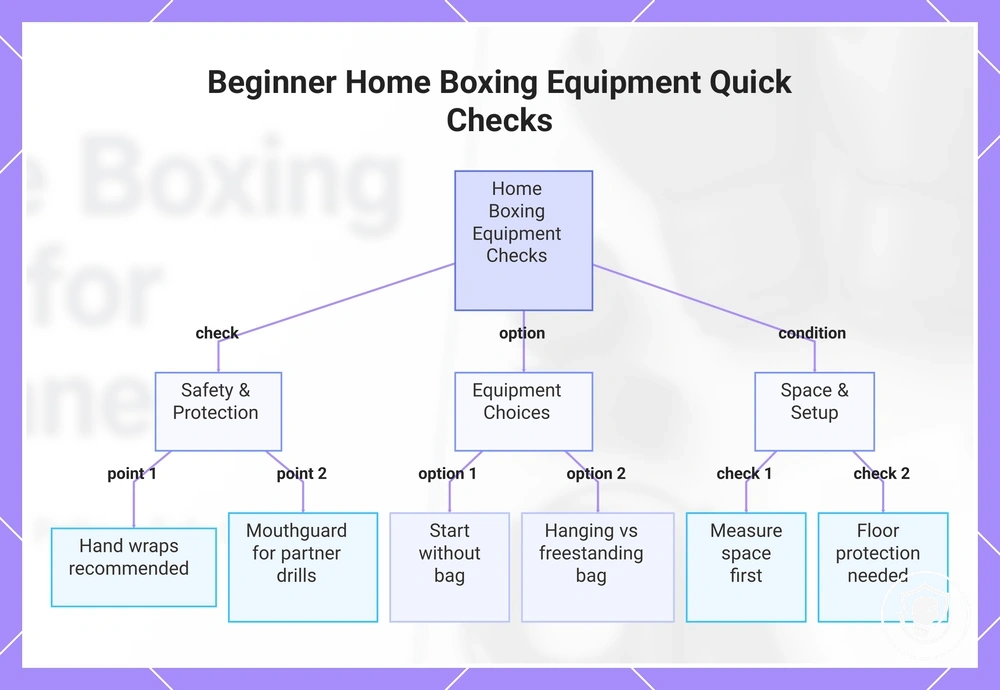
Quick checks resolve common doubts about safe setup and purchase confidence for beginners setting up home boxing equipment. The questions are grouped by kit essentials, hand and wrist protection, space and setup constraints, and safety trade-offs. For a more detailed list of questions and answers, see the beginner home boxing equipment FAQs page.
Do I need a mouthguard for home boxing training?
A mouthguard is often recommended if you plan to do partner drills or sparring, but may not be necessary for solo bag work. If you practice alone with a heavy bag or pads, the risk of dental impact is lower. However, if you ever train with a partner, even light drills can cause accidental contact, so having one available is a sensible addition to your gear.
Can I practice boxing at home without a punching bag?
Yes, you can start with shadowboxing and bodyweight drills to learn basic movements and footwork. Pads or a bag add impact training, but they are not required for the first weeks. If you have limited space or noise concerns, shadowboxing combined with a jump rope can provide a solid workout until you decide on a striking option.
How much space do I need for a basic home boxing setup?
Space requirements depend on the equipment you choose. For shadowboxing and footwork, a clear area can work. If you add a freestanding bag, you need extra room for safe movement around it. A hanging bag requires clearance for the bag to swing without hitting walls or furniture. Measure your space before buying equipment to avoid mismatch.
Should I choose a hanging bag or a freestanding bag?
The choice depends on your space, mounting options, and noise tolerance. Hanging bags offer a more realistic feel and are often preferred for footwork, but they require a sturdy ceiling or wall mount and create more vibration. Freestanding bags can be moved and do not require installation, but they may shift during heavy use and often take up floor space. Consider your ceiling height and floor material before deciding.
Do I need training pads if I train alone?
Pads are typically used with a partner to hold them, so for solo training they are not essential. If you train alone, a heavy bag or a floor-to-ceiling bag can serve as a striking target. Some freestanding pads and reflex balls can also be used solo, but their benefits vary by design. For most beginners starting at home, a bag is a more practical option.
How often should I replace my boxing gloves?
Replacement timing depends on usage frequency, material quality, and how well you care for them. Gloves used several times a week may show wear within months of regular use, while lighter use can extend that period. Replace them when the padding flattens, stitching breaks, or the inner lining tears, as these issues reduce protection and comfort. Check your gloves regularly for signs of wear.
Is it okay to hit a heavy bag without hand wraps?
Hand wraps are recommended because they provide wrist support and protect the small bones in your hand. Without wraps, the risk of sprains and impact injuries increases, especially for beginners who are still learning proper punch alignment. Wraps also help keep your gloves clean and dry by absorbing sweat. Skipping them may lead to discomfort or injury that slows your training progress.
What kind of floor protection do I need for a home boxing setup?
Floor protection depends on your surface and equipment. A heavy bag hanging from the ceiling may need a rubber mat or interlocking foam tiles to absorb impact and prevent floor damage. Freestanding bags often come with a base that can scratch or dent softer floors, so a mat underneath is a good idea. For general training, a non-slip mat can define your workout area and reduce noise.
This chart summarizes the key quick checks for beginners setting up home boxing equipment, covering safety, equipment choices, and space constraints.