
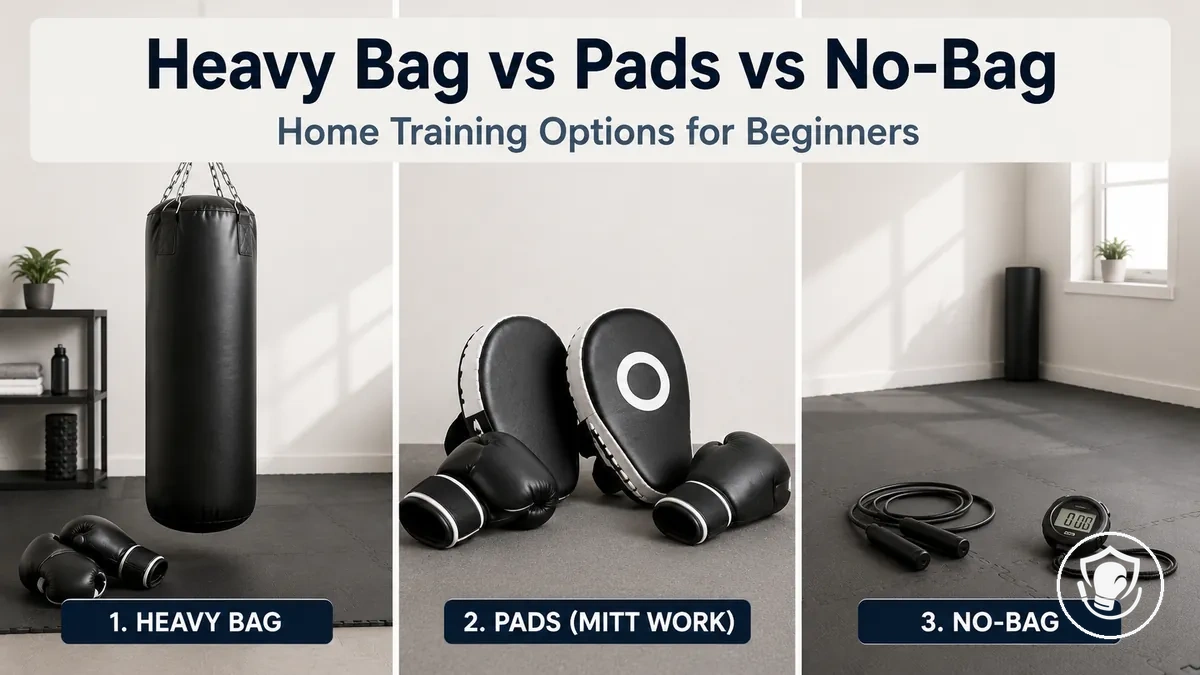
Home Boxing Equipment for Beginners: Heavy Bag vs Pads vs No-Bag Training
Home boxing equipment for beginners—heavy bag, pads, or no-bag training—depends on your space, noise tolerance, and whether you train alone. Each path serves a different purpose: a heavy bag can build power and endurance, pads can improve accuracy and timing, and no-bag training (shadowboxing) can develop technique and cardio without equipment. Our home boxing equipment hub provides a structured overview of all beginner options.
Heavy bag vs pads vs no-bag training depends on your training goals and physical environment. What matters more than the equipment itself is consistent practice and proper technique.
- Heavy bag: Provides continuous resistance for power and conditioning; requires sufficient space and a mounting point.
- Pads (focus mitts or punch pads): Improve accuracy and reaction; typically need a training partner.
- No-bag training (shadowboxing): Builds technique and cardio with zero equipment; ideal for tight spaces or noise restrictions.
Choose by constraint first, then by outcome (cardio vs feedback vs impact).
Many beginners pick gear based on perceived power or cardio benefits without considering their home setup, which can lead to unused equipment or ineffective workouts. Your choice should match your fitness goals and the space and noise limitations of your training environment. A practical approach is to start with a path that fits your current constraints and adjust as your needs change.
A punching bag is not necessary for home boxing. Pads and no-bag training can be effective for developing technique. Pads can be used with a partner, but solo pad drills are less common and typically less effective than partner training.
What heavy bag training, pad work, and no-bag boxing training mean in a beginner home setup
Heavy bag training is a solo striking method where a boxer punches a weighted bag and receives impact feedback on force and accuracy. Pad work involves a partner holding padded targets, providing target feedback to guide speed and precision. No-bag training, including shadowboxing, is performed without equipment and offers no-impact feedback through movement and visualization.
In a home setup, heavy bag training includes a bag, boxing gloves, and sufficient space but excludes partner interaction and real-time target cues. Pad work includes a second person and hand mitts but excludes the consistent striking surface of a bag. No-bag training includes only the athlete's body and excludes any external feedback from equipment.
The choice between these modes depends on available equipment, space, and whether a training partner is accessible.
The diagram shows how these three modes differ in feedback and setup.
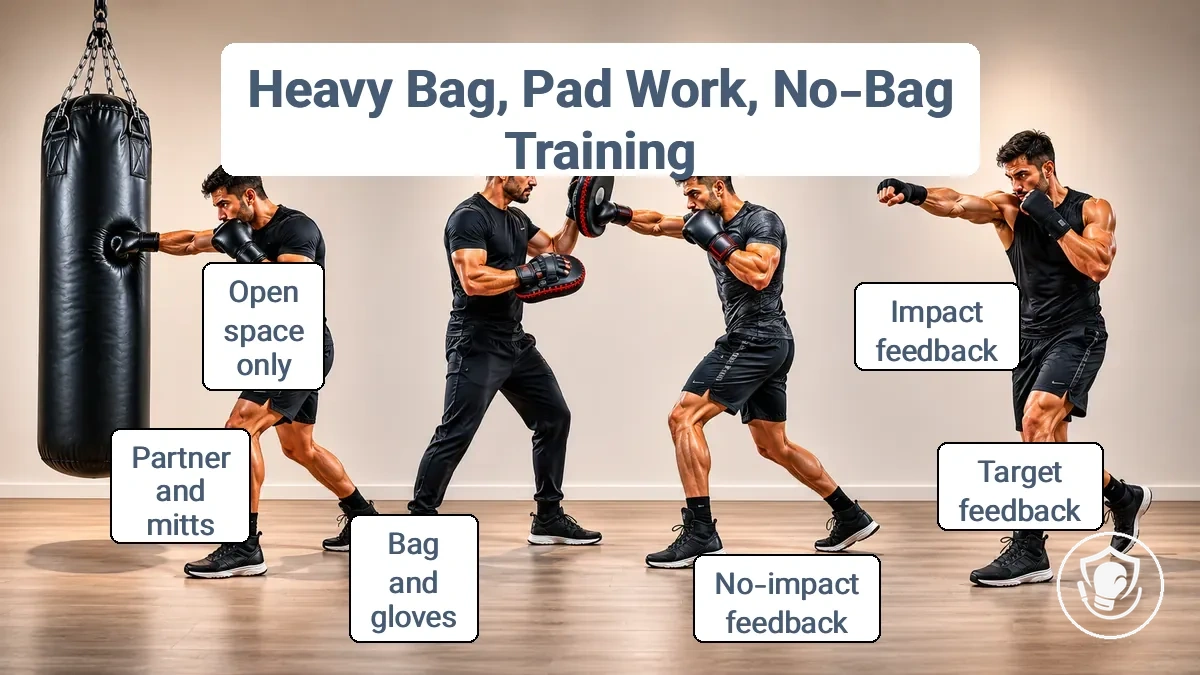
Each option's feedback type, requirement, and decision implication for a home setup:
- Heavy bag training: impact feedback; requires a heavy bag, gloves, and sufficient space; suited for solo force-building. Bag weight and placement affect noise and space.
- Pad work: target feedback; requires a partner and hand mitts; develops timing and accuracy. It allows real-time coaching but is limited to partner availability.
- No-bag training: no-impact feedback; requires only open space; safe for beginners to learn technique. It may not gauge real power and relies on internal feedback.
Impact vs target vs no-impact feedback:
- Impact feedback: comes from striking a bag.
- Target feedback: comes from hitting pads.
- No-impact feedback: comes from body movement.
Heavy Bag Training as a Solo Impact Station – What It Includes and What It Does Not
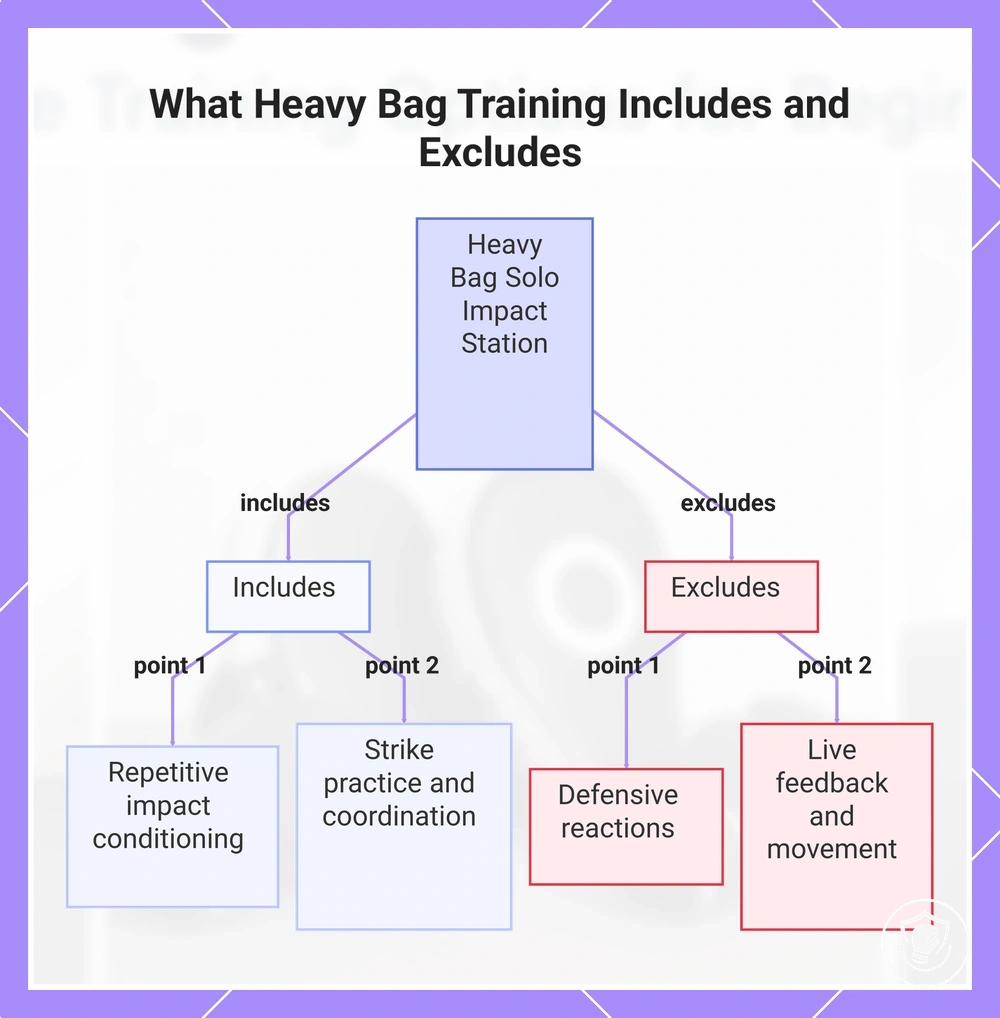
Heavy bag training as a solo impact station provides a home beginner with a consistent target for power and conditioning, but it does not include defensive drills or live feedback.
- Includes: repetitive impact conditioning; practice of jab, cross, hook, and combinations; gradual improvement in hand speed and body coordination; a consistent target for building strike volume and stamina.
- Does not include: defensive reactions like slips, blocks, and counters; dynamic movement against an unpredictable opponent; real-time feedback on form or technique from a coach or partner; training for timing and distance against a moving target.
Impact feedback from the bag helps build power and endurance, but home noise and space constraints can limit its practicality, and technique drift may occur without live correction.
This chart shows the key components included in heavy bag training as a solo impact station and what it does not provide.
Pad work at home as a target-feedback option (when you train with a partner or self-held targets)
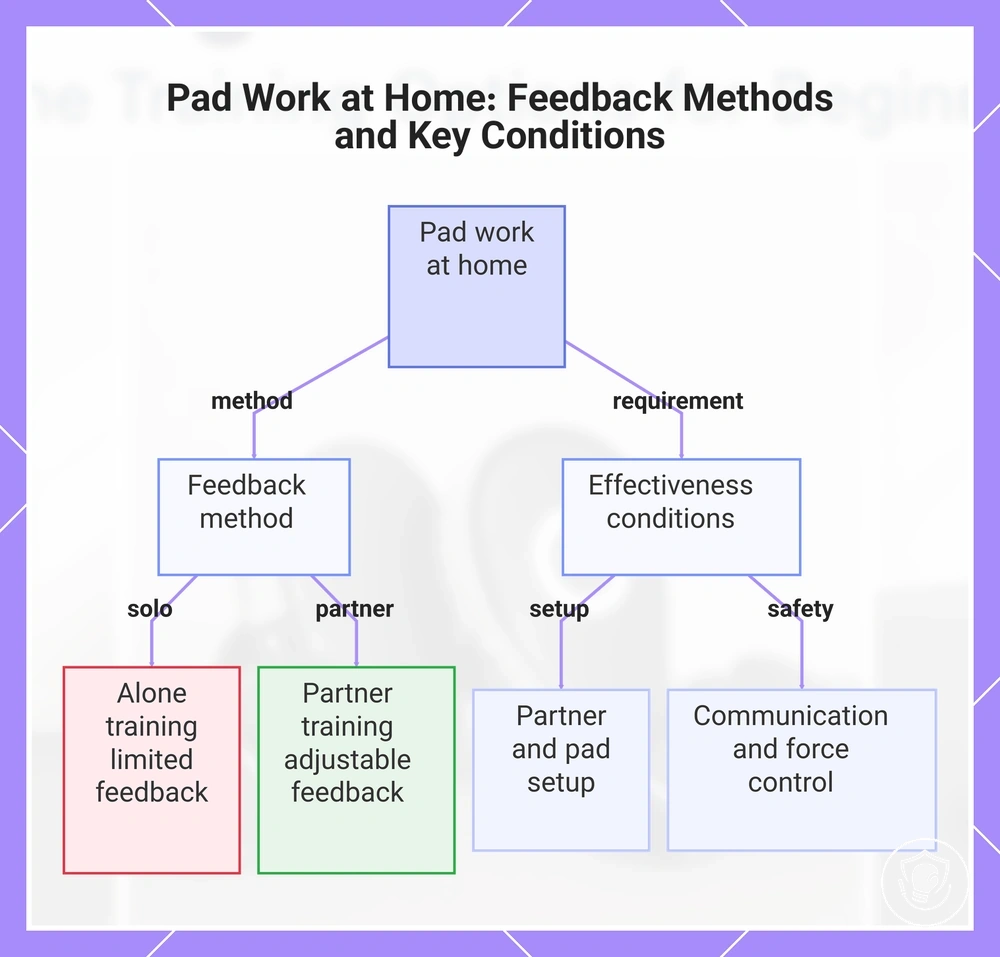
Pad work at home uses handheld pads to provide immediate feedback on strike accuracy, timing, and power. When training alone, feedback is limited because the holder cannot react independently; with a partner, the holder can adjust pad position and pressure, making the feedback more realistic for beginners. For effective pad work at home, several conditions must be met:
- A partner with basic pad-holding skills who holds a firm, stable target without excessive movement.
- Pads that match the strike type and intensity for safe contact.
- Clear communication between striker and holder to coordinate combinations and defensive reactions.
- Controlled strike force to reduce injury risk to the holder's hands or wrists, especially with smaller targets.
This chart shows the two feedback scenarios for pad work at home and the essential conditions for effective partner-based training.
Focus mitts vs punch pads vs Thai pads (what changes for beginner home boxing equipment use)
Focus mitts, punch pads, and Thai pads mainly differ in target stability, holder effort, and feedback type—differences that affect beginner home training choices. Focus mitts are small and lightweight, punch pads are larger, and Thai pads are the largest and heaviest.
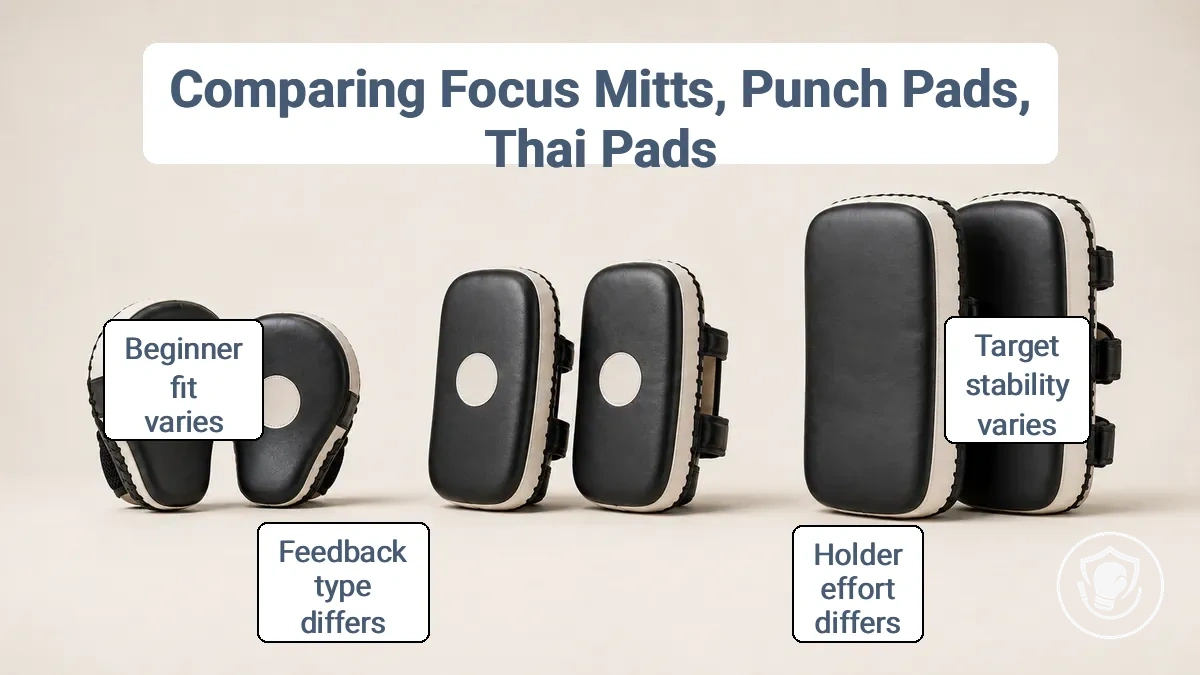
| Pad Type | Target Stability / Size | Holder Effort / Learning Curve | Beginner Fit Implication |
|---|---|---|---|
| Focus Mitts | Small, curved surface; holder can change position quickly | Often requires active movement and timing from holder; higher skill demand | Suitable for developing hand speed and accuracy, but works best with a partner comfortable with fast combinations |
| Punch Pads | Medium-to-large surface; often flatter, more stable | Moderate weight; holder absorbs punches with less need for rapid repositioning | Easier for a beginner partner to hold; supports consistent power training with less setup |
| Thai Pads | Large, thick, heavy; designed to withstand kicks, knees, and elbows | Substantial weight; holder typically must brace against powerful strikes; fatigue can occur | Suitable for full-body striking practice, but holder strength and endurance become limiting factors |
These three pad types affect feedback and handling more than basic conditioning potential. A beginner can get a comparable cardiovascular workout with any of them, but which specific skills improve depends on the pad type.
The holder's role shifts significantly between pad types: focus mitts typically involve active feeding, while Thai pads typically involve static bracing. The training partner's experience becomes a key variable in home setup decisions.
No-bag training as skill and conditioning work without impact (shadowboxing and simple tools)
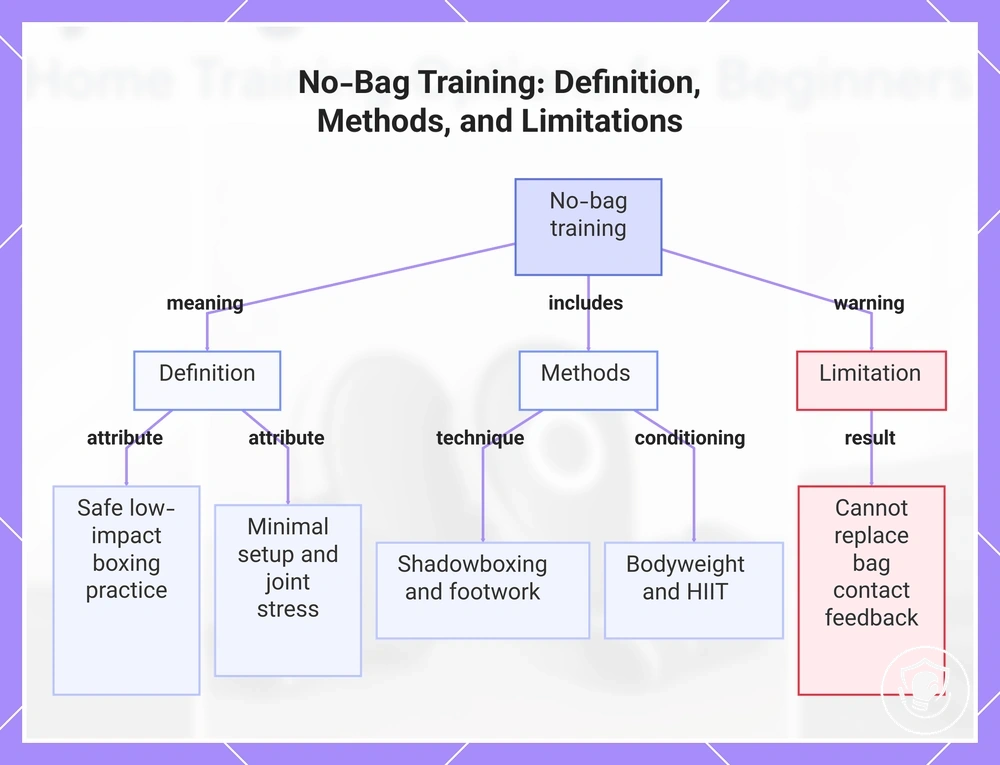
No-bag training is a safe, low-impact structured boxing practice performed without a punching bag, using shadowboxing, footwork drills, and bodyweight exercises to build technique and conditioning while minimizing setup requirements and joint stress. However, it cannot fully replicate the contact feedback and power absorption practice that bag work or pad training provides.
No-impact methods include:
- Shadowboxing – throwing combinations and defensive moves in open space to refine form and timing.
- Footwork drills – moving through the boxer's shuffle, pivots, and lateral steps to improve agility and balance.
- Bodyweight conditioning – push-ups, squats, lunges, and burpees integrated into round-based intervals to build strength and endurance.
- HIIT structure – organizing work into timed rounds to improve cardiovascular conditioning.
It is often thought that shadowboxing alone can replace bag work entirely for skill development.
No-bag training typically lacks the force-absorption practice and reaction feedback of hitting a heavy bag or focus mitts, making it a complement rather than a full substitute.
This chart explains what no-bag training is, its key methods, and its main limitation compared to bag work.
Which Option Builds the Beginner Outcomes People Usually Want First
For a beginner, heavy bag training often delivers faster visible results in power and endurance, while pad training tends to build technique and precision first.
| Desired Outcome | Matching Option | Trade-Off Accepted |
|---|---|---|
| Quick, visible results (e.g., power, endurance) | Heavy bag | Technical flaws may become ingrained if form is not prioritized early |
| Consistent technique and reliable response | Pads | Slower visible power progression at the start, but accuracy improves with partner feedback |
| Balanced development of power and technique | Both heavy bag and pads | Requires more training time and equipment access; progress may feel less linear |
Without conscious evaluation, a beginner may default to the option that comes to mind first—typically heavy bag—and then struggle with technical plateaus.
Pad training, by contrast, focuses on small corrective adjustments, which can improve consistency over time when partner feedback is available.
Cardio and conditioning benefits for home boxing equipment beginners
Both heavy bag and pad work can deliver cardio and conditioning benefits for beginners when the session keeps the heart rate elevated through sustained effort and recovery intervals.
The conditioning outcome depends less on the equipment and more on how the workout is arranged: the timing of rounds, the length of rest periods, and the movement patterns demanded during each interval.
Intensity drivers that make either option effective for beginners include:
- Round structure – Alternating short bursts of high-intensity work with rest mimics interval training, which elevates heart rate and improves aerobic capacity. Three-minute rounds with one-minute rests are common in both bag and pad work.
- Rest control – The duration of rest between rounds directly influences how much the heart rate recovers and how hard the next round feels. Shorter rest keeps the intensity high; longer rest allows for fuller recovery and more explosive output.
- Movement demand – Constant footwork, slipping, weaving, and angle changes increase energy expenditure and challenge coordination, building conditioning beyond punching power alone.
Consistent pacing and gradual progression further improve conditioning for beginners using either heavy bag or pad work.
Technique, accuracy, and timing feedback differences between bag, pads, and no-bag work
Pad work gives real-time partner cues for timing and accuracy; the heavy bag gives sensory impact and movement feedback for power and endurance; shadowboxing depends on self-observation for footwork and form.
Beginners need to distinguish feedback that directly refines accuracy and timing from feedback that only feels productive.
| Method | Feedback Signals | Common Beginner Error | Quick Correction |
|---|---|---|---|
| Pad work | Real-time coaching cues on timing, accuracy, and distance; audible pop when connection is crisp | Throwing punches without watching the mitts or rushing combos | Let the pad holder present the target first; focus on hitting the centre of the pad |
| Heavy bag | Sensory feedback from impact and bag swing; reinforces power and endurance | Sacrificing form for loud impacts and bag movement | Alternate power rounds with technique rounds at a controlled effort |
| Shadowboxing | Self-observed feedback via mirror or video; checks footwork, guard, and balance | Moving without visual self-evaluation or repeating the same patterns | Use a mirror and pause after each combination to check hand position and stance |
Power Development and Impact Tolerance Without Building Bad Habits
For beginners, developing power means learning to transfer weight through the kinetic chain with proper alignment, not simply hitting harder. Impact exposure differs between options: a heavy bag provides continuous resistance that can reinforce flawed mechanics if posture breaks down, while pads offer controlled feedback but may encourage overextension without the bag's stabilizing weight.
To build impact tolerance without building bad habits, apply these constraints:
- Alignment: Keep the wrist straight and the shoulder connected to the torso on every rep; a misaligned strike under load can reinforce joint stress with repeated practice.
- Controlled volume: Limit rounds so you can maintain technical focus; fatigue shifts mechanics and can encourage poor habit formation.
- Gradual intensity: Increase force only after consistent clean contact is automatic at lower effort; premature power work can lead to compensation rather than effective strength development.
Decision criteria that actually change the best home boxing equipment choice
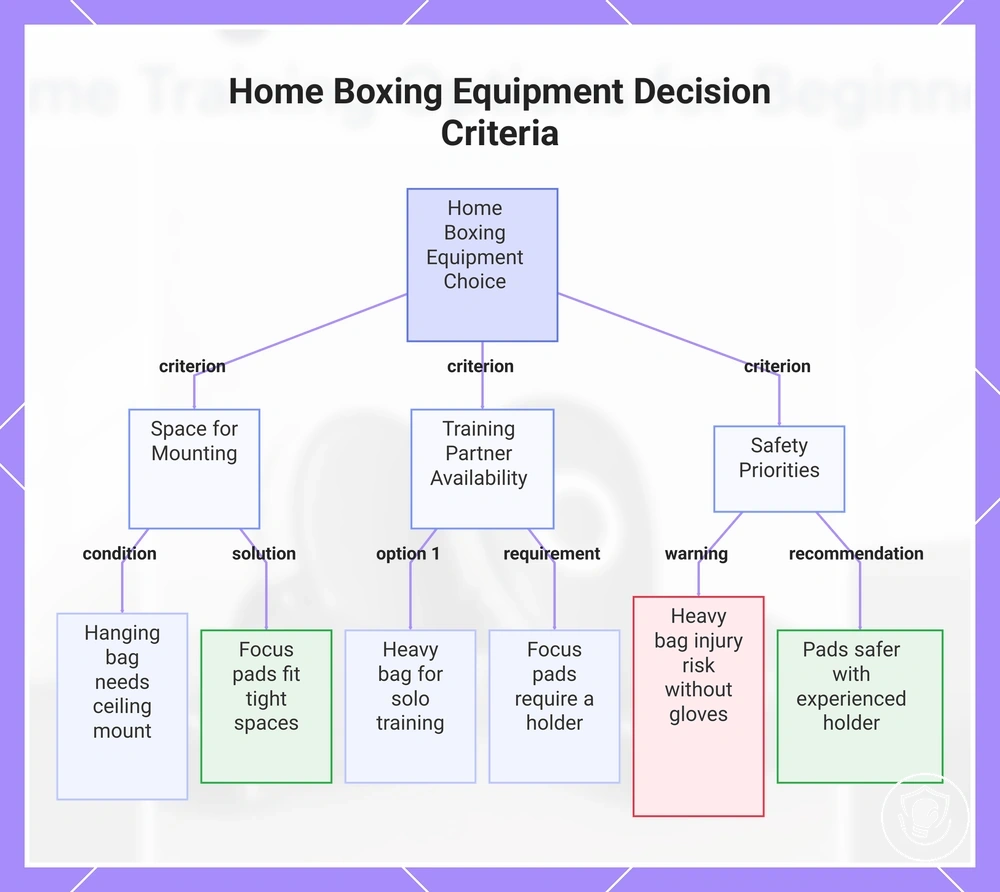
Space for mounting, training partner availability, and safety priorities shift the best home boxing equipment choice.
- Space for mounting. When ceiling mounting is not possible, a hanging heavy bag becomes impractical. Free-standing bags offer a non-mountable alternative but tend to be less stable and less effective for developing power. Focus pads require no permanent installation and can be used in tighter spaces, which makes them a better fit when room is constrained.
- Availability of a training partner. If you train alone most of the time, a heavy bag allows you to practice combinations and build endurance without assistance. Focus pads depend on a holder to provide a moving target for accuracy drills. The trade-off with a heavy bag is missing the live feedback and defensive reactions that pad work with a partner can offer.
- Safety priorities. Heavy bag training can increase the risk of hand and wrist injuries without proper gloves and hand wraps. Focus pads, when held by an experienced partner, can be safer for beginners learning form because the impact can be controlled. The trade-off is that pads limit the intensity of impact training until the holder can absorb harder strikes consistently.
This chart shows the three main decision criteria—space, training partner, and safety priorities—that influence the best home boxing equipment choice.
Space, Floor Protection, and Clearance Constraints That Limit Heavy Bag Options
Space, floor protection, and clearance constraints determine whether a heavy bag works in your home training area.
Use these space checks to assess your room:
- Clearance around the bag — Check that there is enough open space in all directions to move and let the bag swing without hitting walls or furniture. Hanging bags typically need several feet of free space to swing, while freestanding bags also require a clear perimeter around the base.
- Ceiling height — Make sure the ceiling is high enough so the hanging bag does not touch the floor at rest and you do not need to crouch while training.
- Distance from walls — Ensure walls are far enough to prevent your strikes or the bag's motion from making contact. Even limited-access setups, like 180-degree use, still need a buffer from adjacent surfaces.
- Floor protection — Check that the floor can absorb repeated impact. Heavy-duty foam mats or rubber flooring can protect the surface and reduce noise, which is especially important in shared spaces.
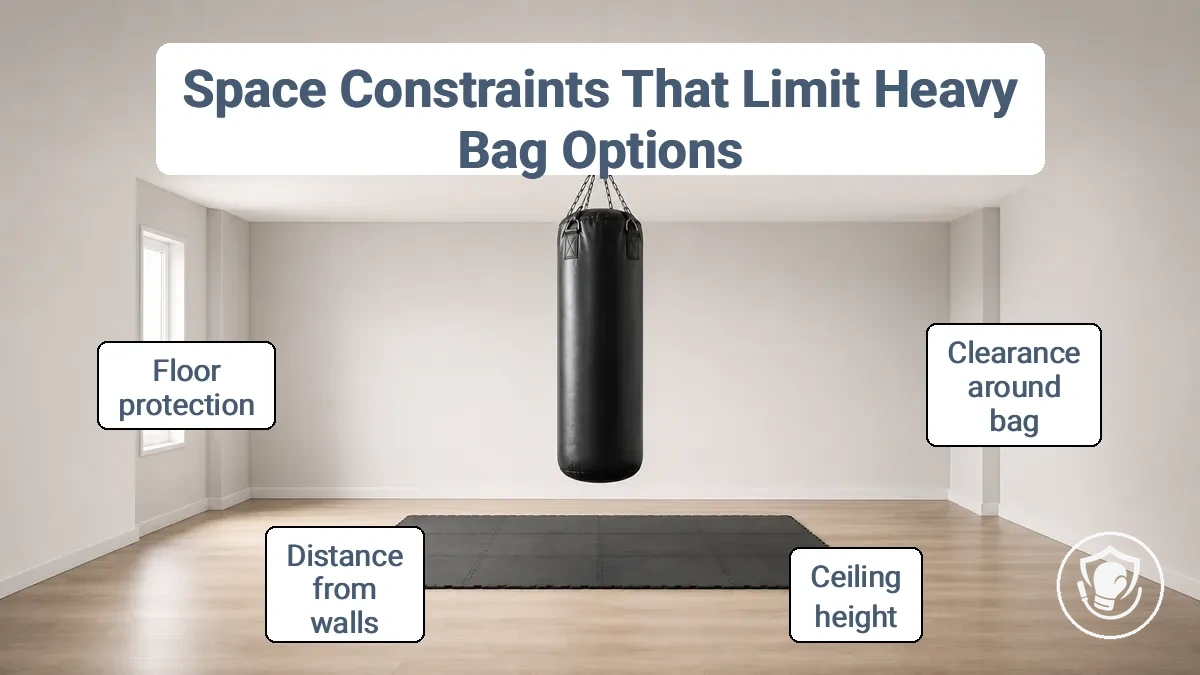
If these checks are not met, a heavy bag is not practical. Focus mitts, Thai pads, or bodyweight drills offer a compatible alternative that builds striking skills without the same space demands. For more guidance on adapting to tighter spaces, see small space setup choices.
Noise, vibration, and neighbor constraints that change the best setup
The best choice between a heavy bag, pads, and no-bag work at home depends on sound and vibration transfer through shared walls and floors.
A heavy bag produces low-frequency thuds and structural vibration. Pads generate more mid- and high-frequency impact noise. Shadowboxing or footwork drills produce little structure-borne noise. For someone in an apartment or townhouse with attached walls, this difference often determines which option is feasible without disturbing neighbors.
Heavy bags tend to cause the most neighbor complaints because their low-frequency energy excites walls and floors, making them audible and feelable in adjacent units. No-bag work produces minimal vibration and is generally the least disruptive option. However, even pads can cause issues if used directly against a shared wall or on an uncarpeted floor.
- Heavy bag: In a home with shared walls, typically the highest disturbance potential. Low-frequency vibration travels through floors and walls.
- Pads (handheld or wall-mounted): In a home with shared walls, often a moderate disturbance potential. Impact noise is more airborne, less structural, but still audible if loud.
- No-bag work: In a home with shared walls, generally the lowest disturbance potential. Minimal vibration and airborne sound; usually safe for shared walls.
Basic measures can make each option more neighbor-friendly, but the disturbance ranking depends on the construction of your home and the sensitivity of your neighbors, not just the equipment itself.
Budget and upgrade-path risk for first-time home boxing equipment buyers
For first-time buyers on a budget, a staged upgrade path reduces financial risk compared to buying everything upfront.
Buying too much gear early often wastes money on items that do not match your actual training habits or space limits, and can increase injury risk if the equipment is not used as intended. Your decision depends on your budget, available space, and how consistently you plan to train.
A minimum viable purchase offers better value than a full set of gear that may not suit your training. This setup covers basic technique work, partner drills, and solo practice without overwhelming a small room.
- Minimum viable purchase: gloves, hand wraps, one striking surface (mitt or bag). Use this until you train consistently.
- First upgrade trigger: when you need more resistance or variety. A heavier bag or a set of focus pads can extend your workouts.
- Second upgrade trigger: when you plan to spar or increase intensity. Headgear, a mouthguard, and higher-quality gloves become relevant.
- General warning: avoid buying very cheap versions of every item; cheap equipment may need replacement sooner and can increase injury risk. Instead, buy one well-made item at a time.
This staged approach can reduce financial pressure and helps you learn what actually fits your space and training style before committing to a full set of gear.
Training alone vs training with someone (and how that changes pad work value)
For beginners, the value of pad work depends on partner availability. Partner-held mitts provide realistic movement and feedback, while solo work uses stationary targets that limit unpredictability.
- Partner work helps develop timing, accuracy, and defensive reactions in ways solo work may not replicate.
- Solo pad work remains useful for drilling technique and muscle memory, but lacks the pressure and responsiveness of a live partner.
Beginners should consider their primary goal—if preparing for interaction, a partner is important; if refining solo technique, training alone can suffice.
Hand and Wrist Safety Tolerance for Impact Work (Bag and Pads) vs. Lower-Impact Alternatives
Striking a heavy bag or focus mitts places greater demand on wrist and hand safety tolerance than lower-impact training such as shadow boxing or light drill work.
Beginners often lack the conditioning and technique to absorb these forces safely, which can lead to pain or injury if intensity is increased too quickly.
Before progressing to high-impact bag or pad work, build a foundation with lower-impact alternatives to allow gradual adaptation of the wrist and hand. Follow this safety mini-checklist:
- Start with light, controlled strikes and limit session duration. If pain develops, reduce force or stop completely.
- Pay attention to persistent pain in the wrist, knuckles, or forearm. Discomfort that lasts beyond the session can signal that the current load may be too high.
- Use protective gear such as properly fitted gloves and hand wraps to provide additional support. Even with gear, avoid overexerting until tolerance has built up over several sessions.
- Alternate impact work with lower-impact conditioning like shadow boxing or footwork drills to give the hands recovery time.
If concerns persist during any checkpoint, return to lower-impact work until tolerance improves.
Do Beginners Need a Punching Bag for Home Boxing Equipment Training
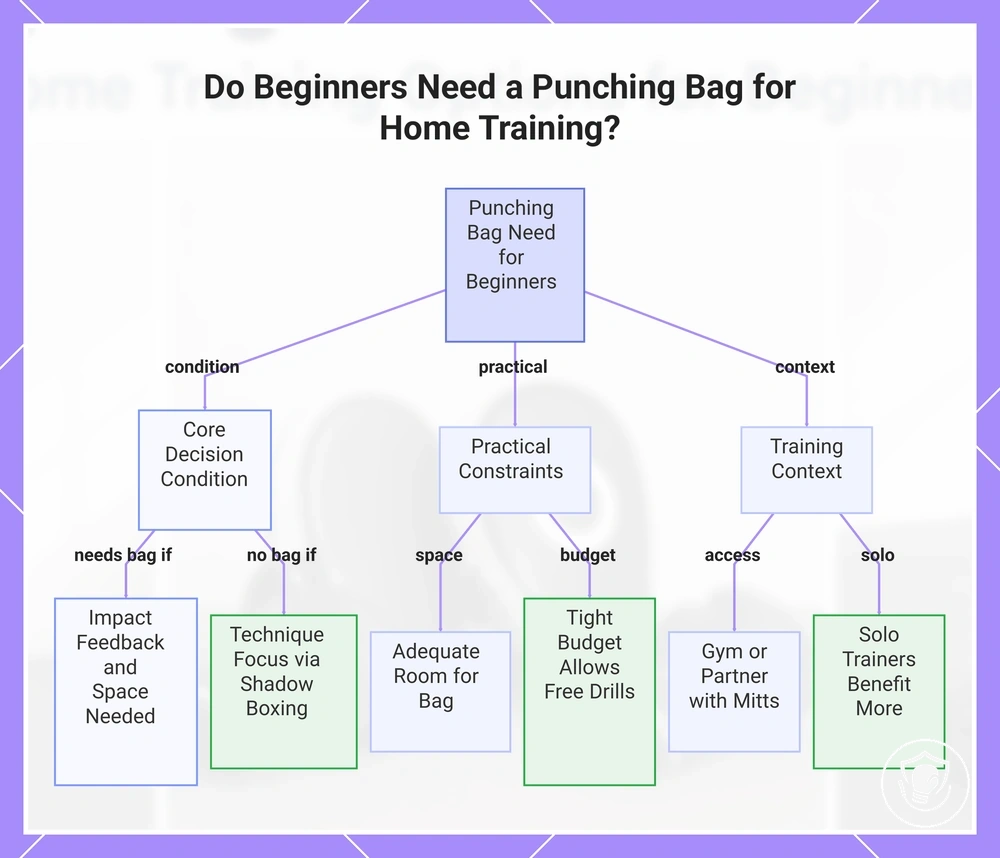
Yes, a beginner may need a punching bag for home training if their goals require impact feedback and adequate space; no, it is not necessary if they focus on technique through shadow boxing and footwork drills.
Punching bag training can give you impact feedback, stress relief, and full-body conditioning.
- Training goals: Are you training for fitness, stress relief, or skill development? A bag adds intensity to workouts but is not essential for getting started with boxing technique.
- Space and installation: Do you have adequate room for a hanging or freestanding bag? Beginners in apartments or limited spaces may find bag-free training more practical.
- Budget: If budget is tight, shadow boxing and bodyweight drills are effective alternatives at no extra cost.
- Access to gym or partner: If you can train at a boxing gym or with a partner using focus mitts, a home bag becomes optional. Solo home trainers may benefit more from a bag.
- Commitment to fundamentals: Beginners who prioritize form over power can build strong foundations without a bag. Bag work is valuable once basic techniques are established.
This chart shows the key factors that determine whether a beginner needs a punching bag for home boxing training.
When a heavy bag is worth it for a beginner home setup
A heavy bag is worth it for a beginner home setup only when these conditions are true:
- Sufficient space: A hanging bag requires clearance for swinging (at least 2–3 feet on each side) and a sturdy ceiling or wall mount. A freestanding bag needs a footprint of roughly 3–4 feet and a solid floor surface to stay stable.
- Bag stability: Hanging bags should be mounted to a joist or beam that can handle repeated impact. Freestanding bags often use a heavy base filled with sand rather than water to help prevent tipping during hard strikes.
- Tolerance for noise: Chain rattle, bag thud, and vibrations can travel through ceilings and walls. Noise matters most in apartments or shared-wall homes.
- Consistent training commitment: A heavy bag delivers value only when used regularly. Beginners who plan to train at least 2–3 times per week are more likely to benefit from the investment.
When any condition is missing, a heavy bag may not be the right choice. Alternatives like pads can still provide a solid workout without the same demands. For help choosing between bag types, see hanging vs freestanding bag decision.
When pads or no-bag training is the better first purchase than a punching bag
Pads or no-bag training is often the better first purchase than a punching bag because both reduce setup risk and improve consistency, with no hanging hardware, minimal floor space, and less noise.
| Option | Primary Benefit | Setup Requirement | Consistency Factor |
|---|---|---|---|
| Pad work | Develops accuracy, timing, and movement simulation | Needs a partner with focus mitts | High when partner is available; feedback improves form |
| No-bag training (shadowboxing) | Refines technique, footwork, and spatial awareness | No equipment needed; works with a mirror | High; can be done in many places |
When both pad work and shadowboxing are feasible, consider your training environment. Pads are the better first purchase if you have a reliable partner, while shadowboxing is the better solo option because it requires no partner at all.
If you cannot drill or mount: freestanding bags, bag stands, or pads as the safer path
When drilling or mounting is not possible—due to rental restrictions, lack of structural support, or avoiding permanent installation—three alternatives remain: freestanding bags, bag stands, and pads.
Each has trade-offs in portability, stability, and striking feel.
| Option | Setup & Portability | Striking Feel & Stability |
|---|---|---|
| Freestanding bag | No drilling; base filled with sand or water; can be rolled or tipped for relocation | Softer striking surface; base may rock under heavy strikes; base weight provides anchor |
| Bag stand | Freestanding frame; takes up floor space; typically easier to move than a wall mount but usually less portable than a freestanding bag | Can support a hanging bag; some stands may shake; stability depends on design and weight |
| Training pads | No installation; requires a training partner; fully portable and storable | Real‑time feedback and movement; cannot be used alone; well suited for technique and timing work |
The safe placement and mounting basics guide covers setup considerations for these alternatives.
Beginner-friendly setup paths for each option (minimum viable gear, not a full shopping list)
The minimum viable gear depends on whether you train with a heavy bag, focus mitts, or Thai pads. Each setup has its own essentials.
Heavy bag setup
- A bag that matches your weight and space (commonly 70-100 lbs for adults using a standing or hanging mount)
- Hand wraps to protect your wrists and knuckles
- Training gloves (12-16 oz)
Focus mitt setup
- Focus mitts (padded targets held by a partner)
- Hand wraps
- Training gloves (10-12 oz)
- A training partner to hold the mitts
Thai pad setup
- Thai pads (larger, thicker pads for kicks and knees)
- Hand wraps
- Training gloves (10-12 oz)
- A training partner
- Optional: shin guards for kick drills if needed
This chart shows the essential gear and requirements for three beginner-friendly training setups: heavy bag, focus mitts, and Thai pads.
Minimum Viable Heavy Bag Setup for Beginner Home Boxing Equipment Training
At minimum, a safe beginner heavy bag setup includes a few essential items.
- Heavy bag: Choose a bag weighing roughly half your body weight; it provides enough resistance for technique work without being too heavy to control.
- Hand wraps: Protect your wrists and knuckles. Wraps stabilize the small bones in your hand and help reduce the risk of sprains.
- Boxing gloves: Use gloves weighing 12–16 ounces for bag work. Heavier gloves add resistance and cushion impact to help protect your hands during repeated strikes.
- Floor mat: Place a mat under the bag area to absorb shock, reduce noise, and provide a stable, non-slip surface for footwork.
Minimum Viable Pad Work Setup for Beginner Home Boxing Equipment Training
The pad work setup you need depends on whether you train alone or with a partner.
- Partner-held equipment – Focus mitts, boxing gloves, hand wraps, and a training partner.
- Self-held target – A wall-mounted strike pad or a floor-standing dummy as a solo alternative.
- Adequate space – Enough clear floor space to move safely.
- Proper hand protection – Reduces injury risk.
- Control over technique – Emphasis on precision, distance management, and form over power.
- Partner availability (optional) – Enables reactive movement and combination practice that is harder to replicate solo.
Minimum viable no-bag setup for beginner home boxing equipment training
A minimum viable no-bag setup only needs a clear space and a timer to structure rounds—no expensive gear needed.
Shadowboxing lacks contact feedback but builds technique and muscle memory.
- Clear a space of roughly 6 by 6 feet — enough for footwork and basic punches.
- Use a timer or boxing app to structure rounds (2–3 minutes of work, 30–60 seconds of rest).
- Use a mirror if available; it provides visual feedback on your form and guard position.
- Hand wraps are optional for wrist support but not required.
During each round, focus on basic punches (jab, cross), footwork patterns, and head movement.
Common Beginner Mistakes by Setup That Reduce Results or Increase Injury Risk
Wrist soreness after heavy bag sessions often results from improper hand wrapping or a bent wrist. Shoulder strain during pad drills is often caused by holding pads at the wrong angle or reaching too far. Correcting these setup-specific errors early prevents discomfort that can force a training break.
Heavy Bag Setup Mistakes
- Bag height set too low or too high. Forces awkward angles, reducing accuracy and straining the shoulder or wrist. Fix: adjust the bag so its midsection is roughly at your shoulder height for straight punches.
- Neglecting hand protection. Hitting a heavy bag without wraps or quality gloves leads to knuckle or thumb injuries. Fix: always use hand wraps and padded training gloves before bag work.
- Overtraining on the bag. Beginners often hit for too long without breaks, causing fatigue that breaks form and increases injury risk. Fix: limit bag rounds to two or three minutes with equal rest, and stop when technique drops.
Pad Setup Mistakes
- Pad holder holding pads too close to the body. Pads pressed tight prevent full extension, risking hyperextension or poor technique. Fix: hold pads slightly forward and angled inward, allowing full arm extension.
- Using only one pad height or angle. Repeating the same target position limits skill growth and risks shoulder overuse. Fix: vary pad heights and angles to simulate real combinations and distribute work evenly.
- Neglecting pad holder movement. A stationary holder encourages poor footwork and reach mechanics. Fix: pad holder should step around and shift positions to guide the puncher’s movement and balance.
This chart shows the two main categories of setup errors (heavy bag and pads) and their key fixes to prevent injuries and improve results.
Heavy bag mistakes that lead to wrist pain, poor form, or overuse patterns
These common heavy bag mistakes can lead to wrist pain, poor form, or overuse patterns. Each has an immediate correction priority.
- Not wrapping hands or wearing gloves: Without protection, the wrist may bend awkwardly on impact, causing pain or strain. Immediate correction: use hand wraps and proper bag gloves before every session.
- Throwing punches with limp wrists or haymaker form: Incorrect wrist alignment transfers shock to the wrist and shoulder rather than the bag. Immediate correction: keep the wrist straight and focus on controlled technique over raw power.
- Standing too close or too far from the bag: Wrong distance can cause jammed punches or overreaching, and both can stress the wrist and shoulder. Immediate correction: adjust your stance so the jab extends fully without locking the elbow.
- Staying stationary while punching: Not moving the feet can throw off balance and lead to awkward punches that strain the wrist. Immediate correction: stay light on your feet and circle the bag between combos.
- Throwing every punch at maximum force: Full-power shots without solid form fatigue the muscles and increase the chance of joint discomfort. Immediate correction: mix in light, fast punches and prioritize speed and accuracy before adding power.
Pad work mistakes that reduce skill transfer and turn sessions into random fatigue
Pad work mistakes that reduce skill transfer and turn sessions into random fatigue often come from a breakdown in control and pacing.
- Mistake 1 – Uncontrolled pace that overwhelms attention. When the pad holder sets a speed that forces the beginner to rush, the learner may struggle to connect perception with action, turning the session into reactive swings instead of deliberate technique. Correction: Reduce the tempo until each strike can be executed with proper weight transfer, hip rotation, and arm extension. Use a steady rhythm that allows the beginner to process the movement before escalating speed.
- Mistake 2 – Prioritizing power over movement quality. Beginners often try to hit hard early, which locks the shoulders, disrupts balance, and narrows the focus to force output. This can remove the movement from the actual demands of boxing. Correction: Cue the beginner to focus on controlled, fluid strikes. Emphasise that power comes from coordinated movement, not isolated arm effort. Have the pad holder provide verbal feedback after each combination to reinforce the correct sequence.
- Mistake 3 – Missing clear feedback loops. Without immediate, specific cues, the beginner may reinforce poor motor patterns. The session feels hard because the body works against inefficient coordination, not because of technical learning. Correction: After every two to three repetitions, give one direct instruction — such as ‘rotate more’ or ‘keep your elbows in’. This keeps the learning environment representative and reduces the random fatigue that comes from aimless repetition.
No-bag mistakes that feel like training but do not carry over to impact work
No-bag training can feel intense but may not transfer to impact work when the structure does not align with drill demands.
- Mistake 1: Skipping a targeted warm-up. Skipping a targeted warm-up may feel like saving time, but cold shoulders and hips can lead to compensations that reduce carryover to bag impact. The straightforward correction is to include a brief period of dynamic mobility work, such as arm circles, torso twists, and light shadow boxing, before any mitt session.
- Mistake 2: Training without a clear plan. Haphazard combinations may feel like practice but often do not reinforce repeatable mechanics that carry over. To improve transfer, assign each round a specific objective—for example, landing a jab-cross-hook, then slipping a return punch. That turns aimless repetition into deliberate practice.
- Mistake 3: Using excessive resistance or stiffness on the mitts. Holding pads rigidly may feel like a workout, but it slows hand speed and reduces the snap needed for real impact. The correction is to keep mitts light and reactive, allowing natural movement so you stay focused on speed and accuracy rather than pushing through force.
Choosing your first path based on your home constraints and training goal
Your primary training goal and strongest home constraint guide the choice between a heavy bag, focus mitts, or starting with no bag.
The table pairs each goal and constraint combination with a recommended first option and its associated trade-off.
| Primary training goal | Strongest home constraint | First option | Trade-off accepted |
|---|---|---|---|
| Develop power and endurance | Limited space for hanging or standing a bag | Focus mitts | You will need a training partner most sessions |
| Improve hand speed and accuracy | Noise concerns (bag impact can be loud) | Focus mitts | Partner required; less resistance for power work |
| General fitness and stress relief | No room for equipment or no partner | No bag – bodyweight drills or shadowboxing | Slower skill development; requires more self-motivation |
| Any focused goal | Adequate space and noise tolerance | Heavy bag | Larger footprint and installation effort |
Accept the trade-off that comes with your first choice; you can always add equipment later.
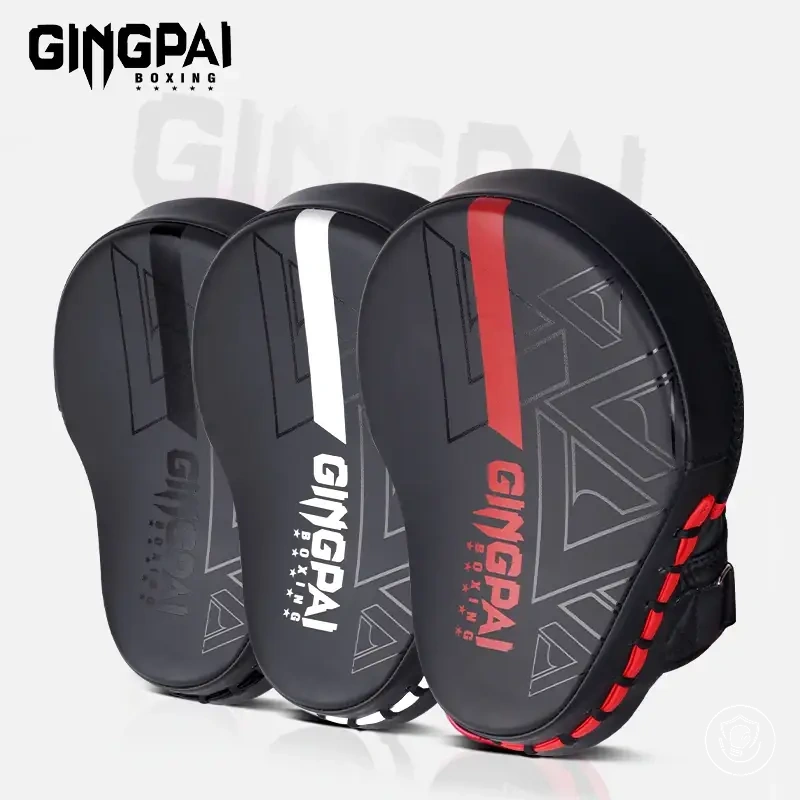
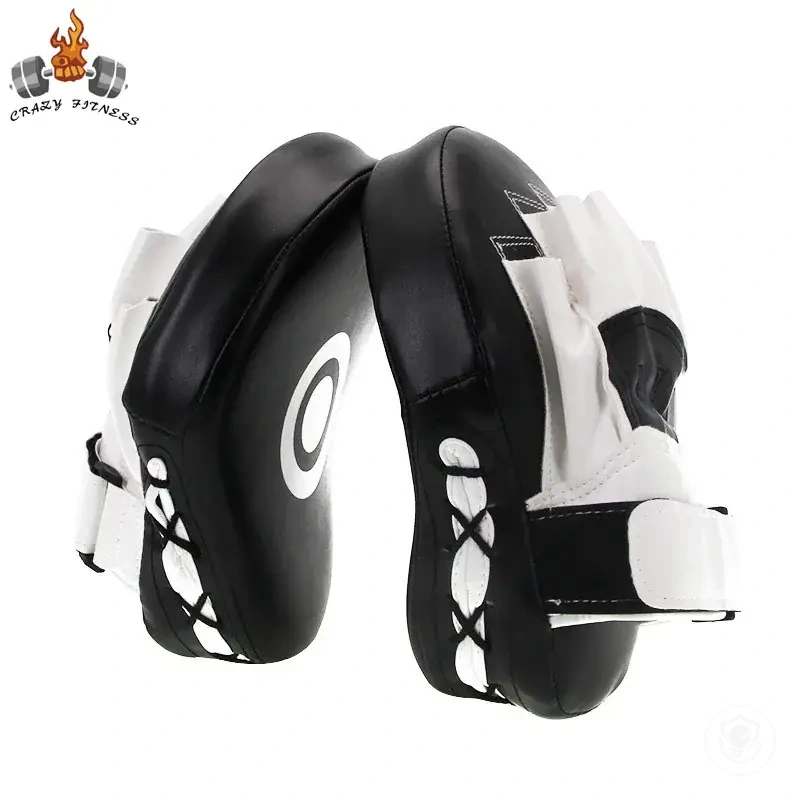
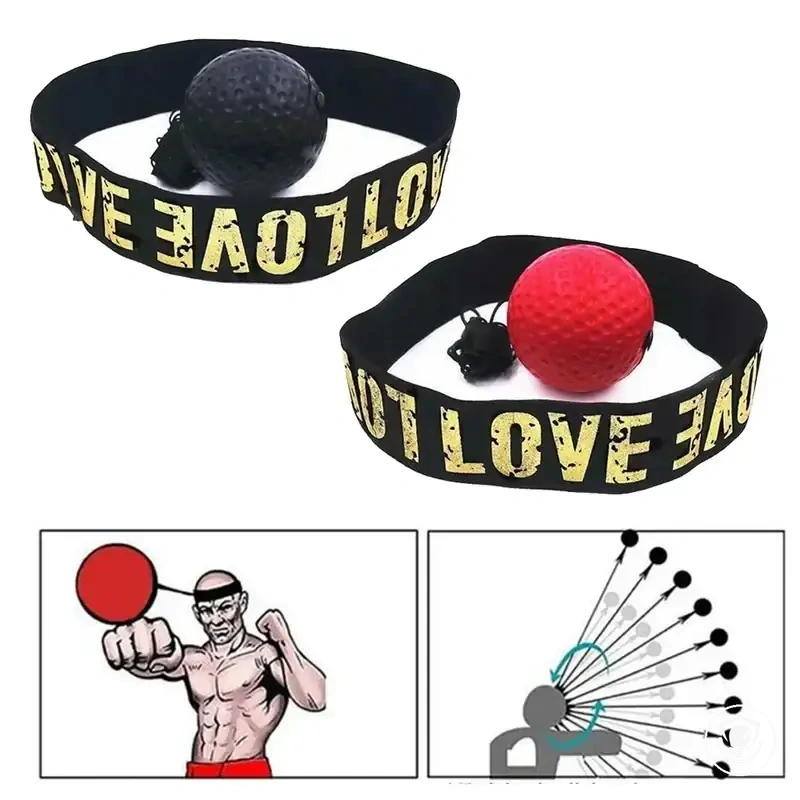
Here are product examples that may make comparison easier. Before buying, always review the compatibility criteria, essential features, and product details.
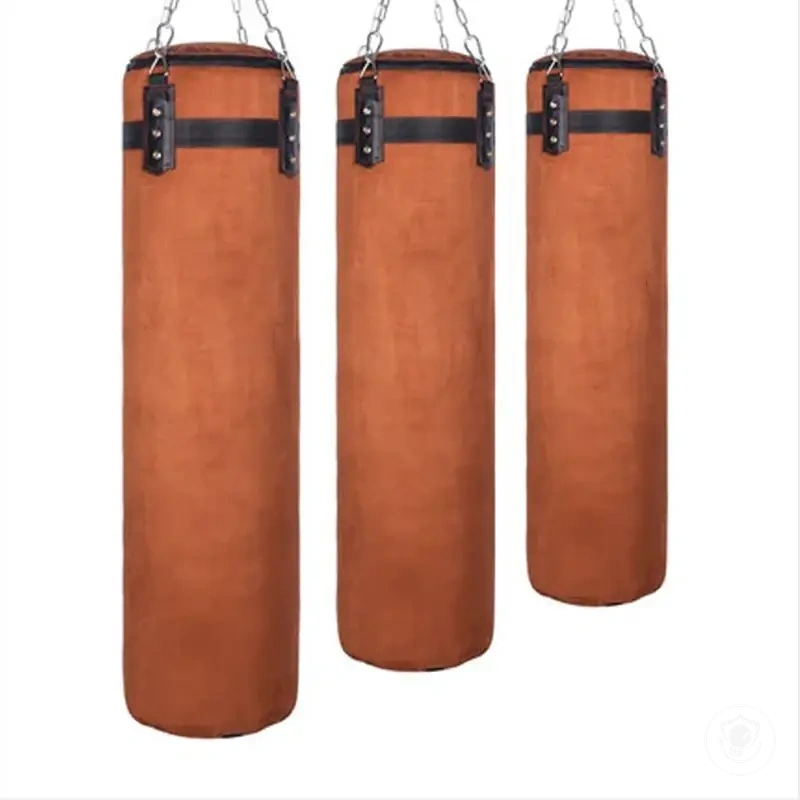

Choose a Heavy Bag First When You Want Solo Impact Rounds and Have a Stable Home Setup
A heavy bag can be a good first choice when your goal is solo impact rounds for power, conditioning, and realistic punching feel, and you have a stable home setup.
Use this mini-checklist to verify setup feasibility before deciding:
- Can you install the bag permanently? Hanging bags typically need a ceiling joist or wall stud, or a floor stand that stays stable under heavy strikes.
- Do you have enough clearance? Heavy bags swing during use and typically require several feet of open space around them.
- Can you manage the noise? Chains and impact can create loud vibrations, especially in apartments or rooms above other floors.
- Will you train solo? Heavy bags do not require a partner.
For temporary setups or tight spaces, a freestanding bag may fit better. The trade-off is that a heavy bag requires more space and installation effort than other punching bag options.
Choose pads first when you want feedback, combinations, and a partner-friendly home routine
Pads are a practical first choice for immediate feedback, combination practice, and a partner-friendly home routine.
When a partner holds pads, you get real-time sensory cues — sound, feel, and visual reaction — allowing you to evaluate each punch's form immediately. This quick feedback lets you correct technique on the spot, something a stationary heavy bag cannot provide.
Before committing to pads, check these conditions to ensure training stays productive and safe:
- Your partner is willing and available for regular sessions, and both understand the time commitment.
- Agree on session goals and use requests rather than demands when giving feedback (e.g., “could you keep your elbows in?” instead of “stop dropping your arm”).
- Keep feedback constructive and focused on improvement, and take turns holding pads so each person practices.
- Control pace and intensity, starting slow and increasing only when both feel ready, reducing injury risk and keeping the learning curve manageable.
When these conditions are met, pads provide the feedback and repetition beginners need.
Choose no-bag training first when you want cardio and skill practice with minimal equipment risk
When you want cardio and skill practice with minimal equipment risk, no-bag training is the better first choice because it removes setup barriers.
Unlike bag training, it requires no mounting hardware, floor protection, or gloves, so you can start immediately and build consistency without upfront investment.
Key elements of effective no-bag training sessions include:
- Use timed rounds (for example, 3 minutes of work followed by 1 minute of rest) to replicate fight pacing and build endurance.
- Focus on footwork, head movement, and guard position between punches to develop defensive fundamentals.
- Practice basic punch combinations at varying speeds, emphasizing form over power.
- Gradually increase round duration or intensity as your conditioning improves.
- Include dynamic warm-up movements such as arm circles, high knees, and light shadowboxing to prepare the body.
One limitation of no-bag training is the lack of impact feedback from hitting a bag, which can make it harder to gauge punch power and accuracy until you add bag work later.
Price and availability checks for beginner home boxing equipment choices
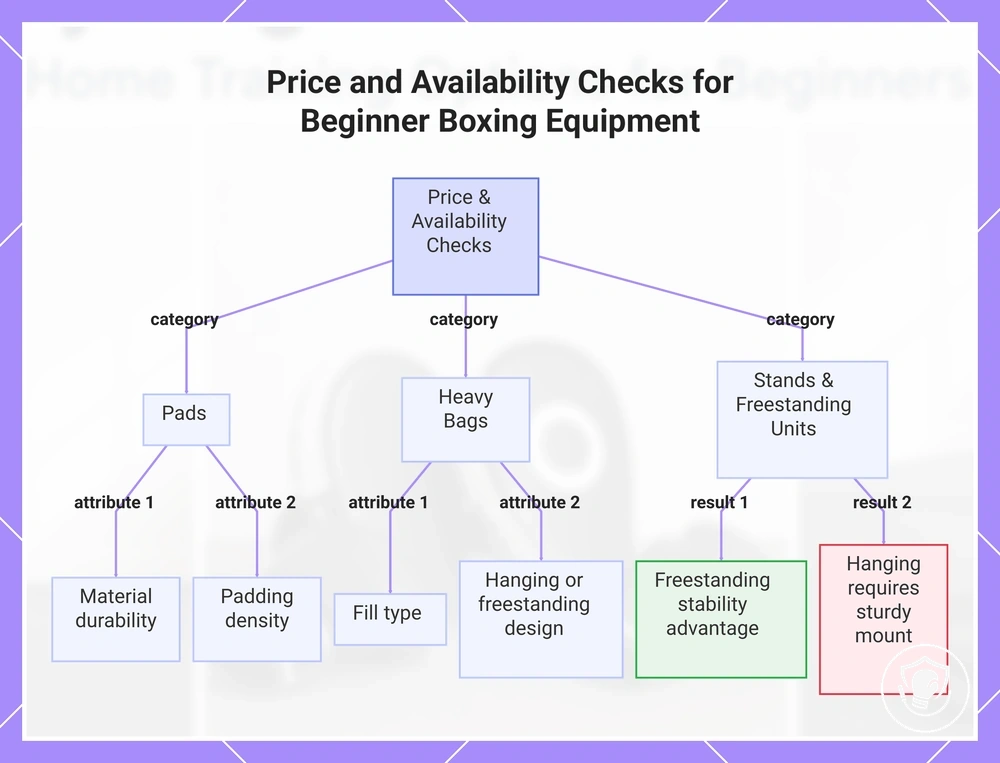
To compare price and availability, evaluate each category by key attributes that affect cost and supply. For pads, criteria include material durability, padding density, hand compartment fit, and wrist support—these affect cost and longevity.
For heavy bags, fill type (synthetic fiber, water, or foam), weight range, hanging versus freestanding design, and outer cover durability affect stability, feel, and price point; availability varies by configuration.
For stands and freestanding units, base stability, height adjustability, footprint size, and assembly requirements determine fit, movability, and storage ease.
Use these criteria to compare options based on your training goals and space constraints. A freestanding bag with a wide base may offer better stability for home use, while a hanging bag requires a sturdy mount and more ceiling clearance.
Here are product examples that may make comparison easier. Before buying, always review the compatibility criteria, essential features, and product details.
This chart illustrates the key attributes for comparing price and availability across pads, heavy bags, and stands, plus a stability tradeoff note.
Focus mitts and punch pad sets to compare for beginner home training
Focus mitts and punch pad sets vary in target size, padding, and strike versatility. What works best depends on training partner availability, space, and primary striking goals.
Focus mitts are smaller and lighter, making them suited for rapid punch combinations and improving hand speed and precision. Hybrid pads offer a larger strike surface with extra padding, which helps absorb kicks, knees, and heavier punches, making them more versatile for multi-discipline training. The choice between the two depends on whether the training focuses on boxing-only drills or includes kickboxing, Muay Thai, or MMA elements.
- Target size and shape – Smaller curved mitts encourage greater accuracy for punches; larger flat or oval pads provide a bigger target for kicks and reduce timing pressure for beginners.
- Padding thickness and density – Thicker foam or layered padding helps protect the holder’s hands and forearms, especially during repeated heavy strikes, while still giving the striker clear feedback.
- Wrist and hand support – An adjustable strap or ergonomic grip can reduce strain on the holder and keep the pad stable during combination work.
- Material durability – Leather or high-quality synthetic leather typically withstands regular use better than basic PU leather, which may crack or peel over time.
- Weight and balance – Lighter mitts allow faster movement and longer holding sessions; heavier pads absorb impact better but can fatigue the holder more quickly.
- Versatility for different strikes – For training that includes kicks, knees, or elbows, a hybrid pad with reinforced padding is often a better fit than a standard focus mitt.
- Ease of cleaning and maintenance – Removable or wipeable surfaces help keep the pads hygienic after sweaty sessions at home.
A good fit balances the trade-offs between target size, padding, support, durability, weight, versatility, and maintenance, while aligning with the user's most common strikes and available space.
How to Compare Heavy Bag Options Without Over-Choosing the First Setup
Comparing heavy bag options at a beginner level depends on matching a few key attributes to your current training consistency rather than predicting future needs.
- Bag weight relative to your body weight. A common guideline is to choose a bag that weighs roughly half your body weight. Lighter bags (under 100 lb) swing more, which can help you work on footwork and movement, while a heavier bag (100+ lb) absorbs force with less swing and may be better suited for developing power. A bag in the 70–100 lb range offers a balanced starting point.
- Bag type: hanging vs freestanding. Hanging bags typically require permanent installation and provide a more authentic feel, but are less portable and can be noisy. Freestanding bags require no drilling and are easier to move, but may shift or tip under heavy strikes, especially on carpet.
- Material and fill quality. Synthetic leather bags offer a good balance of durability and affordability for home use. Canvas is a budget option but can be rougher on the hands. Filled bags that hold their shape over time provide a more consistent training experience. Avoid bags packed too hard, as they may be jarring on the hands and wrists.
- Cost. Factor in the cost of the bag plus any necessary mounting hardware or stand.
Bag stands and freestanding punching bags to compare when hanging is not possible
When comparing bag stands and freestanding bags, the main factors are stability and space constraints.
Bag stands suspend a traditional heavy bag from a frame, while freestanding bags rely on a weighted base. The trade-off is between convenience and stability: stands typically provide a more stable striking surface but require more floor space and assembly, whereas freestanding bags are simpler to set up and move but can rock or tip under hard strikes.
| Aspect | Bag Stand | Freestanding Bag |
|---|---|---|
| Setup | Requires assembly and a dedicated floor area; may need a compatible heavy bag | Fill base with sand or water; no drilling or permanent installation |
| Stability | Frame usually provides a firm anchor; the bag swings but the stand typically stays in place | Base weight limits tipping but heavy punches can shift or rock the unit |
| Movement after strikes | Bag swings freely; helps build timing and angle awareness | Bag tends to rock and rebound; less realistic swing pattern |
| Space requirements | Needs a clear radius around the stand to allow free movement and the bag’s swing | Can be placed in a corner or moved to the center for a session; base footprint is smaller |
| Portability | Difficult to relocate once assembled | Can be tipped and rolled on its base; can be disassembled for storage |
For home users with limited space, freestanding bags offer flexibility yet may not absorb full-power kicks without shifting. A stand, while bulkier, can provide a more predictable hitting surface for serious training.