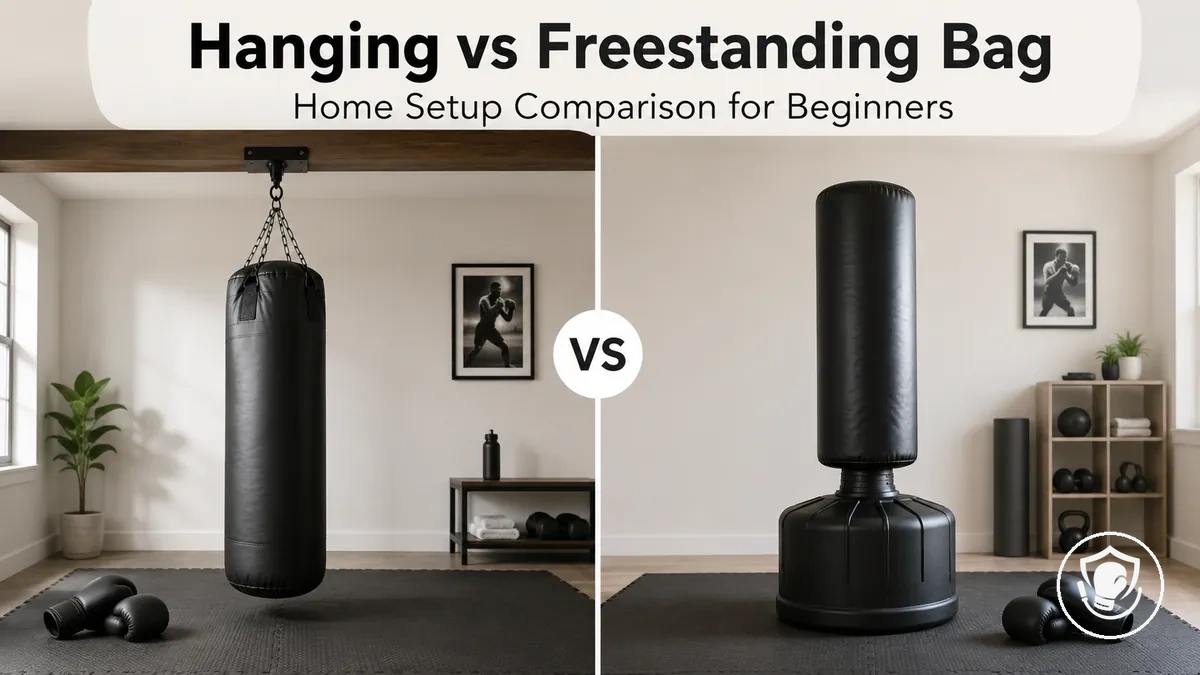
Hanging vs Freestanding Punching Bags for Beginner Home Boxing
A hanging punching bag is suspended from a ceiling mount and swings when struck, while a freestanding punching bag rests on a weighted base and remains upright. The choice between them for a home setup depends on mounting permission, available space, noise tolerance, floor type, neighbors, and training goals. Neither type is universally better.
Home constraints such as ceiling height, floor construction, and shared walls shape which bag fits. This comparison is one part of selecting home boxing equipment for beginners, where mounting availability and room layout often decide which bag fits. For a beginner home setup, the choice between hanging and freestanding bags comes down to two main scenarios:
- If you can mount safely (you have a sturdy beam, permission, and enough clearance): a hanging bag offers swing that trains footwork and timing, but expect noise and vibration that may travel through the structure.
- If you cannot mount safely (no access to a joist, no drilling allowed, or shared walls): a freestanding bag provides mobility and easy setup, but you may deal with base wobble and a smaller footprint that limits full-round movement.
Many assume that freestanding bags are always unstable, but stability depends on base weight and floor surface — a well-filled base on carpet or rubber matting can stay in place. Conversely, hanging bags are not always noisy; vibration varies with mounting method and isolation pads. The first major constraint cluster is mounting feasibility: whether you can install a ceiling mount without damaging the property.
This page compares bag types, not specific models. The answers are not universal because home framing, flooring, and noise tolerance vary. Later sections cover setup details for each type separately.
Core setup constraints that decide the bag type: ceiling, floor, and moveability
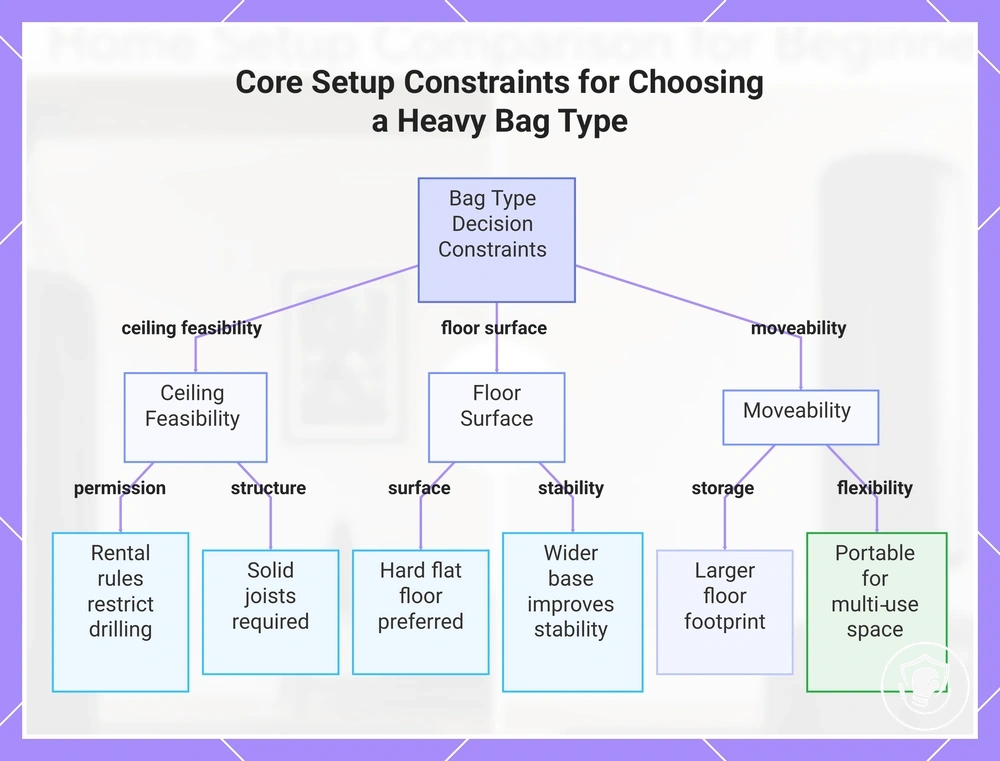
The choice between a hanging and freestanding bag comes down to three core constraints: ceiling mounting feasibility, floor surface, and whether the setup needs to be portable. These factors act as feasibility gates long before training preference matters. If any one of these conditions is restrictive, the compatible bag types typically narrow quickly.
Ceiling feasibility depends on having permission to drill into the overhead structure and on that structure being solid enough to hold the weight and repeated impact of a heavy bag. In rental homes, mounting permission is often not given, which typically rules out hanging options regardless of the room's layout. Even in owned homes, the ceiling usually needs adequate support—joists or reinforced beams—rather than drywall alone.
When ceiling mounting is not possible, floor surface and mobility needs become the deciding factors. Freestanding bags rely on a stable, non-slip floor; carpets or uneven surfaces can cause sliding or vibration that compromises both safety and training quality. If you need to reposition the bag frequently to reclaim floor space for other activities, a portable freestanding unit offers more flexibility.
Core setup constraints group into three feasibility checks:
Ceiling
- Mounting feasible – permission: allowed in owned homes with structural access.
- Mounting feasible – structure: solid ceiling with reinforced joists or concrete supports dynamic loads.
- Mounting not feasible – permission: rental rules often prohibit drilling.
- Mounting not feasible – structure: lightweight or suspended ceilings cannot withstand dynamic loads.
Floor
- Surface condition: hard, level floors reduce sliding; carpet or uneven tiles can destabilize a freestanding base.
- Stability trade-off: wider bases and heavier foundations improve stability on less-than-ideal surfaces.
Moveability
- Footprint and storage: freestanding bags require more floor space but are movable; hanging bags stay fixed.
- Repositioning need: a portable bag allows quick reconfiguration if the training area doubles as living space.
This chart shows the three primary constraints—ceil feasibility, floor surface, and moveability—that determine which heavy bag type fits your space and setup.
How the punch feels on each type: swing, rebound, and feedback for beginners
In boxing training, 'feedback' refers to the physical sensation you feel after your fist makes contact with the bag. That sensation — whether the bag swings, rebounds, or stays still — helps you judge accuracy, timing, and power transfer. For beginners, three feel variables matter most: swing, rebound, and target stability.
A hanging bag tends to swing when punched. The direction and speed of the swing depend on the bag's weight, fill density, and whether the mounting allows free movement. Too much swing can make it hard to maintain distance control and accuracy during combinations, especially when you are learning basic punches.
A freestanding bag typically wobbles or shifts its base rather than swinging. The amount of wobble depends on the base weight and fill. This type of feedback often requires a quicker reset between punches because the bag does not always return to the same position on its own.
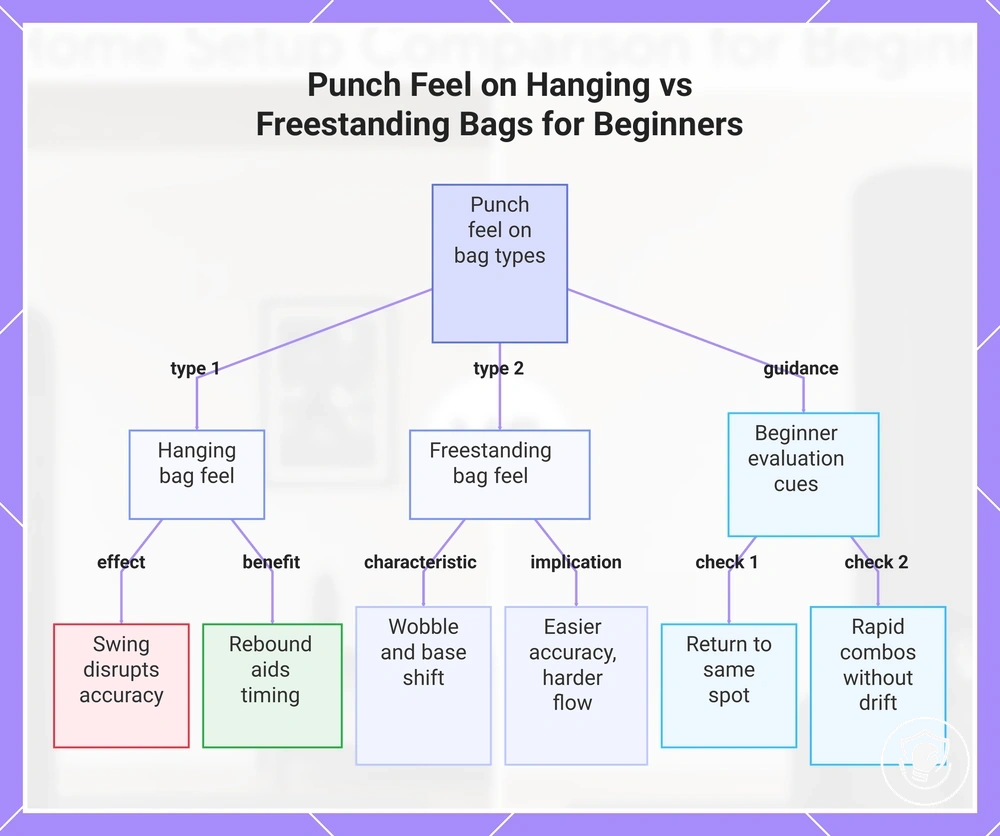
Hanging feel. The bag swings away after impact, with rebound speed varying by fill and chain length. This movement can help train timing because you may need to wait for the bag to return before your next punch. Beginners often struggle with accuracy when the swing is unpredictable.
Freestanding feel. The bag wobbles or tilts rather than swinging, and the base may shift slightly, requiring you to reset your position. This typically provides stable target feedback but less rhythm guidance. Beginners may find it easier to land punches consistently but harder to develop combo flow.
A bag that swings less can help maintain flow when you focus on conditioning and want to throw many punches in a row without pausing. For single-punch accuracy and distance control, a bag that swings and returns can give clearer cues about whether you are reaching or over-punching. Your choice between the two types also depends on space and how much clearance you have around the bag.
Beginner cues to notice:
- Does the bag return to the same spot after each punch, or does it drift?
- Can you throw rapid combinations without losing the target?
- How much do you need to adjust your footwork to stay in range?
- Does the bag's movement encourage you to set up punches in a rhythm?
This chart compares the swing, rebound, and target stability feedback of hanging and freestanding bags, and lists key beginner cues to assess bag suitability.
Space and placement reality: footprint, clearance, and safe striking distance
The choice between a hanging and freestanding bag depends on three placement variables: footprint, clearance, and striking distance. These determine whether your room can accommodate the bag without walkway conflicts or wall contact. You must measure your space before deciding.
Footprint measurement covers the floor space for the bag base and any storage area nearby. Checking side clearance ensures the bag does not hit the wall during a swing. The measurements become even more critical when you need to set up boxing gear in a small space.
This diagram illustrates the Space and placement reality by labeling the footprint area, the clearance zone for the swing arc, and the safe striking distance behind the stance.
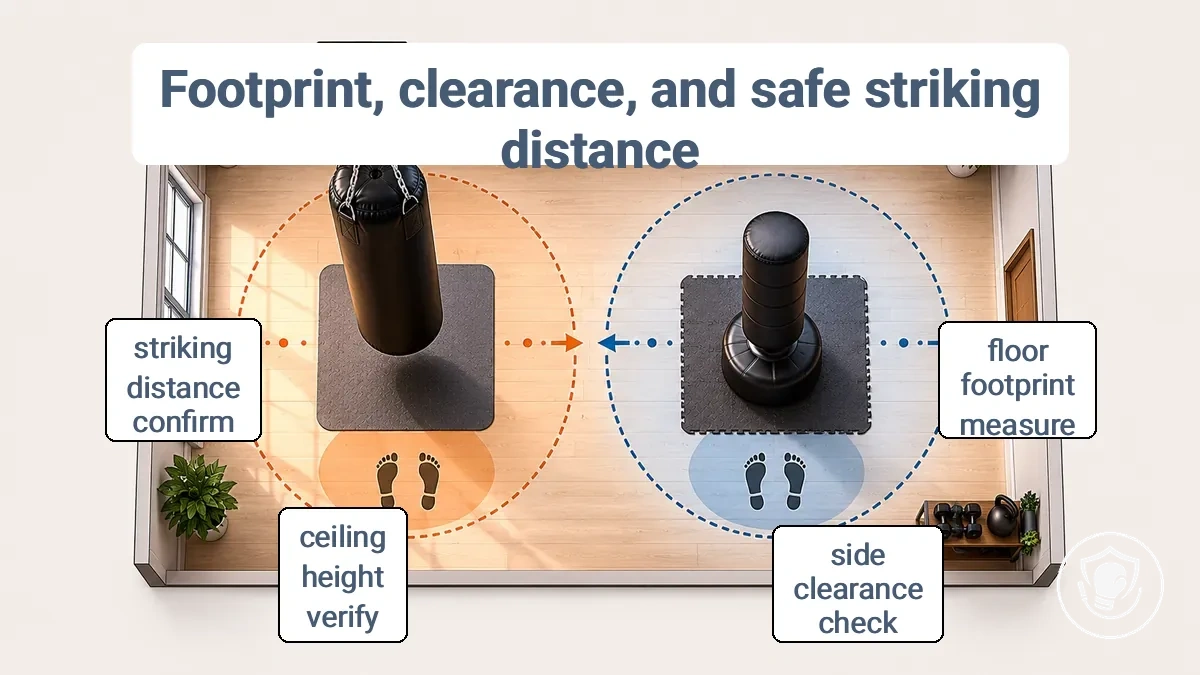
Space and placement reality: the checklist below verifies both clearance and striking distance. Before you place the bag, verify the following using these zones:
- Measure the floor footprint of the bag base and allow space for storage when not in use.
- Check side clearance to avoid the bag hitting the wall during the swing path.
- Verify ceiling height so the hanging bag does not hit lights or beams.
- Confirm striking distance behind your stance leaves room for movement and reset steps.
- Ensure walkway lanes stay clear of the bag's swing zone to prevent collisions.
- Test that the stance area does not overlap with doorways or other obstacles.
- Account for the base stabilizer space required by a freestanding bag.
Note: If any of these checks fail, the bag position may be unsafe because it risks contact with walls, walkways, or obstacles.
In narrow rooms where movement is constrained, a freestanding bag often becomes the safer choice because it can be positioned to avoid walkway conflicts and does not rely on ceiling height for placement. However, you still need to verify that the striking distance allows full stance and reset without hitting furniture or walls. Once your space passes these checks, the next step is evaluating mounting feasibility for your chosen bag type.
Mounting a hanging bag: what the hardware must handle and why it matters
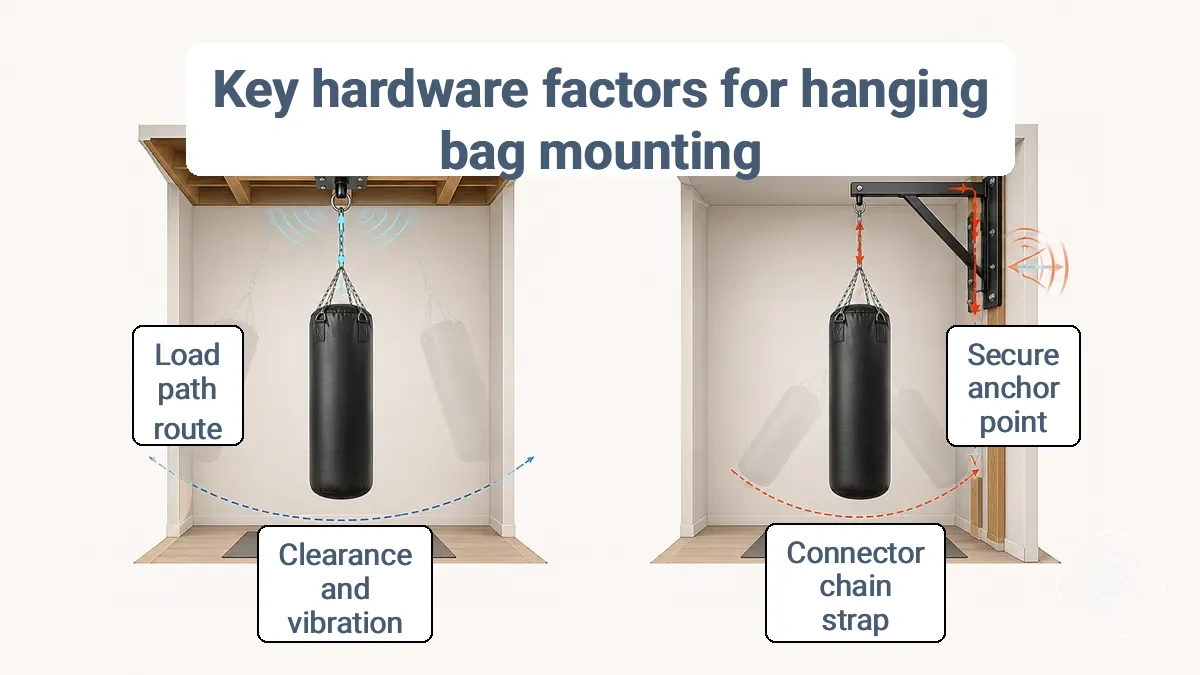
The load path is the route force travels from the bag through the mounting system into the building structure. When the load path is secure, movement stays controlled and stress spreads safely. A weak link anywhere in that path can lead to unwanted motion or damage over time.
Every hanging bag setup relies on three core components: a secure anchor point in the ceiling or wall, a connector such as a chain or strap, and an attachment point on the bag; how well these match your structure affects bag behavior. Mounting a hanging bag means choosing an approach that balances load handling with the clearance your space allows. The table organizes common mounting approaches by what they connect to, their key limitations, and why those limitations matter for your setup.
Mounting a hanging bag starts with understanding the load path; the diagram shows its path for ceiling and wall mounts, including where clearance and vibration become factors.
| Approach | What it connects to | Key limitation | Why it matters |
|---|---|---|---|
| Ceiling hook setup | Ceiling joist or beam | Swing clearance and vibration transmission | Limited overhead space can restrict movement; vibration may travel through joists |
| Wall bracket setup | Wall studs (at least two) | Limited swing arc and potential for wall damage | Bag swings in a narrower path; wall must absorb pulling force |
Clearance problems appear when the bag hits nearby walls or objects during a wide swing, increasing noise and wear on the mount. Vibration traveling through the structure may loosen fasteners if the attachment is unstable. These risks depend on how well the anchor point is secured and the condition of the mounting hardware. Installation feasibility is a reason many renters default to a freestanding bag.
Feasibility signals
- You have access to a wooden ceiling joist or concrete beam for a secure anchor point
- The mounting hardware is rated for the bag weight and dynamic forces of training
- You have sufficient clearance around the bag to allow full movement
Stop signals
- You can only anchor to drywall or a suspended ceiling tile without reinforcement
- The attachment point shows cracks, loosening, or movement after moderate use
- You cannot control vibration that shakes light fixtures or transfers noise to other rooms
Ceiling Hooks and Swivels: Load Management, Clearance, and Rotation Control
Ceiling hooks and swivels affect rotation and alignment, but a swivel alone does not stop noise—noise typically comes from contact points where clearance is tight.
Ceiling hooks and swivels affect rotation and contact noise through these checks:
- Rotation smoothness: A free-turning swivel can reduce chain or strap twisting and the resulting uneven wear on the bag mount.
- Alignment: Proper alignment of the hook with the bag's hanging point can minimize angled swinging and reduce strain on the ceiling anchor.
- Clearance: Sufficient space between the hook, chain, and ceiling surfaces helps minimize friction and reduce rubbing that causes noise.
- Contact points: Inspecting where the chain or strap touches the ceiling mount or joist and minimizing that contact helps lower audible scraping during a workout.
A scraping noise during a swing often signals chain or strap contact with a ceiling surface, meaning clearance is too tight or a contact point needs adjustment.
Wall Mount Brackets: Leverage Forces, Spacing, and Placement Limitations
Wall mount brackets support the bag at an offset from the wall, creating leverage that multiplies force at the mounting point. A greater offset increases stress on the bracket and fasteners, affecting long-term stability. Depending on the bracket design and wall structure, this leverage changes how vibrations travel through the mount and into the wall, which can alter how the bag feels during training. What changes when comparing a wall mount to a ceiling mount is the leverage-driven stress and vibration path; what generally remains consistent is the need for sufficient clearance to prevent the bag from contacting the wall or nearby objects.
Wall mount brackets face placement limitations that affect swing path and vibration transfer. These include:
- Offset distance: Longer offsets increase torque on the mount and require a stronger structural attachment.
- Spacing from corners or obstacles: Limited clearance can restrict the swing path and cause the bag to contact the mount or wall, increasing vibration and wear.
- Attachment surface stability: Mounting onto a hollow wall or surface without robust backing reduces the bracket’s ability to resist rotational forces, which can lead to gradual loosening and unpredictable swing behavior.
- Fastener stress and fatigue: Repeated dynamic loads from the bag’s motion place cyclic stress on bolts and anchors; over time, this can degrade the attachment unless spacing and bracket strength are matched to the bag weight and usage intensity.
- Vibration transfer to the structure: The bracket acts as a conduit for vibration; poor placement near a resonance point in the wall can amplify vibration transfer, degrading training feel.
Chain vs straps: noise, swing behavior, and wear points over time
Chain and strap suspensions create different noise, swing, and wear patterns because metal contact behaves differently than fabric contact. Chains produce a sharp clank when contacting hardware or swivels, while straps can twist under tension if alignment is off, creating friction points that degrade fabric and reduce swing stability. Noise comes from contact points, not the material alone, so recognizing a loose swivel (chain clank) or a twisted strap (uneven tension) makes it easier to identify problems early.
- Chains: metal contact produces a loud clank near swivels and connectors; wear concentrates at link interfaces; swing stability stays high when tension is consistent.
- Straps: fabric-to-metal friction generates a softer noise at contact points but can cause fraying; twist can reduce swing stability and lead to uneven wear.
- Chains: require regular inspection of swivel clearance and link deformation; a clank often indicates a loose component or insufficient clearance.
- Straps: require careful alignment to prevent twist; a visible twist or uneven tension signals friction stress that can shorten strap life.
Freestanding Bases and Stand Frames: Stability, Wobble, and Usable Target Height
Stability for a freestanding system means how well the target stays where you expect it during each strike. This quality divides into two main parts: the behavior of the base and the behavior of the stand frame.
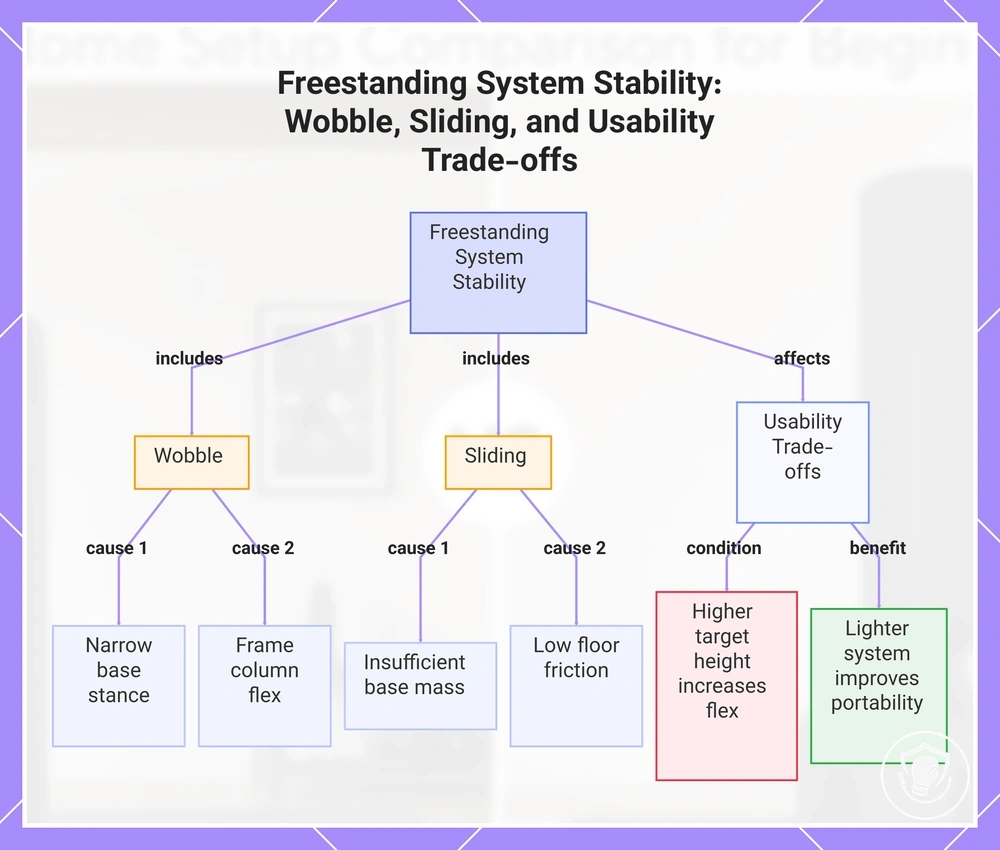
For freestanding bags, wobble and sliding are two distinct movement types. Wobble usually stems from the base's mass distribution and its grip on the floor, while sliding occurs when the base is too light relative to impact force. A heavier base or a floor with more friction reduces sliding, but wobble can still occur if the base shape is narrow or the bag arm creates leverage. On smooth floors, sliding is more likely; on carpet, wobble may dominate due to uneven base contact.
At higher target heights, frame flex becomes more noticeable because the lever arm multiplies small movements. This can shift the bag's position slightly with each hit, affecting accuracy over a session. A lighter freestanding system is easier to move for storage or repositioning, making it practical for shared spaces where floor layout changes often. The mobility advantage depends on the base fill and floor grip, which in turn influence overall stability during use.
Wobble and sliding arise from different factors:
- Wobble – can arise from a narrow stance, making the system rock on impact.
- Wobble – often linked to frame flex when the column is tall or connection points are not rigid, causing the bag to drift off-center.
- Wobble – may be more pronounced on uneven floors where the base does not sit flat.
- Sliding – can be reduced by using rubber feet or a wider base that spreads the load; some systems allow filling with sand or water for extra grip.
- Sliding – may require resetting the bag after heavy strikes, interrupting training flow if it moves more than a few inches.
This chart shows the two main movement types affecting freestanding bag stability, their root causes, and how target height and portability influence usability.
Base fill and floor grip: what actually changes tipping and sliding
Base fill and floor grip determine whether a freestanding bag slides or tips. Sliding depends on floor friction; tipping depends on fill mass and contact area.
Check friction when the bag slides; check mass distribution when it tips. On smooth floors like tile or laminate, grip can drop sharply, making sliding the probable failure mode even if the base is well filled.
- Fill mass: A heavier base increases the force needed to tip the bag, improving stability.
- Contact area: A wider base shifts the tipping point outward, making the bag harder to tip.
- Floor surface friction: Rough surfaces (carpet) provide higher traction, reducing sliding; smooth surfaces (tile, laminate) lower friction, increasing sliding risk.
- Floor condition: Dust, moisture, or residue can further reduce grip, making sliding more likely.
- Fill mass distribution and base shape: Weight distribution and base shape influence how applied force translates into tipping moment.
Stand frame rigidity: how flex affects accuracy and durability
Stand frame rigidity describes how much a freestanding bag's base or frame bends under impact. When the stand is not rigid enough, the bag does not return to the same position after each hit, causing target drift. That drift reduces strike accuracy and forces the boxer to adjust mid‑combination. The difference becomes clear when comparing hooks to straight punches: hooks generate stronger lateral forces, so target drift is more noticeable and the reset is slower.
Stand frame rigidity affects both accuracy and durability in clear, observable ways. Each sign of flex corresponds to a specific effect on training.
- Excessive flex and joint play at connecting points create an unpredictable return, increasing the chance of missed strikes.
- Loud creaking or clunking noises during impact often signal loosening joints, which can worsen over time with repeated lateral movement.
- Frequent side‑to‑side sway in the stand after impact indicates insufficient lateral rigidity, which can accelerate wear on frame joints.
Noise and vibration in apartments: what transfers through floors and walls
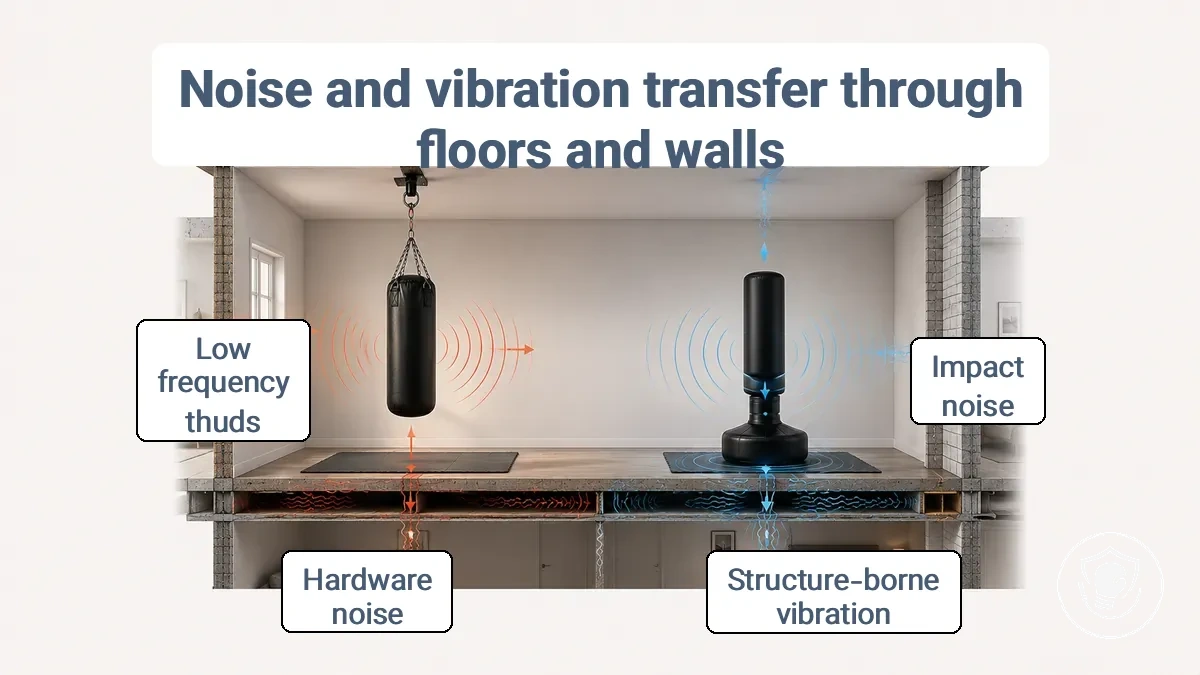
Whether a hanging or freestanding bag is easier to quiet depends on mounting quality and how noise and vibration travel through your building’s floors and walls. The main noise sources are impact noise, structure-borne vibration, and hardware noise.
Impact noise: direct strikes send vibrations into the floor or ceiling. Structure-borne vibration: bag strikes or footsteps travel through the building frame, felt in other rooms. Hardware noise: chain rattle, strap clanks, and squeaks from contact points like brackets or the base plate.
Noise and vibration in apartments travel through floors and walls in different ways depending on the bag setup, as shown in the diagram.
The table separates each noise source by setup type and explains what causes it and what changes how it affects neighbors.
| Setup type | Noise source | What causes it | What changes it |
|---|---|---|---|
| Hanging | Impact noise | Strikes on bag travel through mounting bracket into ceiling joists | Mounting quality, joist isolation, ceiling construction |
| Freestanding | Impact noise | Bag base absorbs some impact but foot strikes transfer through floor | Floor type, underlayment, base weight and padding |
| Hanging | Structure-borne vibration | Bag movement vibrates the ceiling structure and adjacent walls | Building frame type, wall connections, mounting location |
| Freestanding | Structure-borne vibration | Base sits on floor; vibrations travel through floor slab into walls | Floor construction, building material, position relative to walls |
| Hanging | Hardware noise | Chains or straps clank at contact points with bag hooks or brackets | Type of hardware (chain vs strap), lubrication, padding at brackets |
| Freestanding | Hardware noise | Base may rattle or slide on hard flooring; bag hitting frame | Base design, floor surface, rubber feet or mat |
- What you hear: bag impacts, hardware clatter, or base scuffing.
- What neighbors feel: low-frequency thuds through walls or floors, especially when the bag’s energy transfers into the building frame.
The table shows that the loudest source for neighbors depends on mounting and floor transmission. A rigidly mounted hanging bag can send impact noise directly into upstairs floors, while a freestanding bag’s structure-borne vibration may travel through shared walls. The goal is meaningful reduction, not elimination – results vary by building construction. For more on reducing specific noise paths, refer to the guide on reduce noise and vibration at home.
Safety and failure modes: tipping risks, pull-out risks, and common weak points
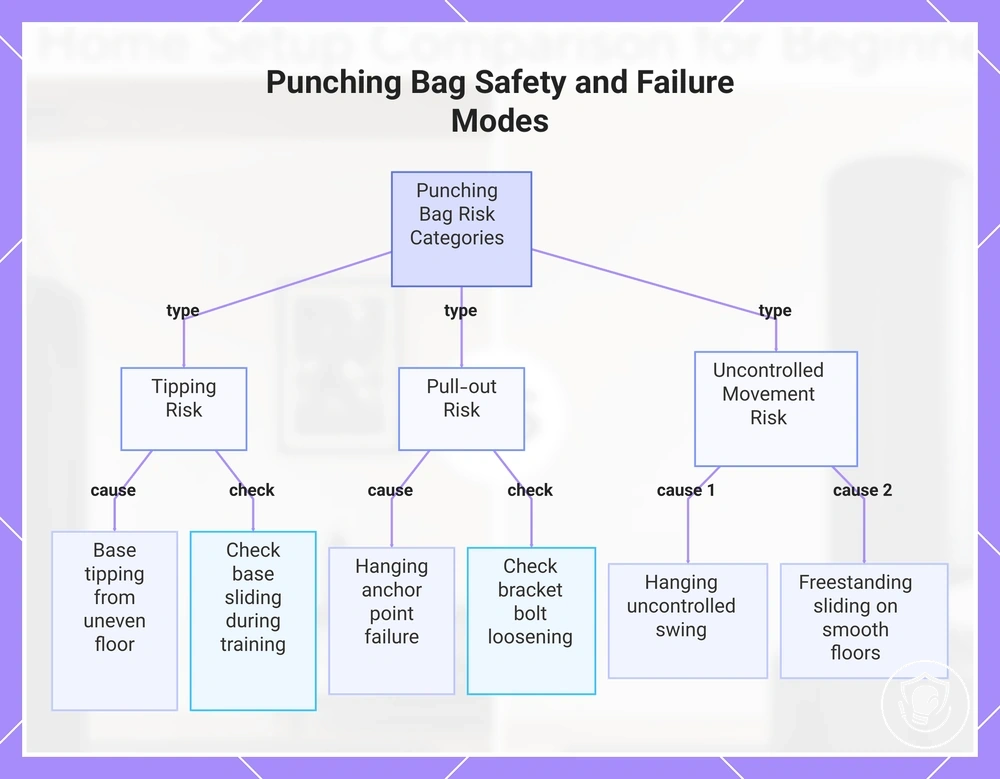
Hanging and freestanding bags expose three main risk categories—tipping, pull-out, and uncontrolled movement. Each category corresponds to specific weak points that appear under poor setup conditions. The list below separates risks by bag type so you can identify unsafe setups before buying or installing.
- Hanging bag risks:
- Anchor point failure — pull-out risk rises when the bracket or joist cannot handle vibration, with an undersized anchor or weak surface.
- Uncontrolled swing — a poor swivel or loose bracket causes erratic movement that can loosen the anchor over time.
- Overuse loosening — bracket or frame bolts loosen with regular use, creating a pull-out hazard.
- Stop signal: visible loosening of bracket bolts after a session indicates imminent pull-out risk.
- Freestanding bag risks:
- Base tipping — uneven floor or lightweight base increases tipping risk during heavy strikes, causing sliding or tipping.
- Sliding on smooth surfaces — a base without grip pads slides on tile or hardwood, creating a movement hazard.
- Frame fatigue — overuse weakens the base or column joint, causing uncontrolled movement or collapse on off-center hits.
- Stop signal: base sliding more than a few centimeters during training signals tipping risk.
A freestanding bag placed on a slightly uneven garage floor shifts with each heavy hook punch; over a session, repeated sliding can loosen the base-fill seal and cause tipping. A hanging bag mounted with a bracket not rated for the bag weight can have screws gradually loosened by vibration, and a hard cross can pull the assembly from the ceiling. Checking the floor surface and anchor rating before the first workout helps prevent these failure modes from escalating.
This chart shows the three main risk categories (tipping, pull-out, uncontrolled movement) and their specific causes and checks for hanging and freestanding bags.
Choosing the right option for beginners: matching bag type to space, goals, and constraints
For most beginners, the choice between a hanging and a freestanding bag is primarily constrained by mounting feasibility and noise tolerance. The decision matrix below shows the trade-offs so you can map your constraints to the more suitable bag type.
The matrix columns represent two layers: the constraints that limit your options (mounting feasibility, noise tolerance) and the training goals that shape what you need from the bag (stability for form practice, durability for conditioning). The direction column indicates which bag type is typically more practical when a given condition applies. Choosing the right option for your situation means mapping your goals and constraints to the more suitable bag type, and the table below serves as a starting point. Adjust for your specific space and willingness to manage setup trade-offs.
| Your situation | Constraint | What matters most | Direction (Hanging/Freestanding) |
|---|---|---|---|
| Apartment or rental | Mounting feasibility, noise tolerance | Permission to mount, vibration to neighbors | Freestanding when space and budget allow; hanging only with permission and sound dampening |
| Dedicated room | Mounting feasible, noise less immediate | Stability, consistent rebound | Hanging often preferred for stable feedback |
| Frequent mover | Mobility, ease of relocation | Portability, no permanent modification | Freestanding typically easier to move and reset |
| Noise-sensitive home | Noise tolerance low, vibration concerns | Minimizing impact on walls and floors | Freestanding may reduce structural vibration |
| Form-practice focus | Stability, feedback | Predictable rebound for technique work | Hanging supports consistent bag movement |
| Conditioning focus | Durability, power absorption | Ability to handle heavy strikes without sway | Both can work; hanging offers more stability for high-volume work |
If your constraint is fixed, prioritize feasibility; if both are feasible, prioritize training feel. When neither constraint strongly limits you, the decision depends on whether your training emphasis is on technical form or power conditioning and how much setup variance you are willing to manage. For other early training approaches, see the bag vs pads decision.
Apartment and rental constraints: when freestanding becomes the practical default
In rentals, freestanding bags become the practical default because drilling is usually prohibited and building rules often limit hanging options. Freestanding bags avoid these constraints but introduce trade-offs in footprint and stability. If permission exists or a suitable anchor point is available, a hanging bag may still be feasible. Apartment and rental constraints that affect feasibility are summarized in the following checklist:
- No drilling: Landlords frequently prohibit making holes in walls or ceilings, eliminating the primary installation method for hanging bags.
- Uncertain structure: Plaster, drywall, or concrete walls may not support the dynamic loads of a heavy bag without reinforcement.
- Building noise rules: Condos and apartments often have quiet-hour regulations, where the repetitive impact and vibration from a hanging bag can disturb neighbors.
- Vibration transfer: Even if drilling is allowed, the structural frame may transmit sound and movement to adjacent units, leading to complaints.
- Space limitations: Many rentals lack dedicated high-ceiling areas, making a hanging bag's clearance requirements hard to meet.
Dedicated training area: when hanging becomes the better long-term training platform
A dedicated training area provides a stable anchor, consistent clearance, and permanent placement, all of which support feedback consistency and beginner progression:
- A stable anchor typically reduces sway and improves feedback consistency, helping beginners develop timing and accuracy.
- Consistent clearance allows full movement without repositioning, supporting safer practice and longer sessions.
- Permanent placement eliminates daily mounting and dismounting, turning the setup into a long-term training platform that encourages regular use.
- Fixed positioning lets the user repeat drills under consistent conditions, enabling clear progression tracking and skill transfer.
Dedicated space improves feasibility, not automatic safety. Hanging still requires safe mounting and noise consideration even in a dedicated room.
Cost, maintenance, and flexibility over time: what you keep adjusting and replacing
The recurring effort for hanging bags centers on chain, swivel, and hardware maintenance, while for freestanding bags it centers on base fill and column leveling. The table separates ongoing adjustments and typical wear points for each bag type, linking them to cost, maintenance, and flexibility over time.
| Bag type | What you adjust | Typical wear point | What it affects |
|---|---|---|---|
| Hanging | Chain and mount alignment | Bag cover and swivel | Striking surface feel and rebound |
| Freestanding | Base fill and column leveling | Base seam and column padding | Stability and wear consistency |
These points represent time and friction rather than fixed dollar amounts. How often they become relevant depends on your training frequency and intensity—daily use typically requires more frequent re-leveling and replacement parts than occasional use.
If you move often, value flexibility; if you stay put, value stability and lower adjustment. Frequent movers may benefit from a freestanding bag that typically does not require wall mounting, while permanent setups may allow a hanging bag with fewer base-fill tasks and lower upkeep.
A Quick Decision Checklist for Hanging vs Freestanding in a Home Setup
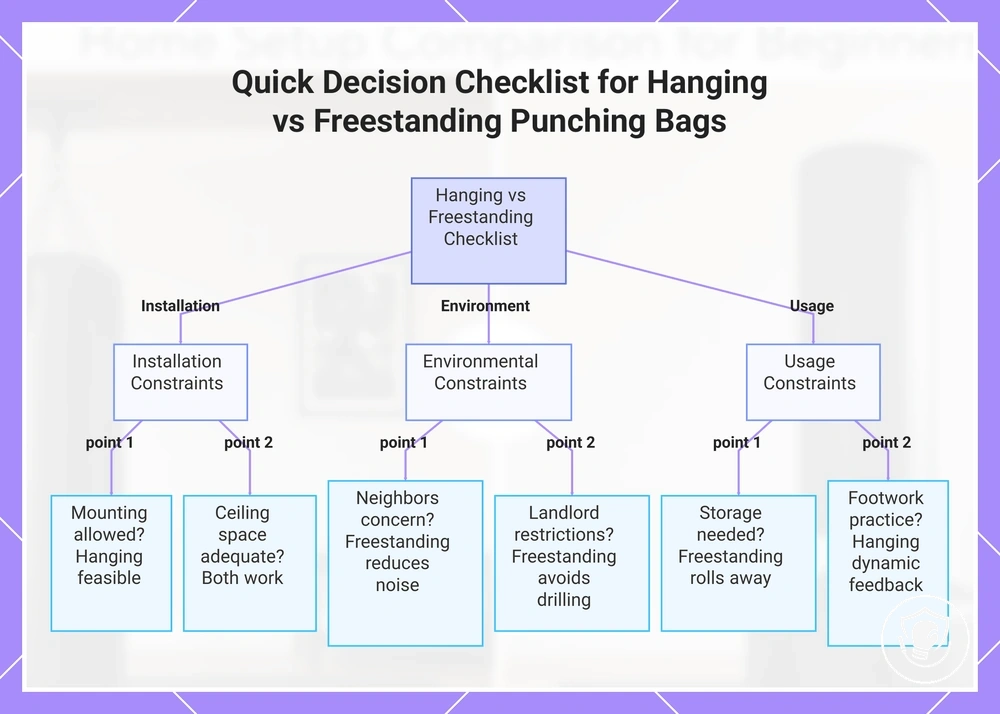
This checklist quickly verifies feasibility and trade-offs for hanging vs freestanding bags. Safety and noise tolerance matter more than minor performance differences. Use these yes/no checks to verify your constraints.
- Mounting allowed: Can you drill into a ceiling joist or install a stand? If yes → hanging is usually feasible; if no → freestanding avoids drilling.
- Ceiling and movement space: Do you have at least 5 feet of open space above and around, and room to walk 360°? If yes to both → hanging or freestanding work; if space is limited → freestanding avoids overhead constraints; if you need 360° but overhead is tight → hanging may limit angles.
- Floor behavior: Does a sliding or wobbling base bother you? If yes → hanging may be better; if no → freestanding is acceptable.
- Noise and vibration: Are neighbors in adjacent rooms or floors a concern? If yes → freestanding reduces both; if no → hanging works.
- Permission: Do you have landlord or building restrictions? If yes → freestanding avoids drilling; if no → hanging is an option.
- Storage: Do you need to store the bag after use? If yes → freestanding rolls away; if no → hanging stays put.
- Partner training: Do you plan to train with a partner on opposite sides? If yes → freestanding often allows 360° access; if no → hanging suffices.
- Footwork practice: Do you need the bag to swing for timing drills? If yes → hanging provides dynamic feedback; if no → freestanding still works.
If unsure about any constraint, prioritize safety and noise control over minor performance gains.
This checklist helps you evaluate key constraints to decide between a hanging or freestanding punching bag for your home setup.